
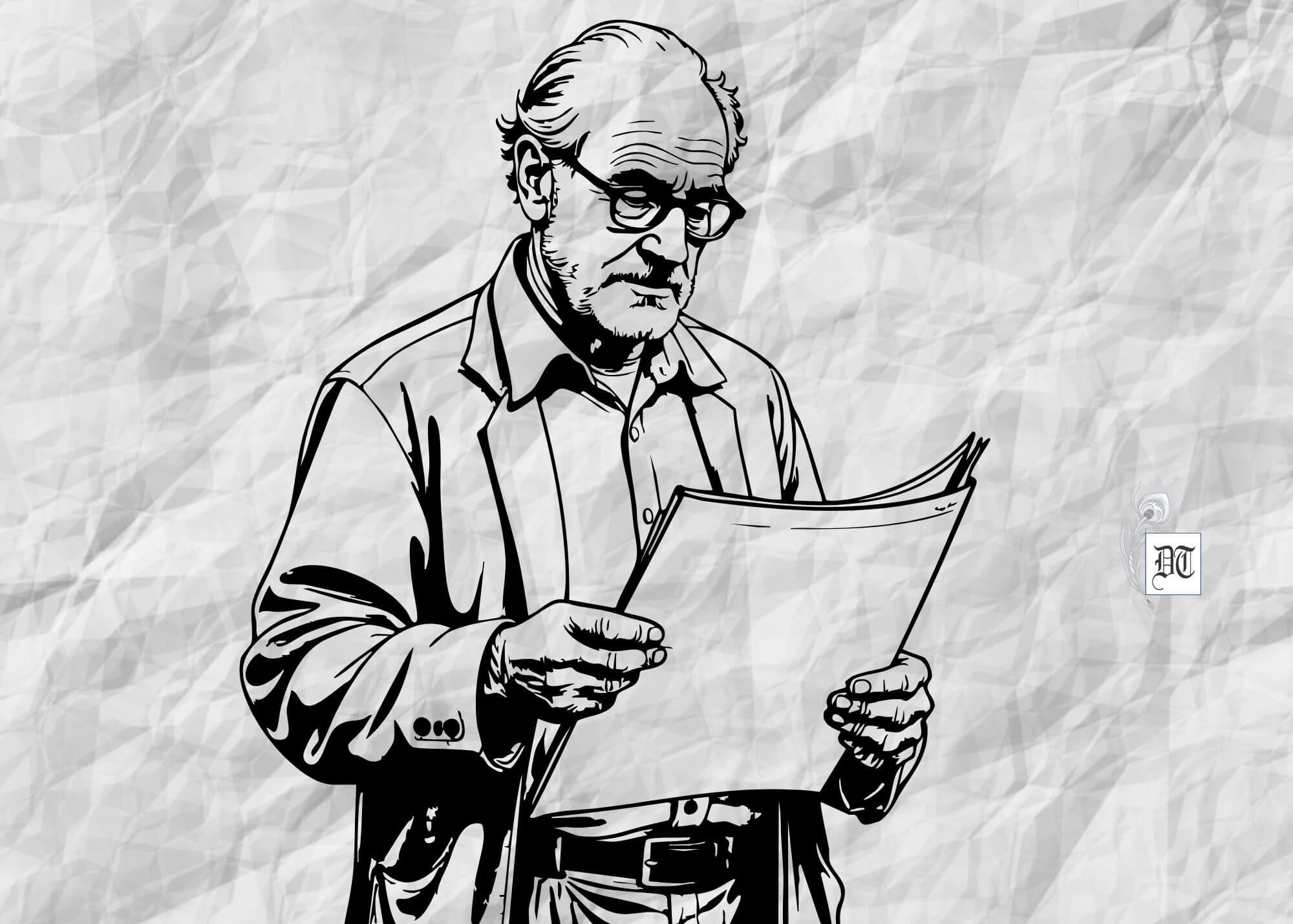
Prof Bhaskar delves into the Bengali term “buddhijibi,” examining their identities, roles, and diverse responses to societal issues, exclusively for Different Truths.

Since the past few decades, the term buddhijibi (intellectual) has been in circulation in society, which seems enigmatic, for it seems difficult to identify them by head count. Who are these buddhijibis by occupational categories—teachers, lawyers, doctors, scientists, writers, poets, filmmakers, and opinion influencers? The term evolved during the Left Front regime in West Bengal that had some connotations not very transparent, but probably these buddhijibis were expected to carry forward the agenda of the then government. That did not happen as expected. Let me elaborate.
The true colour of buddhijibi is education-weighted, and if education is termed as buddhi (intelligence), then the term becomes synonymous with ‘earning with intelligence’. The question arises, who earns non-intelligently? Though there is no answer so far, it seems they are the manual workers – the vendors, the rickshaw pullers, the paid domestic workers, the head-load workers, etc. The economic relation between the earners with intelligence and the earners without intelligence needs intensive research, which I abstain from here.
Rather than beating around the bush, let me focus on the issue right where it deserves to be focused – it is West Bengal because the very term is a Bengali term that evolved in West Bengal. In my understanding, this buddhijibi was expected to be left-minded, radical, ideology-carrier, path-finder, raising voice for human rights and similar. The question is how they perform these duties.
Blessings of Lord Jagannath
Some examples may clarify the conditions of the buddhijibi. A few days ago, a Jagannath temple was inaugurated at the tourist town of Digha by the Chief Minister of West Bengal. The buddhijibis know that the state should keep equidistance from all religious practices, or that the state will not build temples, mosques, churches, gurdwaras, etc. The buddhijibis kept silent for reasons not very clear. Probably they understood it as a counter-step to stop political rivals from entering West Bengal or win votes in West Bengal – after all, people are religion-minded pan-India. The buddhijibis did not invite the ire of common people by abstaining from opposing the inauguration of the temple as mentioned. Not surprisingly, a few days later, the government of Odisha objected to the originality of the Neem wood of Lord Jagannath at Digha temple. Adi (original) and Prachin (ancient) carry unfathomable weight for the devotees in India.
Right and Wrong
Some of the historical wrong actions are, however, questioned by the buddhijibis through mainly their pen, while common people come on the public road to protest, like the blatant wrong actions against schoolteachers in West Bengal very recently – the ‘cash for job’ scam. The buddhijibis also questioned the killing of many tourists in Kashmir very recently, allegedly by the terrorists. It is not known if they questioned the chaining of people of Indian origin while they were sent back by flight from the United States recently. All these are phenomena of very recent origin, the year 2025.
A year back, on August 9, 2024, a young lady doctor on duty was murdered and allegedly raped in RG Kar Hospital in central Kolkata, and that was protested by the buddhijibis and the protest is still alive.
In general, the buddhijibi, and many others dance to the tune of the state. They take their agenda from the state actions and remain either silent or protest. Silence may mean consent. Let me enlist, as I observed the strata of the buddhijibi in West Bengal.
Stratification of Buddhijibi
The list of buddhijibis and their features excludes the non-Hindu Bengali, pravasi Bengali, the non-resident Indian Bengali and Bengali of the remote past. Naturally, Rabindranath-Rammohun-Vidyasagar-Subhas Bose-Nazrul-Sukanta-Tarashankar-Satyajit Ray-Amartya Sen-…. are not included. It is also safe in some sense for the term buddhijibi is used in a derogatory sense, as I tried to comprehend the essence of it.
Escapist Buddijibi: This section is in fear, often cowardly. This section does not opine in the public domain – probably they avoid the public domain. They are self-centred, organised within the nuclear family, and know the right path to avoid distress crises.
Silenced Buddijibi: Some of them keep silent to be distanced from public criticism. They also keep a distance from the crowd. Their needs are fulfilled through others like drivers, domestic assistants, and personal secretaries, whom they pay for services received online.
Mortgaged Buddijibi: This is an opportunistic section that seeks benefits from the establishment or system. This section is loyal and conformist, whatever the social consequences.
Upright Buddijibi: This section is vocal at both the local and national levels. Of this, some are rigid and adamant. They often do not participate in collective action and opine or act as an individual. They carry an ideology that is unchangeable.
Strategic Buddijibi: This section changes colour (opinion) concerning changing political power. They are voters who do not cast votes but pretend to cast votes for the ruling power. They wait for the state benefits to come to them.
These strata are non-additive – they are not for any consensus. They do not think or act along a single trajectory. The intellectual cell of the political parties also shows opinion-making or influencer buddijibis. Then there is no intra-buddhijibi social cohesion. If so, who will the buddhijibi be that the common people will accept as the pathfinder?
Evolution and Evaluation
It seems these buddhijibis evolved in the middle section of Bengali society that settled in West Bengal through education-enlightenment. It also could be, if the canvas is stretched, the bhadralok or people in babu culture that the British promoted through education and culture. In my understanding from what I listened to from the followers or voters in the left parties, these buddhijibis are expected to come forward to promote the cause of the common people through ideas and advice.
In practice, most of these buddhijibis often promoted and aspired to promote their narrow interests. The cultural gap between them and the common men remained unbridgeable because of education, quality of job, and mobility. The buddhijibis do not evaluate them – others do. Many of them do not know that they are buddhijibis, or the non-jibis identify them as buddhijibis. Others check if these buddhijibis are socially relevant, which, of course, may not be revealed in the public domain.
Are the buddhijibis socially redundant then? This is difficult to answer, for most of them do not know that they are being identified as such. Thus, they have become a category in abstraction – whoever is away from manual labour, whoever distances himself from the common people, whoever is educated-enlightened, and whoever is soft in behaviour is identified as buddhijibi. The list containing these features is not exhaustive, and each one identified as buddhijibi may not carry all the features.
Appendix
It is not possible to say what the buddhijibis are not – there is an infinite world of negation. I tried to say what they are as termed by the vocal people in the power centre. It is not possible to locate where the buddhijibis live or work for wages or work as self-engaged. I relied on the people to my left, who required transmission of the power of the pen that the buddhijibi supposedly had.
Lest the stratification miss its focus, I abstained from listing other types like buddijibi by association, echo-buddhijibi, pseudo-buddijibi and so on.
Methodology: Participatory and disguised observations.
Picture design by Anumita Roy
Prof. Bhaskar Majumder, an eminent economist, is the Professor of Economics at GB Pant Social Science Institute, Allahabad. He was the Professor and Head of the Centre for Development Studies, Central University of Bihar, Patna. He has published nine books, 69 research papers, 32 chapters,15 review articles and was invited to lectures at premier institutes and universities over 50 times. He has 85 papers published in various seminars and conferences.
He also worked in research projects for Planning Commission (India), World Bank, ICSSR (GoI), NTPC, etc. A meritorious student, Bhaskar was the Visiting Scholar in MSH, Paris under Indo-French Cultural Exchange Programme. He loves speed, football and radical ideology.



 By
By
 By
By

 By
By