
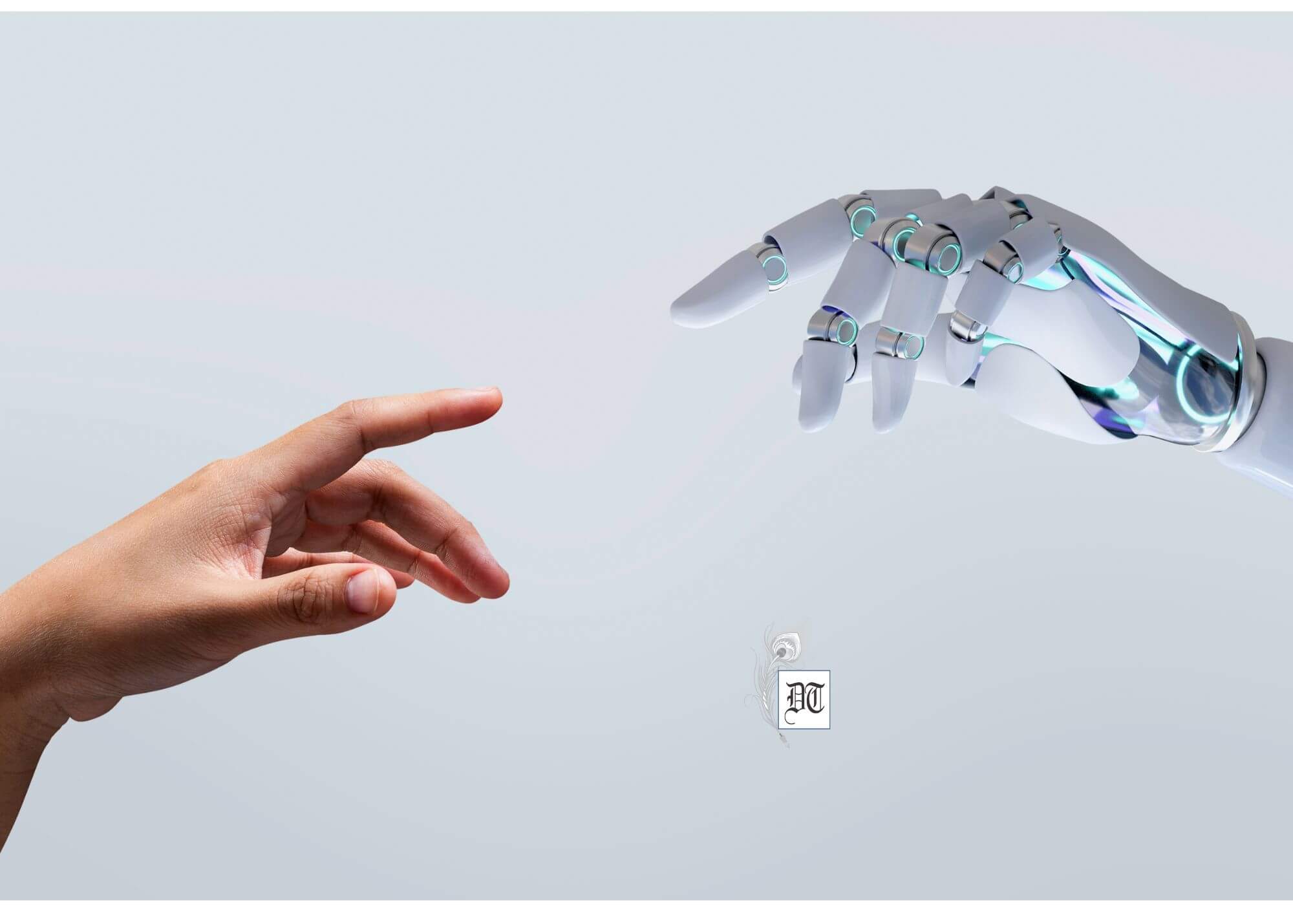

In 2025, AI transforms lives—uplifting dreams, threatening livelihoods. Is it humanity’s ally or foe? Arindam Roy, Editor-in-Chief, unravels this paradox with a storyteller’s lens, exclusively for Different Truths.
In the quiet of a South Bangalore evening, as the monsoon clouds hung low, casting a silver veil over the city, I sat by my window, sipping chai, the aroma of Darjeeling tea curling into the air. The world outside buzzed with its usual chaos—vehicles honking, street vendors calling, and the distant hum of life. Yet, in my mind, a different hum persisted, one not of the streets but of circuits and algorithms, of artificial intelligence weaving its way into the fabric of our existence.
It is 2025, and the question lingered like the aftertaste of my tea: Is AI a threat?
Let me tell you a story, as I often do, to unravel this knot of curiosity and fear. On the outskirts of Bolpur, in a small village in West Bengal, a young girl named Anjali tends to her family’s paddy fields. Her hands are calloused, her dreams tethered to the soil. One day, a sleek drone hums overhead, mapping the fields with precision no human eye could match. It’s an AI-powered marvel, sent by a cooperative to optimise crop yields. Anjali’s father, sceptical yet hopeful, watches as the machine predicts rainfall patterns and suggests planting schedules. That season, their harvest doubled. Anjali’s eyes gleam with dreams of college, no longer bound by the limits of the land. AI, in this moment, is a liberator, a quiet hero in a story of survival.
But stories, like life, have shadows. Across the country, in a bustling tech hub in Bangalore, a coder named Vikram (name changed) sits in a glass-walled office, his fingers dancing over a keyboard. He’s building an AI to streamline customer service for a multinational. One morning, he’s called into a meeting. The AI he crafted—his pride, his creation—has not only replaced the call center but also his entire team. Vikram, now jobless, walks the neon-lit streets, wondering if he’s coded himself into obsolescence. The same AI that lifted Anjali’s family threatens Vikram’s livelihood. Is it a villain now?
This duality, this dance of light and dark, is the heart of AI in 2025. It’s not a monolith, not a faceless menace or a benevolent god. It’s a tool, forged by human hands, reflecting our brilliance and our flaws. To call it a threat is to oversimplify a tale as complex as humanity itself.
Let’s weave another thread. In the oncology department of a Mumbai hospital, Dr Pankaja, a seasoned surgeon, relies on an AI diagnostic tool. It scans X-rays with an accuracy that humbles her years of training, catching a rare cancer in a patient she might have missed. The patient, a father of three, gets a second chance at life. Pankaja marvels at the machine’s precision but feels a pang of unease. What happens when AI doesn’t just assist but decides? In 2025, we’re not there yet, but the horizon looms. Stories circulate—whispers of AI systems in distant countries overriding human judgement, of algorithms in the finance markets triggering crashes no one foresaw. The threat isn’t AI’s existence but its autonomy, its potential to slip from our grasp.
Now, let’s pause and step into a classroom in posh South Delhi. A teacher, Somak Sen, uses an AI tutor to personalise lessons for his students. Ria, a shy girl who struggles with math, finds the AI patient breaking down equations in ways Sen’s busy schedule couldn’t. Her grades soar, and her confidence blooms. But in the staff room, Sen hears of schools replacing teachers with AI systems, cheaper and tireless. He wonders if his chalk-dusted hands will soon be relics. The threat here isn’t just jobs—it’s identity, the human connection that education thrives on.
These stories—Anjali’s harvest, Vikram’s redundancy, Pankaja’s unease, and Sen’s fear—paint a mosaic of AI in 2025. It’s a force that amplifies human potential and exposes our vulnerabilities. The threat lies not in AI itself but in how we wield it. Are we crafting a tool to serve or a master to obey?
Consider the global stage. In 2025, nations race to dominate AI, much like the space race of old. In Beijing, AI surveillance tracks citizens with chilling precision, tightening the state’s grip. In Silicon Valley, tech giants churn out algorithms that shape what we see, think, and buy, often without our consent. In war-torn regions, autonomous drones make life-and-death decisions, their cold logic divorced from human empathy. These are not hypotheticals but realities, threads of a story unfolding before us. The threat here is power—concentrated, unchecked, and amplified by AI’s reach.
Yet, every story has hope. In a small Chennai startup, a team builds an AI to preserve endangered languages, recording the songs of tribal elders before they fade. In a London lab, AI models climate patterns, guiding policies to save ecosystems. In a rural school in Rajasthan, AI-powered apps teach children to read, bridging gaps no government could. These are not just tools but extensions of our dreams, our will to create and heal.
So, is AI a threat in 2025? It’s a question that demands nuance, not headlines. AI is a mirror, reflecting our intentions. If we wield it with greed or carelessness, it can amplify our worst impulses—inequality, control, and dehumanisation. But if we guide it with wisdom, it can lift us, like Anjali’s drone or Pankaja’s diagnostic tool, toward a better world.
The real threat is not AI but our failure to tell its story well. We must write policies that prioritise people over profits, ensuring workers like Vikram aren’t discarded. We must teach ethics alongside code so AI serves humanity, not supplants it. We must listen to voices like Anjali’s, ensuring technology reaches the margins, not just the metropolises. And we must never forget the human heart—fallible, feeling, irreplaceable.
As I finish my chai, the rain begins to fall, tapping a rhythm on my window. I think of the stories yet to be told of AI in 2030, 2040, and beyond. It’s not a threat or a saviour—it’s a chapter in our saga, one we’re writing now. Let’s write it with care, with courage, with the storyteller’s faith that every tale, well told, can change the world.
References
- Bostrom, N. (2014). Superintelligence: Paths, Dangers, Strategies. Oxford University Press.
- Discusses the risks of AI autonomy and the need for ethical frameworks in AI development.
- Schwab, K. (2016). The Fourth Industrial Revolution. World Economic Forum.
- Explores AI’s transformative potential in agriculture, healthcare, and education, as well as its socioeconomic impacts.
- Tegmark, M. (2017). Life 3.0: Being Human in the Age of Artificial Intelligence. Knopf.
- Examines AI’s dual role as a tool for progress and a potential source of existential risk.
- United Nations (2023). AI for Sustainable Development: Opportunities and Challenges. UN Report.
- Highlights AI applications in rural development and education, with case studies on drone technology in agriculture.
- Amnesty International (2024). Surveillance States: AI and Human Rights in 2025.
- Documents the use of AI in global surveillance systems and its implications for privacy and control.
- World Economic Forum (2025). Jobs of Tomorrow: The Impact of AI on Employment.
- Analyses job displacement risks due to AI automation, with examples from tech and service industries.
Picture design by Anumita Roy

Arindam Roy has over four decades of experience in various newsrooms of renowned media houses. He is the Founder, Publishing Director, Editor-in-Chief of Different Truths, and Kavya Kumbh Publishing Consultant (KKPC). He has co-authored ten chapters in six Coffee Table Books (CTBs) of national and international repute and is the sole author of four forthcoming CTBs (Times Group). He has also published four international poetry anthologies as the Publisher and Editor-in-Chief, participated in several poetry and literary festivals, and won awards and accolades. Arindam co-authored the novel Rivers Run Back with an American writer. He stays in Bangalore and Prayagraj.


 By
By
 By
By
 By
By
 By
By