
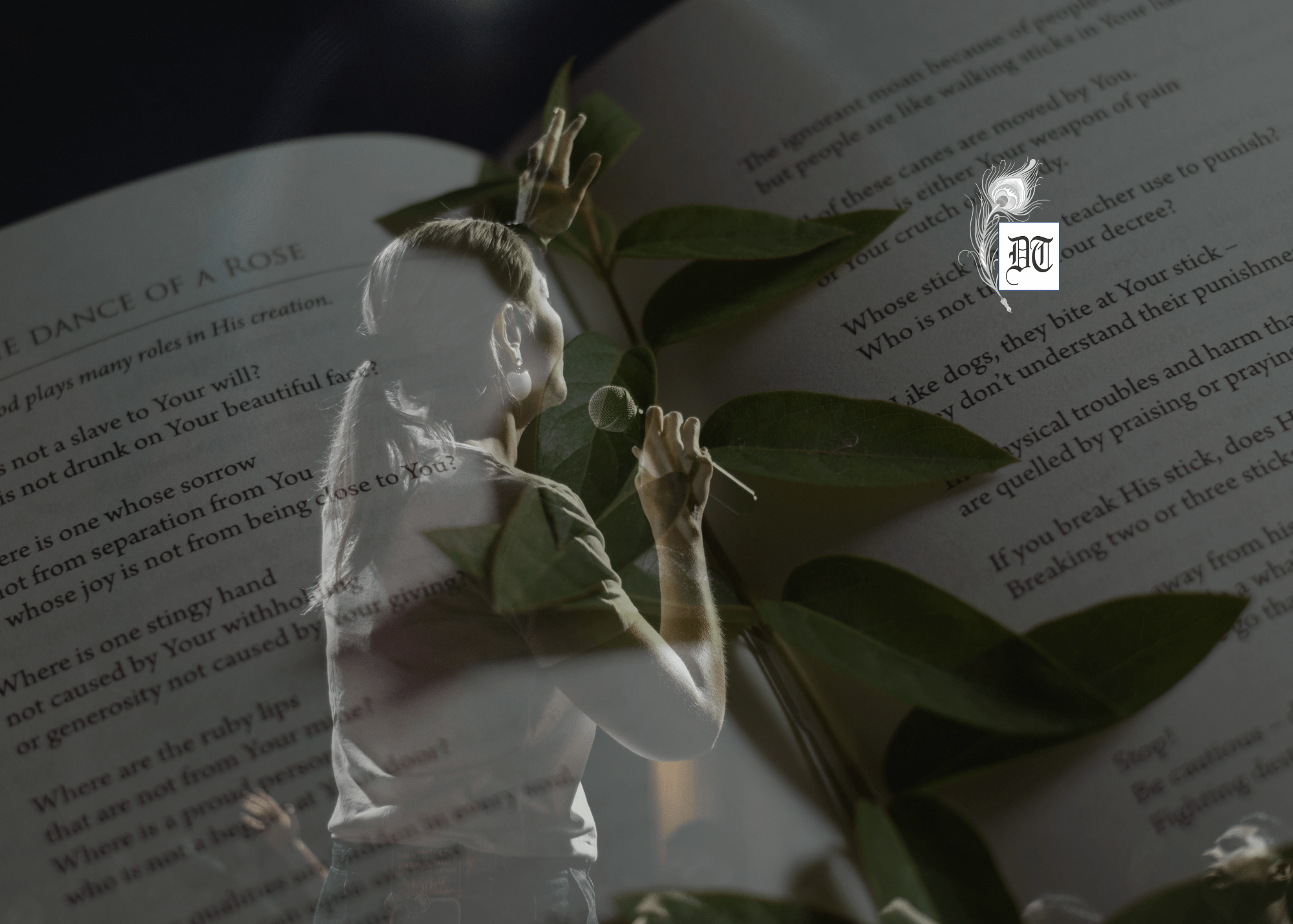
Mehzabeen, an Indian poet, reclaims ancient philosophy to craft a resonant, globally relevant poetic voice, exclusively for Different Truths.
I am a poet, qualitative researcher, communications strategist, and someone who believes that language carries more than just meaning. It carries memory, silence, tension, and resistance. My work is often shaped by emotion that has been asked to wait its turn: grief that has learned to sit upright, and rage that has been trained to be eloquent. What I offer here is both personal and public, both theoretical and real. I speak not only as a writer, but also as someone trained in Bharatanatyam, the classical Indian dance form where every emotion becomes a gesture, and every gesture holds layers of history. This training has taught me to hold silence with intention and to speak even through stillness. That embodied knowledge continues to shape my poetic craft in ways I am still discovering.
This paper considers poetry not only as a form of self-expression but as a philosophy of creation. My central proposition is this: a serious engagement with the Nāṭyaśāstra offers Indian poets a unique and powerful aesthetic position in the global literary field. Far from being merely a classical manual for performers, the Nāṭyaśāstra is a deeply relevant and transformative poetic framework—one that enables writing grounded in emotional intelligence, rootedness, and formal precision.
This is not a return to purism. It is not about imitation or nostalgia. Instead, it is a reclaiming. A way of writing that allows the Indian poetic voice to remain locally anchored while being globally resonant.
Rasa: The Emotional Architecture of the Indian Poem
The most enduring concept in the Nāṭyaśāstra is rasa—aestheticised emotion, experienced not only by the artist but also by the audience or reader. Rasa is not raw feeling, but emotion distilled, universalised, and made available for reflection. The original eight rasas—love, laughter, grief, anger, heroism, fear, disgust, and wonder— and the later addition of peace, form a complete emotional spectrum for the poet.
In my writing, I return often to karuna, the rasa of compassion, particularly when I write about marginalised lives or silenced hungers. I have also found raudra, or poetic anger, to be a necessary resource. These rasas are not decorative—they are foundational. They shape tone, rhythm, and silence. They teach the poet how to construct emotional landscapes that are both particular and expansive. This is especially significant in a global context, where Indian poetry is often expected to translate itself—culturally, emotionally, even linguistically. Rasa offers an alternative. It enables emotion to travel across borders without explanation. When feeling is crafted with care, it becomes recognisable, regardless of where or how it is encountered. Historical Indian poets understood this intuitively. Jayadeva’s Gīta Govinda, for instance, composed in the 12th century, was written not for silent reading but for sung and danced performance by temple dancers. Each aṣṭapadi is emotionally rich, formally exacting, and meant to be felt in movement and music. Similarly, the padams of Kṣetrajña, or the Bhama Kalapam of Siddhendra Yogi, were composed with a profound understanding of abhinaya and rasa—textual forms built for embodied performance, not merely oral recitation.
Abhinaya and the Feminist Voice
Although the Nāṭyaśāstra emerged from a patriarchal context, its focus on abhinaya—the language of gesture, expression, and embodiment—offers an unexpected resource for feminist poetics. It presents a vocabulary of the body. For women poets and those writing from experiences of marginalisation, this is significant. The body is not abstract; it remembers. It responds. Abhinaya allows us to write from within the body, not merely about it. A shift in breath, a moment of stillness, the way a line breaks or turns—these become expressive tools. This is especially liberating for feminist poetry, which often must navigate the line between vulnerability and agency. Through abhinaya, poetry becomes performative in the best sense. It does not merely report pain; it expresses it with nuance and control. Anger becomes sculpted. Desire becomes legible without apology. Historical voices such as Mīrābāi remind us of this inheritance. While she was not trained in classical dance as we define it today, she sang and danced in spiritual ecstasy. Her poems are not still objects; they are kinetic, full of longing, refusal, and embodied devotion. In her, we see how a woman’s voice and movement coalesce to create a poetics of both resistance and surrender, something the Nāṭyaśāstra enables us to re-access with rigour.
Poetry as Protest with Precision
Much of my work, and the work of many poets I admire, exists at the intersection of poetry and protest. In such writing, the Nāṭyaśāstra does not constrain us; it strengthens our intent. The theory of rasa allows protest to be articulated not as unmediated rage, but as a structured emotional offering. Raudra is powerful precisely because it is measured. It does not shout; it resonates. Similarly, bībhatsa, the rasa of revulsion, enables a poet to confront caste, gender, or ecological violence in a way that invites reflection rather than recoil. This emotional architecture gives political poetry its depth. It is not about softening the message. It is about layering it with affective weight, so that it lingers, moves, and transforms. In an age when outrage is often immediate and ephemeral, rasa invites us to create something enduring, something that can be returned to, felt again, and shared across difference.
Writing from India, Not Just About It
Indian poets working in English or regional languages are frequently expected to make their work legible to a global audience. This often involves simplifying cultural references, removing texture, or over-explaining one’s context. The Nāṭyaśāstra offers another way forward. When we write through rasa, through emotion that is embodied and distilled, we do not need to flatten our work. We can be rooted without being provincial. We can be culturally specific while remaining aesthetically universal. Rasa travels. A poem grounded in śṛṅgāra—love and longing—can resonate with a reader in Lagos or Lisbon, even if the imagery is entirely Indian.
A protest poem that works with raudra or karuṇa does not require cultural translation. The feeling does the work. The poet does not have to explain herself; she has to feel with precision. This is a powerful aesthetic position. It allows Indian poetry to enter the global literary field not as an exotic addition, but as a serious, fully formed tradition with its theoretical backbone.
The Poet as Performer and Witness
The Nāṭyaśāstra offers a vision of the artist not as a detached observer but as a conscious, disciplined performer. The poet, like the classical actor, works with breath, silence, rhythm, and emotion. She does not simply narrate; she inhabits. The poem is not merely language. It is a body. A space. A movement. My background in Bharatanatyam allows me to approach poetry not only with metaphor but with muscle memory. I write as I move—shifting weight, holding balance, changing tempo. My poetry, like my dance, becomes an act of presence. This is not unique to me. Historically, many Indian poets were dancers or composed with dance in mind. From Andal, whose Tiruppavai continues to shape Bharatanatyam abhinaya, to Chandidas, whose Radha-Krishna lyrics remain central to Gaudiya Nritya, our tradition has long blurred the line between word and movement. Their legacy reminds us that the Indian poet has always been, in some sense, both performer and witness.
Conclusion
To engage with the Nāṭyaśāstra today is to reclaim a poetics that is intellectually rigorous, emotionally resonant, and politically necessary. It offers a vocabulary of feeling that resists erasure; a structure that supports, rather than suppresses, complexity; and a poetic method that is both culturally grounded and globally relevant. Indian poetry need not seek validation by performing cultural spectacle or by imitating dominant literary forms. Instead, it can draw from its aesthetic systems—rich, embodied, and precise. For me, rasa is not merely a theory. It is a way of writing, of resisting, of remembering. When emotion becomes architecture, the poem becomes a place we can enter together.
References
Bharata. (200 BCE–200 CE/2009). Nāṭyaśāstra: A treatise on Hindu dramaturgy and aesthetics (M. Ghosh, Trans.). Chowkhamba Sanskrit Series Office. (Original work dated ca. 2nd century BCE–2nd century CE)
Bharucha, R. (1993). The politics of cultural practice: Thinking through theatre in an age of globalization. Oxford University Press.
Chakravorty, P. (2008). Bells of change: Kathak dance, women and modernity in India. Seagull Books.
Gerow, E. (1977). Rasa as a category of literary criticism. In S. Mittal (Ed.), The problem of meaning in Indian literature (pp. 69–90). Oxford University Press.
Higgins, J. B. (1983). The rasa theory and Indian aesthetics. Indian Institute of Advanced Study.
Kersenboom, S. (1987). Nityasumangali: Devadasi tradition in South India. Motilal Banarsidass.
Lal, M. (2004). The Oxford anthology of modern Indian poetry. Oxford University Press.
Rich, A. (1979). On lies, secrets and silence: Selected prose 1966–1978. W. W. Norton & Company.
Soneji, D. (2012). Unfinished gestures: Devadasis, memory, and modernity in South India. University of Chicago Press.
Varadpande, M. L. (1987). History of Indian theatre: Volume 1. Abhinav Publications.
Vatsyayan, K. (1996). Bharata: The Nāṭyaśāstra. Sahitya Akademi.
Picture design by Anumita Roy

Mehzabeen Hussain is an Indian feminist poet and author, recipient of
the 2023 International Excellence Award (Poets Category). She has
authored five books and contributed to seven anthologies
internationally, including in Malaysia, the University of Vienna, the
Dominican Republic, and Bangladesh. Recognised as the Female Voice
of 2023 by Grito de Mujer for her work on environmentalism and
domestic violence, she also curated content on Gandhi for 17 national
museums across India.


 By
By
 By
By
 By
By
 By
By