
Ruchira delves into the diverse and often contradictory characteristics of India’s middle class, highlighting their ambition, education, and practical thriftiness, exclusively for Different Truths.
At present, India tops the list of highly populated countries across the globe. Interestingly, the bulk of this mega-population consists of what is famously called the ‘Great Indian Middle Class’. This community has certain traits that distinguish it from the rich (read affluent) and the economically backward sections. The members of this category are ambitious, intelligent, educated, and hard-working. Since none of them were born with the proverbial silver spoon in their mouth; they are pretty much conscious that hard work is the only way to get what you aim for.
However, having tasted a certain degree of success and recognition in society, middle-class gentlemen tend to flaunt (deliberately or otherwise) their possessions and achievements: hefty pay packages, luxury cars, futuristic homes, and gizmos.
The females are rather money-minded, cribbing and cringing to save every penny…
The females are rather money-minded. cribbing and cringing to save every penny wherever possible. Umpteen anecdotes narrate how such women are prone to grab hold of their kids’ discarded tee shirts and make dusters out of them. Still unsatisfied, their next move is to convert them into pochchas (floor mop/swab) and keep using them until they are threadbare. Likewise, with bath soaps and toothpaste. All of us must have observed how the thinning soap is patted into a lump to last another three to four days. They work on the flattening of toothpaste tubes with all their might until the last bit is squeezed out.
In this context, a common joke doing the rounds says that housewives will haggle over the prices of fruits and veggies but will have no qualms about blowing up a bigger amount in salons and beauty parlours. Paradoxical indeed!
Who among us is unfamiliar with the hectic activities and interest concerning the conversion of old saris into suits, or at least kurtas? During my growing-up years, my mom would often fish out some of her expensive but rarely used silk saris to carve out maxis and/or long skirts for me using her sewing machine. At other times, she used to drag me off to the tailors, where many more of her exquisite saris would be turned into salwar suits. During these modern times where” use & throw” is in vogue, some individuals, whom I happen to know, persist in this money-saving activity.
Folks of this class are infamous for polishing off mouth fresheners, including fennel… and sugar candy… served in restaurants at the end of a meal.
Folks of this class are infamous for polishing off mouth fresheners, including fennel (aniseed or saunf) and sugar candy (mishri) served in restaurants at the end of a meal. I confess that I, too, am guilty of this misconduct. Many guys pour the stuff into little pouches or paper bags to carry home. Another familiar middle-class syndrome is hand-me-downs in the shape of (mainly) clothes, besides toys and books. Being a “large kid,” I would grow out of my clothes pretty fast while they were still in pretty good condition. Promptly, they would be handed over to my cousins, who were slightly undersized in comparison.
Nonetheless, one must admit there are certain positive points in middle-class ethos. Respect for elders is one. Two, there has always been a great emphasis on higher studies and academic qualifications. The best way to reach the highest echelons of society is through intellectual attainment, which is a common belief. Some well-known maxims, e.g., “Honesty is the best policy,” ” Simple living and high thinking,” “Vidya dadhati vinayam” (knowledge exudes humility), “Food is God’s gift,” et al., are still inculcated in their kids’ psyches. It is a different matter that they may be more honoured by the breach than the observance.
I mean, at least people of my age group grew up adhering (mostly) to these ideas. It is a matter of immense pride that for us, malpractices like bootlicking, bribery, and favouritism were (and still are) sinful and highly avoidable. I learned early on not to waste food because my parents had limited resources.
In the decades gone by, fashionable dressing sense didn’t have a powerful grip on society…
In the decades gone by, fashionable dressing sense didn’t have a powerful grip on society like it does now. Therefore, it would be no surprise to see intellectuals, educators, and scholars dressing modestly, in drab shades while their menial, caregivers don clothes a la mode!
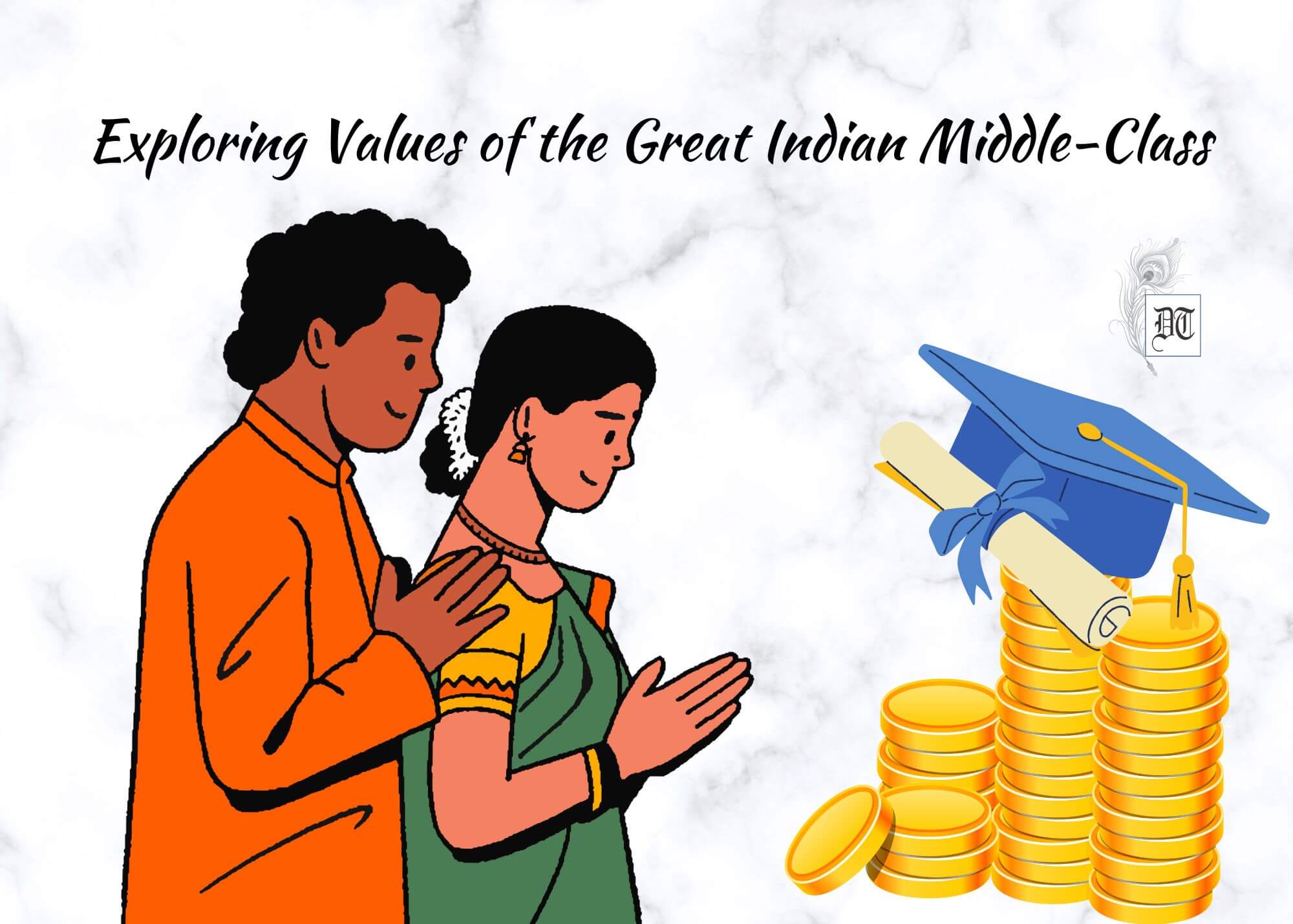
Picture design by Anumita Roy

Born in Guwahati and raised across Delhi and Punjab, Ruchira Adhikari Ghosh is an alumna of Sacred Heart Convent, Ludhiana. She holds a master’s degree in English literature from Punjab University, Chandigarh, and a postgraduate diploma in Journalism. With nearly 25 years of experience in print, web, and television media, she has carved a niche as a feature writer. Her writing focuses on women’s issues, food, travel, and literature, reflecting both versatility and depth.



 By
By
 By
By
 By
By