
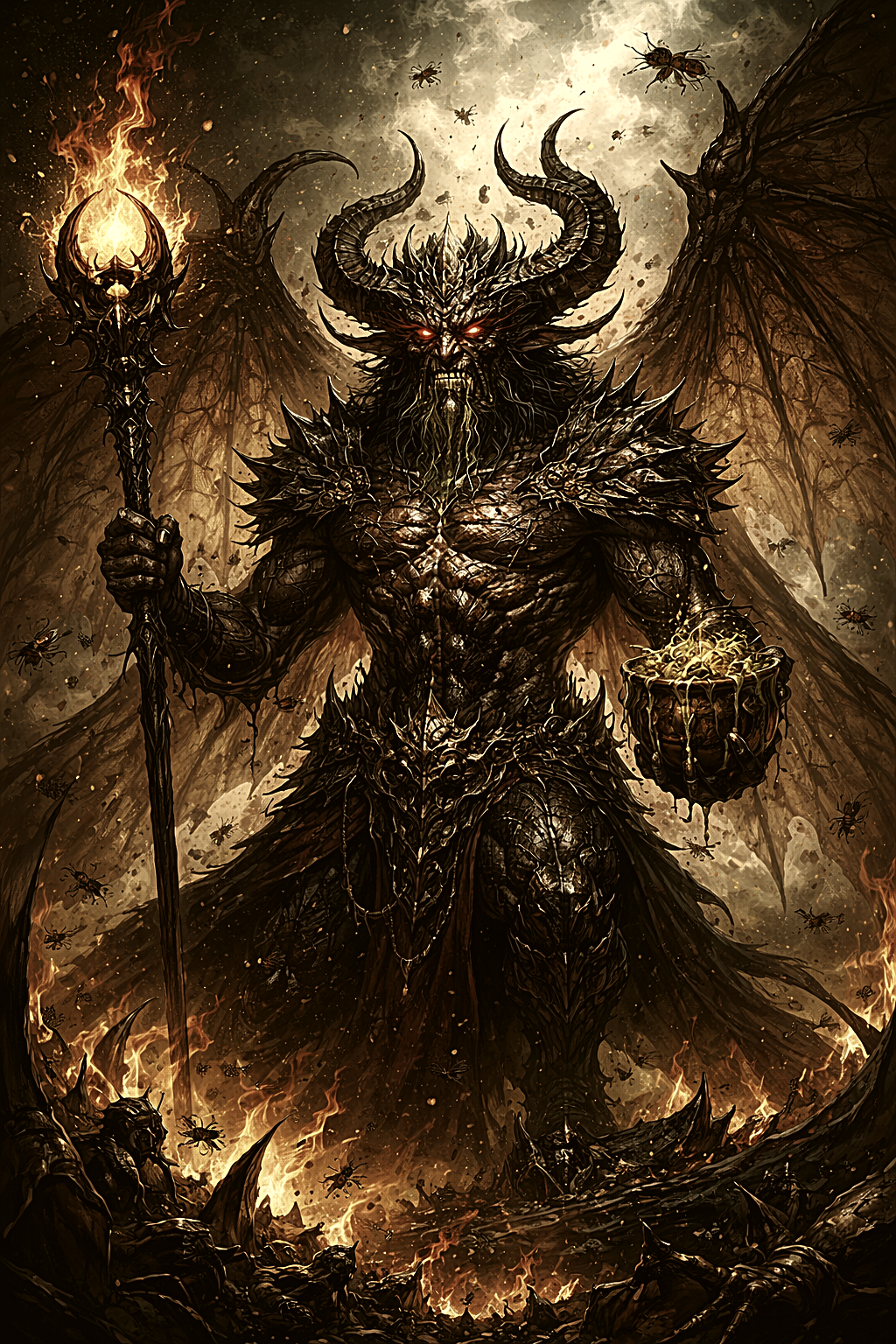
Alash elucidates Beelzebub’s epic transformation from an ancient Philistine god to a demonic prince in the realms of religion, myth, and literature for Different Truths.
Beelzebub occupies a singular place in the intertwined histories of religion, myth and literature, an enduring figure whose name evokes both the ancient world of Semitic gods and the darker imaginings of Christian demonology. To speak of Beelzebub is to traverse centuries of theological polemic, linguistic transformation and cultural reinterpretation; to witness how a once-local deity became a byword for evil, decay and demonic sovereignty in human imagination.
The name, Beelzebub, offers the first clue to this convoluted journey. Etymologically, the name is derived from the Hebrew Baʿal Zəvûb, literally “lord of flies,” a compound of Baal, meaning “lord” or “master,” and zebûb, meaning “fly”. This appellation appears in the Hebrew Bible in 2 Kings 1:2-3, where King Ahaziah of Israel sends emissaries to consult Baal-Zebub, the god of Ekron, about his recovery from an injury. The narrative is terse but telling: the king seeks counsel from this foreign god, only to be rebuked by the prophet Elijah, who declares that Ahaziah will not live. This early mention situates Baal-Zebub not as a cosmic enemy, but as a local Philistine deity whose name would, in later centuries, be cast in infamy.
From this modest biblical mention, the figure of Beelzebub undergoes a dramatic metamorphosis. In early Jewish and Christian contexts, the name becomes synonymous with demonic power — a terminological shorthand for the chief of malevolent spirits. This transformation is already apparent in the New Testament, where the term shifts from the proper name of a local god to a title of fearful import. In Matthew 12:24, the Pharisees, seeking to undermine Jesus’ ministry, accuse him of casting out demons “by Beelzebub, the prince of the devils”:
“But when the Pharisees heard it, they said, ‘This fellow doth not cast out devils, but by Beelzebub the prince of the devils’.”
Here, the elevation of Beelzebub or Beelzebul, as some textual traditions render the name, to the realm of chief demonic authority is apparent. Rather than a minor deity of a pagan city, he is now depicted as a supernatural antagonist to divine power.
This shift was not merely theological but linguistic. The Greek translators of the Hebrew scriptures and later the Latin Vulgate manipulated the form of the name sometimes as Beelzeboul, which the King James Version further formalised as Beelzebub. These alterations reflect both the transmission of texts across languages and the polemical instincts of monotheistic scribes who sought to recast foreign gods as malevolent entities.
Within Christian demonology proper, which flourished in the medieval and Renaissance periods, Beelzebub’s position as a principal demon was elaborated upon with increasing specificity. Occult treatises, ecclesiastical commentaries and grimoires commonly placed him among the highest ranks of Hell’s infernal hierarchy, often second only to Satan himself. In seventeenth-century sources such as Dictionnaire Infernal and the writings of Sebastien Michaelis, Beelzebub is listed among the chief princes of Hell, sometimes associated with specific vices, ranging from gluttony to envy or pride.
John Milton’s Paradise Lost (1667) stands as perhaps the most celebrated literary treatment of Beelzebub in the early modern period. In this epic poem, Milton reimagines the fallen angels — once glorious beings in Heaven who rebelled against the Almighty, now cast into Hell after their defeat. Among these, Beelzebub is presented not merely as a subordinate fiend but as the principal lieutenant of Satan. In Book II, Satan reflects upon his allies:
“Than whom, Satan except, none higher sat.”
Here, the phrase applied to Beelzebub underscores his elevated status within the infernal host: he is second in command, privy to Satan’s counsel and central to the conspiratorial machinations that define the poem’s exploration of cosmic rebellion.
Milton’s portrayal is significant not only for its vivid characterisation but for how it shaped subsequent literary receptions of Beelzebub. Before Paradise Lost, the figure was predominantly theological; after Milton, he became a dramatic presence and an active agent in narratives of fall, temptation and diabolical will. Paradise Lost thus stands as a pivotal moment in the literary afterlife of Beelzebub, bridging religious tradition and poetic invention.
Yet the figure’s resonance extends far beyond Renaissance epic. In the twentieth century, William Golding’s Lord of the Flies (1954) evokes the ancient name in the title itself. While the novel does not personify Beelzebub as a character, its thematic concern with the innate savagery and moral disintegration of human beings resonates with the infernal associations of the titular “lord of flies.” Golding’s use of the term invokes centuries of symbolic baggage — decay, corruption, the collapse of order and remaps it onto a microcosmic island society descending into chaos.
The persistence of the Beelzebub motif in literature illustrates how cultural artefacts can outlive their original religious contexts, morphing into symbols for universal anxieties. Where once Baal-Zebub might have been worshipped or consulted in matters of healing and fate, the ancient Philistine context suggests a complex, if now obscure, religious practice. Later cultures remember only the epithet “lord of flies” and its attendant filth and pestilence.
Beyond canonical literature, Beelzebub features in various apocryphal and occult texts. In pseudepigraphical works such as the Testament of Solomon, a text composed in the early centuries of the Common Era and framed as a magical dialogue between King Solomon and a host of demons, Beelzebub (sometimes rendered Beelzeboul) appears as an interlocutor revealing his own sphere of influence. In these narratives, he claims dominion over envy, lust and war, laying out a catalogue of human sins and societal ills that he purportedly inspires. Although the historicity of such texts is dubious, their very existence points to the rich tapestry of folklore and theological speculation surrounding demonic beings in the Late Antique imagination.
Medieval demonological compendia elaborate on this further. Treatises such as Peter Binsfeld’s demon classifications assign Beelzebub to one of the seven deadly sins, often gluttony or pride, thereby integrating him into a moral schema designed to chart the landscape of vice. Other sources, including the Lanterne of Light, variously associate him with envy or idolatry, demonstrating the flexibility of demonic typologies in pre-modern thought.
The transition from an ancient deity to a central demonic figure also reflects broader religious and cultural processes at work during the evolution of Israelite monotheism and early Christianity. To denigrate a foreign god by recasting him as an embodiment of evil served polemical ends: it reinforced the exclusivity of the worship of Yahweh and, later, of the Christian God, by presenting rival deities as grotesque and corrupt. This semantic inversion from God to demon is emblematic of how religious discourse negotiates power and identity across cultural boundaries.
Beelzebub’s enduring presence in demonology is therefore as much a testament to historical religious conflict as it is to psychological and literary imagination. In the Christian cosmology that eventually dominated Europe, he became a fixture of sermons, exorcisms and devotional literature, a name parents whispered to caution children against sin or to invoke the terrors of the unseen. In exorcistic manuals, he is often depicted as a strategic and persuasive force, adept at enticing the faithful into disobedience.
Contemporary occultism and popular culture continue to draw upon this deep well of associations. Esoteric traditions may interpret Beelzebub as a powerful archetype of liberation or transgression, while horror media leverage his mythic status to evoke fear. Even outside strictly religious or occult frameworks, the name resonates as shorthand for decay, rot and the darker aspects of human nature.
Yet to reduce the figure to mere monstrosity is to overlook the complexity of his symbolic journey. Beelzebub’s origin as a deity of a particular place and people speaks to the diversity of ancient Near Eastern religion, a plurality that modern monotheisms tend to erase. His later assimilation into the Christian demonological universe reveals the mechanisms by which religious narratives absorb, transform and repurpose older traditions.
Moreover, the literary afterlives of Beelzebub, from Paradise Lost to Lord of the Flies, showcase how writers harness and reconfigure mythic material to explore fundamental questions about freedom, authority, rebellion and the human condition. Milton’s epic, in particular, uses the figure not merely as ornament but as a means of dramatising the tragic consequences of defiance and the ambiguous allure of evil. In this, Beelzebub becomes more than a demon of flies; he is a mirror in which successive generations have seen their own fears and fascinations reflected. As a historical figure, his origins are ruggedly human, a local god with a name tethered to the detritus of life. As a demonological archetype, he towers as a prince of shadows. And as a literary symbol, he invites readers to confront the uncanny and often uncomfortable depths of human experience.
Through these manifold incarnations, Beelzebub endures not simply as a relic of ancient religion, but as a potent emblem of how language, belief and imagination intertwine across time. Scholars and readers alike continue to probe his legacy, aware that within the name so evocative and so maligned lies a rich tapestry of cultural history, linguistic evolution and narrative power.
Sources:
- The Holy Bible (King James Version).
- The Holy Bible. Septuagint (Greek Old Testament). Various manuscript traditions referencing Beelzeboul.
- Jerome. Biblia Sacra Vulgata. Late 4th century CE.
- The Testament of Solomon. Translated by F. C. Conybeare.
- Michaelis, Sébastien. Histoire admirable de la possession et conversion d’une pénitente (1612).
- Binsfeld, Peter. Tractatus de confessionibus maleficorum et sagarum (1589).
- De Plancy, Jacques Collin. Dictionnaire Infernal. Paris, 1818 (various later editions).
- The Lanterne of Light. Anonymous medieval theological text.
- Milton, John. Paradise Lost. 1667.
- Golding, William. Lord of the Flies. London: Faber and Faber, 1954.
- The Oxford Dictionary of the Christian Church. Oxford University Press.
- Encyclopaedia Britannica. Entries on Beelzebub, Baal, and Christian Demonology.
- New World Encyclopedia. “Beelzebub.”
- Oxford Classical Dictionary. Entries on Near Eastern deities and Baal worship.
- Eliade, Mircea. The History of Religious Ideas, Vol. I. University of Chicago Press.
- Pagels, Elaine. The Origin of Satan. New York: Random House, 1995.
- Russell, Jeffrey Burton. The Devil: Perceptions of Evil from Antiquity to Primitive Christianity. Cornell University Press, 1977.
- Russell, Jeffrey Burton. Lucifer: The Devil in the Middle Ages. Cornell University Press, 1984.
- Linguistic and Historical Studies
- Cross, Frank Moore. Canaanite Myth and Hebrew Epic. Harvard University Press.
- Day, John. Yahweh and the Gods and Goddesses of Canaan. Sheffield Academic Press.
- Online Academic References (for verification)
- Encyclopaedia Britannica Online
- New World Encyclopedia
- Oxford Reference Online
- Biblical Studies Online (Interlinear Greek–Hebrew sources)
Picture AI created

Akash Paul, a renowned criminologist, theologian, and demonologist, and the author of two globally acclaimed textbooks, pioneered post-crime analysis in criminology and comparative religious studies in theology. His expertise spans criminal profiling, sexual offenses, Christianity, and religious history, with notable contributions to each of these fields. An insightful critic of contemporary society, he also writes poetry, short stories, and novels, blending creativity with profound societal analysis.



 By
By
 By
By

Awesome article son..
What a great article this is….🥹🩷🩵🩷🩵