
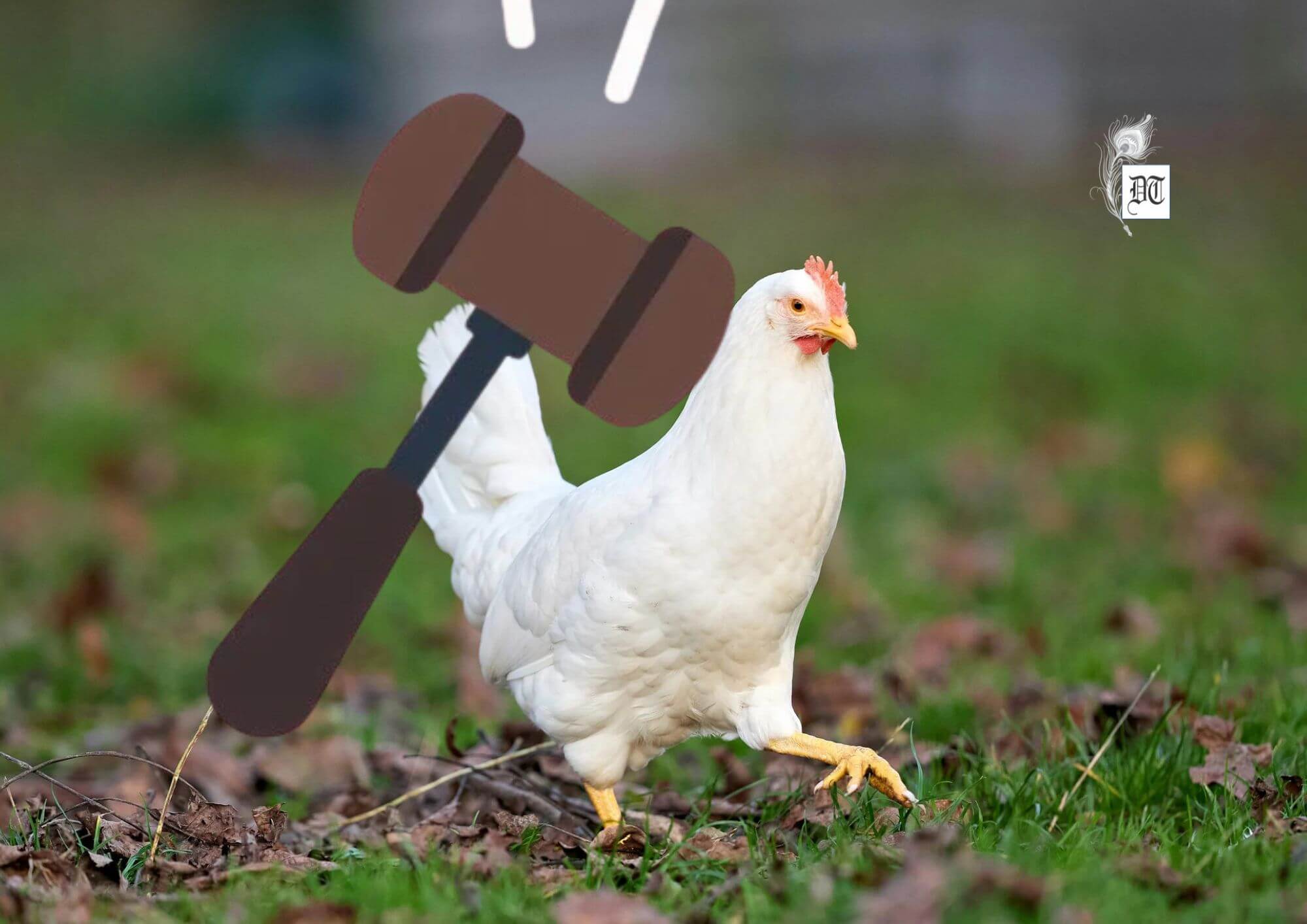

Editor-in-Chief Arindam retells a brilliant Urdu folk story on DifferentTruths.com, exposing institutional corruption and manipulated justice through dark satire.
Key Takeaways
- Systemic Corruption: The narrative illustrates how institutions rot through selective rule application and favours rather than blatant crimes.
- Theatrical Justice: When judges twist laws to serve personal appetites, legal procedures become a farce rather than a pursuit of truth.
- Timeless Satire: Folk wisdom endures by reminding audiences that power dressed up as law often protects the corrupt.
When the keeper of justice has already eaten the evidence, what chance does truth have?
Some stories are just meant to entertain us. Other stories make us laugh and look rather uncomfortably at the world outside the window. The story of the butcher, the chicken and the Qazi is one of the second kind.
It begins with something almost common: a dead chicken.
A man takes his shot bird to the butcher to be cleaned and dressed. “Come back in half an hour,” the butcher says. Then the man departs. Then the Qazi (district judge) comes. He sees the chicken and decides he needs it. The butcher pauses. “Sir, it’s not mine. The Qazi has his answer ready. Give me the chicken, and when the owner comes back, tell him it flew away.
The butcher glares at him. “How can there be a dead hen that flies?” The Qazi could not be convinced. “Do what I tell you,” he says, “and if the owner brings you before the court, remember that I am the judge.”
The single sentence is a joke that sums up all the mechanisms of institutional corruption. The judge is not only a powerful man; he has the final word, and therefore, in his world, truth is negotiable.
Butcher gives the bird. It’s official: the impossible is back. “Your chicken has flown away,” someone says. “But it was dead.” An argument becomes a fight.
Then the butcher’s bad luck is added to it.
They were on their way to court when they saw two men fighting. One of the men was blinded by the butcher in an effort to separate them. Terrified, he scurried up the minaret near the mosque and jumped, crushing an older man who was below him. That old man died. The old man’s son is furious.
He is charged before the Qazi with three offences: theft, grievous hurt and a jump causing death. And the Qazi has one thing that no one else in the courtroom has. His obsession with cases started with the first one.
The First Miracle: A Flying Chicken
As for the owner, “I killed the chicken myself,” he says. “It flew away,” he quoted the butcher, and added, “That’s impossible.” The Qazi listens, then, in silence, delivers the masterstroke.
Do you believe in God Almighty?
“Yes.”
Assume that God can raise the dead?
“Yes.”
Why can’t He make your chicken fly again?
The owner is caught not by evidence but by argument. The chicken is gone. The judge explains it in religious language. To challenge it would be almost sacrilege. The case disappears, and so does the chicken. Qazi’s hunger is still hidden.
If facts get in the way, change the frame. The question was never whether a dead chicken could fly; it was who took the chicken. When the judge changes the question, the truth is denied a hearing.
Second Miracle: Justice Turns into Arithmetic
A man who had lost an eye demanded, “Give me an eye back.” The Qazi makes a bad sum. How much an eye is worth depends on which eye it is. The victim chooses to withdraw rather than obey because the punishment is so severe. So, justice has been done. Nobody gets an eye. The injured man is so scared he remains quiet. Hence, the accused is protected. The judge has done his duty.
A system can breach justice without repealing the law; it merely has to interpret the law selectively.
The Third Miracle: Full Symmetry
The son of the dead man wants his pound of flesh. That is perfect symmetry, says the Qazi. If the butcher jumped from the minaret and killed the older man, then the son must climb the same minaret and jump on the butcher.
“What if he shifts?”
That’s your problem.
“But what if I miss?
Why didn’t your father move?
One should not blame a dead man for avoiding a falling body. The victim is responsible for his own death, the accused is the beneficiary, and the judge remains the guardian of justice.
All three situations fall flat. The butcher is released, the chicken remains with the Qazi, and the law has saved the man who had not been brought before it as a person accused.
The real defendant was never in the dock.
The butcher has some crimes to account for. He is lying down. He puts out a man’s eyes. His escape kills yet another. But the story muddies the waters of guilt. The Qazi himself commits the first injustice. The rest falls like dominoes. Once you start lying, you have to keep on. The collateral damage is one abuse of authority. One lie breeds another to cover it up. Procedural absurdities soon devour the original offence.
Institutions rot this way, not necessarily in great crimes, but in a small favour, a chicken, a phone call. Well, that’s one way of putting it. One file went to the head of the queue. In one case, a rule was used differently than in the other. Ultimately, the institution is no longer there to apply the law but to justify it.
When the Umpire Bats the Ball
Imagine a cricket match where the umpire wants one of the batters to win. He won’t have to touch the scoreboard. He interprets the rules differently. One ball wide. Someone else is dead. Question about catch. An appeal goes unanswered. Still looks good on the scoreboard. The match took place. The rules were in place. And yet we all watching know something is fundamentally wrong.
The most dangerous form of corruption need not be an obvious violation of the rules but can be the selective application of the rules. The law is still in force, the hearing is held, the order is given, the seal is put on it, and justice can disappear as easily as a dead chicken.
The Chicken Is Never Just a Chicken
The chicken is appetite and proof and property and truth. Facts must rearrange themselves around the will of the judge as soon as he has it in his hands. If reason is on your side, appeal to faith. Call arithmetic objects jurisprudence. If morality complains, appeal to process. Use authority when common sense protests—the lexicon changes. The goal is the same. Protect the powerful. Make the victim prove the impossible.
This Qazi story is told in several different versions within Hindi and Urdu folk traditions. Nadeem Farrukh posted a popular video version. The satire below is older and transcends any single telling.
A Judge with a Verdict in Hand
The thief and the butcher are not the most frightening figures. The smiling judge knows the judgement before the hearing is begun.
Laws won’t do. Institutions depend on something more delicate: trust. People enter a courtroom expecting that the power in that room will be bounded by law. If that belief goes, architecture can be beautiful and robes striking, but justice is theatre.
The court of the Qazi is full of people making complaints, bringing charges, arguing their cases and apparently reaching reasonable judgements. Everything looks okay, but the justice is not.
That’s why the story is still being told. People have always known what institutions sometimes forget. A law that can be twisted to suit the wishes of the person who enforces it is not justice; it is power dressed up in the garb of law.
The butcher realises it. The chicken owner knows that. The blind man learns. The son of the dead man learns that, too. The audience laughs. But beneath that laughter lies an uneasy question.
What is the position of the man who administers justice when the same man is the one who eats chickens?
The old folk-wisdom answers with wicked simplicity: the judge will find a law to save the man who gave him a chicken, so long as he gets his chicken.
And somewhere, in every age, another chicken waits on another counter. Dead.
It apparently can’t fly.
But the dead chicken, cut and diced, flies away!
Disclaimer: If this folk story reminds you of Gyanesh Kumar or something similar, it’s your overactive imagination and should be treated as sheer coincidence.
Picture design by Anumita Roy

Arindam Roy has over four decades of experience in various newsrooms of renowned media houses. He is the Founder, Publishing Director, Editor-in-Chief of Different Truths, and Kavya Kumbh Publishing Consultant (KKPC). He has co-authored ten chapters in six Coffee Table Books (CTBs) of national and international repute and is the sole author of four forthcoming CTBs (Times Group). He has also published four international poetry anthologies as the Publisher and Editor-in-Chief, participated in several poetry and literary festivals, and won awards and accolades. Arindam co-authored the novel Rivers Run Back with an American writer. He stays in Bangalore and Prayagraj.

 By
By
 By
By
 By
By
 By
By