

On DifferentTruths.com, Dr Gill examines the lives of Indian warriors who fought and fell in the trenches of World War I and traces the French descendants who still carry their memory.
Key Takeaways
- Gallantry Under Fire: Indian soldiers displayed exemplary discipline and resilience on the Western Front, securing five Victoria Crosses and breaking trench warfare stagnation.
- The Human Connection: Fraternisation between Indian troops and French women led to enduring bonds, children, and a modern lineage of descendants whose heritage often remains unacknowledged.
- A Call for Recognition: The article bridges historical archives with storytelling and modern geopolitics, advocating for long-overdue honour and social restitution for these Franco-Indian descendants.
World War I laundered the sound of exploding shells into a new normal and continues to cast its shadow over the integration of French descendants of Indian soldiers who fraternised with French women, synthesising blood spilt and received.
In the Neuve-Chapelle municipality of the Pas-de-Calais district, northern France, the lethal din of artillery fire finally ceased, placing victory in the hands of victorious church bells pealing the Armistice on November 11, 1918.
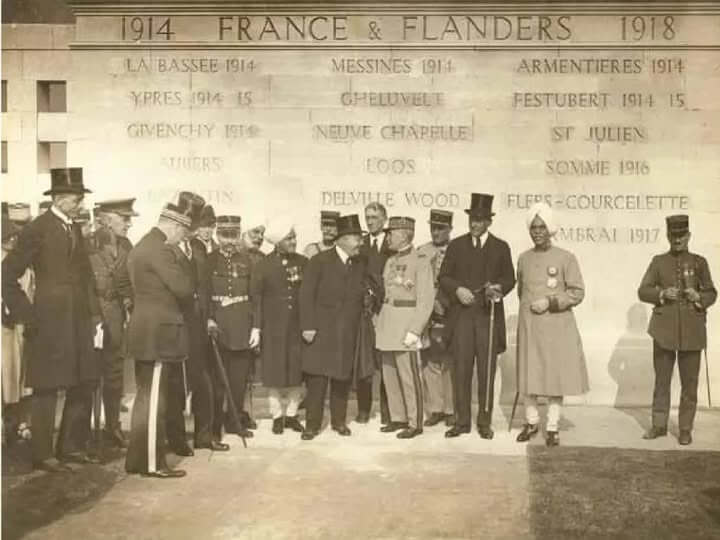
On October 7, 1927, near Neuve-Chapelle, the Indian Memorial was inaugurated by the Maharaja of Kapurthala, Lord Birkenhead; French Field Marshal Ferdinand Foch; Nobel laureate Rudyard Kipling; and a large contingent of Indian veterans. They were commemorating the more than 1.4 million Indian soldiers who had fought with distinctive valour in the war to preserve democracy in Europe. Hereditary professionals, Indian warriors upheld their signed or thumb-marked contractual obligations to honour a multimillennial tradition.
At the inauguration of the Indian Memorial, Field Marshal Foch’s stirring gratitude to Indian warriors still reverberates.
“They showed us the way: they made the first steps towards the final victory.”
In 1915, the Great War had bogged down in the fields of northern France and Belgium. The European allies sipped their coffee and tea in the trenches, waiting for Indian warriors to ‘show them the way‘ through exemplary counterattacks, charging in disciplined waves into live fire.
Spearheading the Indian Corps, the advance units of the Lahore Division landed in Marseilles, France, on September 26, 1914. The Indian Corps directly plunged into its first major action, astounding sceptics, shaking their German adversaries, and earning accolades.
The World War I Indian Memorial at Neuve-Chapelle commemorates over 4,700 of the 50,000 Indian casualties on the Western Front. These 4,700 ‘known’ adorning the Commemorative Wall have no known graves, an inversion of the universally institutionalised ‘unknown’ soldier’s grave. Inspired by the railings of early Indian shrines, Sir Herbert Baker designed the memorial like an Indian sanctuary, enclosing it within a circular wall.
A lotus capital with the imperial British Crown and the Star of India tops the fifteen-foot column in the foreground. It respectfully revives 3rd-century Emperor Ashoka’s inscribed columns. The tigers on either side guard the temple of the dead. ‘God is One, He is the Victory‘ is inscribed on the lower part of the column in Hindi, Gurmukhi, English and Arabic.
Five of the eleven Victoria Crosses awarded to the Indian Army were gained in France. Of these, three were won by Garhwalis, including two by warriors of the Negi clan.
Two-striper Naik Darwan Singh Negi, 1/39 Garhwal Rifles, at the Battle of Festubert on the night of 23rd/24th November, 1914, and posthumously, Rifleman Gabar Singh Negi, 2/39 Garhwal Rifles, at the Battle of Neuve-Chapelle on March 10, 1915.
In the present-day Indian Army, 1/39 is the mechanised infantry 1st Battalion, The Garhwal Rifles, whereas 2/39 is the 2nd Battalion, The Garhwal Rifles.
Philip Mason, in A Matter of Honour: An Account of the Indian Army, its Officers and Men, published in 1974, cites Sir James Wilcox, the Corps Commander, on Garhwalis — pp. 383-384 & 418-419.
“… many of the ones who won fame for the 2nd Gurkhas at Delhi (1858) were in fact Garhwalis… awarded the Order of Merit…”
“The Garhwali Brigade (WW I) won three of the five VCs awarded to Indians in France… the Garhwalis suddenly sprang into the very front rank of our best fighting men … nothing could have been better than their élan and discipline … marvellously steady under shell fire.”
“In plain English, this means they were immune to shell shock and its resulting PTSD.
The body of Rifleman Gabar Singh Negi, the posthumous Victoria Cross awardee at the Battle of Neuve-Chapelle, was never recovered. What became of him before and after is a blank canvas, providing an exciting WHAT-IF for a storyteller’s imagination to paint the truth, overriding mimesis. According to Albert Camus, a 1957 French Nobel laureate for literature, “Fiction is the lie through which we tell the truth.”
“Rifleman Gabar Singh NeNegi’same adorns the Neuve-Chapelle Memorial and the dome of the 2002 Memorial Gates in London.
Following the Battle of Loos, September 25–October 8 1915, the Indian Infantry divisions, having ‘sh’wn the way’ t’ the European allies, were shipped to the Mesopotamian theatre to ‘sh’w the way‘ t’ the British army, continually repelled by the tenacious Ottoman Turks. The September 23, 1918, decisive Battle of Haifa remains his history’s testimony to the valiance of the Mysore and Jodhpur Lancers in a disciplined and fearless cavalry charge into machine-gun and artillery fire.
Deferring to the battlefield performance of the Indian army and to dynamising their stasis, the allies did, however, retain two Indian cavalry divisions in France. Initially, they fought dismounted to bolster the Franco-British infantry. Still, later, they further distinguished themselves in the famous battles of the Somme and the renowned charge at Cambrai by Hodson’s Horse and 5th Cavalry, which smashed through German lines.
Indeed, the very same mixed-class Hodson’s Horse — consisting of Punjabi Muslims, Pathans, Dogras, and Sikhs — had decapitated the last of the Mughal princes outside of Delhi on September 22, 1857.
When Indian soldiers arrived in France to redraw the stagnant line of trenches against the Germans, a terrified populace felt relieved and profusely welcomed them. Women bombarded them with flowers and kisses while the general public cheered. The Indian warriors were battle-hardened, seasoned veterans, known to be professionals and not conscripts.
This was something exciting for European cultures, which had historically relied on an assortment of mercenaries and feudal levies for national defence, eventually evolving, by the eve of World War I, into the servitude of national service. Once that obligation had been acquitted, the conscripts went back to their regular civilian jobs, farms, wives, beer, cheese and wine. When World War I broke out, they unhesitatingly answered the mobilisation call and “walked eye-deep in hell, believing in old men’s” —Ezra Pound in Hugh Selwyn Mauberley, 1920.
These conscripts bravely took their pot bellies and rusted training into the field and died courageously to feed a stalemate in trench warfare. The Allied high commands waited for the Lahore Division to disembark in France.
The Indian troops, unprepared for European women’s inhibited fraternisation compared with their aloofness in India, were delighted with it. The consequences of this Franco-Indian fraternisation engendered bliss and grief, both effects lingering up to the present time.
In 2016, Paris-based Indian filmmaker, screenwriter and novelist Vijay Singh launched his documentary film, Farewell My Indian Soldier (FMIS).
IMDB called FMIS “a moving portrayal of Indian soldiers who came to fight in France and Belgium during the First World War. The presence of these 150,000 soldiers in Europe is a virtually unknown fact of history.”
“The Hindu wrote that “The Paris première, hosted by the French Minister of Defence and the Indian Ambassador at Ecole Militaire Amphitheatre, became a joint homage of France and India to the Indian soldiers.”
“Scroll.in described the event as “a micro-level gaze on the friendships and relationships that bloomed during the war”.
“The extracts of filmmaker Vijay Singh’s interview with Papri Paul and the latter’s comments in the Times of India dated March 22, 2017, are telling.
“… When soldiers were sent behind the lines, they were received by French women. Friendship and sometimes love flourished between the soldiers and their French hostesses. Children were born of them… The filmmaker relied on rare archives of historical testimonies, 100-year-old Indian war songs, and 600 letters written home which the British censored…. Some even described how these French women made love. Their children lived a life of stigma, and their families still hesitate to own up to their Indian origin.”
It is to these descendants that the debt remains outstanding. Apart from Field Marshal Foch, more than a century ago, not enough credit has been given to these warriors, especially when their descendants’ lineage that won nobility by blood and merit on French soil goes unrecognised.
Yet, I remain optimistic, as a refugee from the consequences of religious discrimination wielded through second-class citizenship, who was admitted into France and then passed the stringent 1-out-of-12 selection to join the French Foreign Legion, which, unprecedentedly, allowed him to obtain a PhD and attain grade-A civil service status and university tenure by a national competitive exam.
After all, since Emile Zola, the author of Germinal, restituted France from the disgraceful Dreyfus Affair, France has been notably mindful of redressing grievances, real or even imagined.
On January 13, 1898, Emile Zola wrote J’Accuse, an open letter to French President Félix Faure, in the Paris daily L’Aurore, accusing the government of choosing Captain Dreyfus as the scapegoat in an espionage scandal, a selection consensually attributed to antisemitism.
In the matter of recognising the descendants of Indian warriors in France, India’s economic prosperity, scientific accomplishments, military proficiency and diplomatic stature will also contribute to influencing perceptions and mitigating the social embarrassment of Indian ancestry discerned in Vijay Singh’s documentary.
Thus, it was the story in my forthcoming novel, The Pledge: The Secret of the Desposyni, that galvanised the regeneration of a posthumous Indian Army Victoria Cross winner, whose name is extolled on the Commemoration Wall and whose body was never found. His great-granddaughter, Carrie Braqhuais, trauma nurse, French Savate kickboxing belt holder and born lockpicker, carrying a knife in her bra, impelled recognition. She crosses paths and pairs with her lost cousin, Sergeant Mahabir Limbu, Royal Gurkha Rifles, Prince Harry’s Close Protection Commander in Afghanistan, and hereditary guardian of the Navratan Sangh — the Nine Unknown Keepers of Knowledge. The cousins traverse hell to redeem their inherited, multimillennial pledge.
This article seeks to pay homage to the descendants of World War I Indian warriors who fought on French soil to repel the Kaiser’s poisonous onslaught of Kultur auf Deutsch civilisation.
Like French Foreign Legionnaires, their descendants, too, are French by blood spilt — and, in addition, also by blood received.
References
The Pledge: The Secret of the Desposyni, by Azam Gill.
Corrigan, Gordon. Sepoys in the Trenches: The Indian Corps on the Western Front 1914-15. UK: Spellman, 2015.
Mason, Philip. A Matter of Honour: An Account of the Indian Army, its Officers and Men. London: Purnell Books Services, 1974.
Masters, John. Heart of War. New York: McGraw-Hill, 1980. Number two in John Masters’ ‘Loss of Eden Trilogy’.
Times of India
The Hindu
Scroll in.
France 24
BBC (39 Garhwal)
Indian WW1 soldiers laid to rest after French mystery, November 7, 2017. https://www.bbc.com/news/world-asia-india-42016574
Feature Picture from Royal Archives is at Neuve-Chapelle Indian Memorial.

Dr Azam Gill is a France-based novelist, analyst and retired tenured Lecturer of Toulouse University, France. He has authored nine books, including four thrillers — Blood Money, Flight to Pakistan, Blasphemy and JADINY, and contributed to six anthologies. He also writes for Different Truths, The Express Tribune, and The International Association of Thriller Writers and blogs at https://writegill.com/. He served in the French Foreign Legion, the French Navy, and the Punjab Regiment. JADINY: Just Another Day in New York, his latest novel, is the first counterfactual/alternative history thriller about the 9/11 Twin Tower attacks. He is our Editor-at-Large, Europe.
 By
By
 By
By
 By
By
 By
By