
Our Editor-in-Chief, Arindam, at DifferentTruths.com, reveals how Ritika Chopra examined internal Election Commission documents revealing rare institutional friction over core voter rights.
Key Takeaways
- Internal Dissent: Two Election Commissioners lodged fourteen formal objections over ten months, citing administrative bypasses on crucial decisions.
- Database & Form Risks: Unauthorised additions to Form 6 and centralisation of IT systems like ERONet threatened local registration processes.
- Constitutional Integrity: The probe shifts focus from political drama to the transparency and collective collegiality required of the poll panel.
In a democracy, a reporter’s private fears can become everyone’s business in a hurry.
It took Indian Express journalist Ritika Chopra almost a year to get hold of the internal documents of the Election Commission of India. She spoke frankly about her discomfort. She collected the notes and dates and visited Mumbai, Delhi, Kolkata and Goa to find evidence. But as the investigation approached publication, one concern kept resurfacing: Would people miss the headline about three officials disagreeing? Would they see that this was not some office politics disguised as a constitutional issue but three real dangers to every eligible Indian in the electoral roll?
Her fear was well founded. In a world of limited attention and clicks driven by conflict, the saga of fourteen formal objections over ten months by two of three Election Commissioners can be dismissed as internal drama. Chief Election Commissioner Gyanesh Kumar was on one side, and Election Commissioners Sukhbir Singh Sandhu and Vivek Joshi were on the other. Fourteen written notes were made, some sent to the CEC, some, breaking with tradition, sent to the Cabinet Secretary. The Commission said “differing views” are normal and the final decisions were unanimous. The Opposition called for resignations, and political groups fell into their customary positions. But the bigger issues might have gotten lost in the noise of who said what.
But the notes themselves are more than disagreements. They are concerned with three major facets of the electoral process: the selection of voters and the removal of their names from the rolls.
The Quiet Change of the Gateway
Form 6 is to be filled in by every adult citizen who wants to be registered in the electoral roll. The Registration of Electors Rules of 1960 govern this form. It is not subject to administrative determination. The power to amend those rules is vested in the Union government under section 28 of the Representation of the People Act, 1950, and is not an internal guideline or a software field.
A new question was added to the online form available on ECINet: whether the applicant or any of their parents or grandparents had been included on the electoral roll of the last Special Intensive Revision, held more than twenty years ago. Before they could proceed with the registration process, this question had to be answered. As Vivek Joshi noted in May 2026, such a change would require a formal amendment by rule. He said the SIR was a one-off arrangement under Section 21 (3) and could not change a statutory form. Sukhbir Singh Sandhu concurred. When the amended form came into force several months later, Sandhu termed the insertion “unauthorised and illegal” and demanded immediate removal of it to save first-time voters from harassment. The question lingered on, and young citizens wanting to exercise their constitutional right under Article 326 faced an administrative hurdle that was never established in law.
I. The Steady Process of Centralising the Digital Backbone
Entitlements to vote are stored in the software systems ERONet and, subsequently, ECINet. Local Electoral Registration Officers on the ground said they were being blocked from access or diverted. The Commission’s IT division in Delhi was being given more control. One Commissioner warned this centralisation was stopping officers from doing their legal duties, and the other agreed.
Later, a work order changed the overseer of the IT system, but the two commissioners who made up the majority were not told. Each of them wrote to the Cabinet Secretary in response, which was almost unheard of. They intervened, and the order was withdrawn, and the Commission said that DEC oversight of the IT division had never ceased. But the overriding concern was the transfer of control of the voter database, and this was a grave risk. If most members say they are losing control of the digital system, a three-member constitutional body cannot say it manages the rolls together.
II. Uncertainty as to Deletion, Restoration and Acts Done in the Name of the Commission
In West Bengal, around 16.10 lakh appeals were made for deletion of voters whose names had been restored by judicial officers. Sandhu, on record, asked, “Who approved those appeals [on behalf of ECI] and under whose authority?” He hadn’t been told. Joshi hadn’t been told. Similar concerns were voiced elsewhere. The software in Goa did not include eligible voters in the final rolls despite directions issued by the state CEO’s office and repeated requests. But many cleared by local officers had to reapply; ground verification was found. It appeared processes were moving faster than the full Commission was aware.
These were not just abstract procedural arguments. They were concerned with the real power to add a name, to remove a name, and to institute legal proceedings in the name of the constitutional body charged with the purity of the rolls. Fourteen formal objections in ten months, four of them on the same day, doesn’t sound like the sort of thing that would happen in normal discussion. It is the form in which a three-person body records the fact that decisions affecting the franchise have been taken, orders issued and systems altered, for the majority of it. But at the same time, they were either kept in the dark or went against the advice they had in writing: the 2023 Act and the Constitution Bench verdict in TN. Seshan directed the Commission to take decisions, as far as possible, unanimously, and, in case of impossibility of achieving unanimity, the majority view should prevail. In this case, the majority was recording that it was being circumvented on issues that go to the integrity of the electoral process itself.
How the Story Was Put Together
Big investigative journalism is almost never the product of one big discovery. It grows with time. Chopra first became aware of the issue almost a year ago, not through a dramatic leak, but through ongoing discussions with current and former Commission members. A feeling is not enough for a story. She built a framework for months, talking to new and veteran officers and learning the history of the institution. Patterns were emerging. With the framework in place, the investigation gained pace. Over the last two months, reporting has moved from conversations to fact-checking on the ground in four cities. The Commission sent a detailed questionnaire on September 21 with follow-up calls but did not get a prompt response. The probe was released. The Commission said the objections were part of normal discussion and said all final decisions require the approval of all three members. But the most significant questions raised in the notes, including who had access to the voter database, whether the changes to the form were legal, and how transparent the Commission’s decisions were, largely went unaddressed.
The whole Commission met on September 26, drew up a note with the points, published a photograph of the united group, stated that the BLOs would conduct door-to-door collection in the cases not mapped and in those with a ‘logical discrepancy’, extended the deadlines in Delhi and Maharashtra and had an external review of ECINet carried out. Thereafter, the operational concessions were made. The note also transmitted the more difficult silences on the online Form 6 field and the appeals from West Bengal.
The Public Trial
Former Chief Election Commissioner SY Quraishi made the institutional point, without any embellishment, that the Election Commission is not just another name for its Chairman. The dispute is no longer simply over the wisdom of the SIR, for the report is correct. It is now a question of whether the Commission still functions as a collegial constitutional body.
Ritika Chopra was worried about the public seeing only the clash between the three officials. That worry has not been entirely without foundation, as the political drama has been very visible. At the same time, the investigation has also sparked a more rarefied kind of conversation—not about the people involved or the partisan points at stake, but about whether the quiet machinery of voter registration, data custody and deletion is still being collectively and transparently looked after, as the Constitution requires.
Democracy does not always fall with the spectacle. At times, it unravels in the footnotes of internal notes, in a changed form field, in a software permission that silently moves from the district to the centre, in an appeal filed in the name of the Commission that its own members did not sanction. The disagreement isn’t the story behind the story. That is the essence of the dispute — and the fact that the dispute was recorded, over and over again, by those who make up the majority of the body charged with safeguarding each citizen’s right to vote.
The reporter’s private worry has become a public test. Are we going to dismiss it as just another episode of institutional soap opera, or do we demand answers to the three questions that extend to every polling booth and every electoral roll in the country? Here are the notes. The dates are present. The questions are hanging.
References and Sources
- Ritika Chopra, “14 times in 10 months, two Election Commissioners objected on record to poll panel steps,” The Indian Express, September 23 2026; related exclusives on Form 6, IT centralisation, Cabinet Secretary letters, and Goa rolls.
- SY Quraishi, “Election Commission is not another name for its Chairman,” The Indian Express, September 23, 2026.
- The Wire, Scroll.in, Hindustan Times, The Hindu, India Today, BBC, Economic Times — same-day and follow-up reporting, 23–27 September 2026.
- Election Commission of India Press Note, September 26, 2026 (full Commission meeting; BLO home visits, Form 6 clarification, ECINet review, Delhi/Maharashtra deadline extensions, Cabinet Secretary letter). TN Seshan, Chief Election Commissioner of India v. Union of India (1995) 4 SCC 611; The Chief Election Commissioner and Other Election Commissioners Act, 2023, Section 10; Registration of Electors Rules, 1960; Representation of the People Act, 1950, Sections 21 and 28.
- Primary video sources: Ritika Chopra on the methodology and chronology of the investigation (Facebook/Express Café conversations with Saurabh Dwivedi and related interviews, September 2026).
Over 2,000 Citizens Plead to CJI Surya Kant for Urgent Judicial Audit of Voter Rolls
Democracy rarely announces its problems loudly. Sometimes, it simply shows them when a name is missing from the voter list.
More than 2,000 citizens—academics, lawyers, former civil servants, activists, journalists, artists and retired military personnel—have now written to Chief Justice of India Surya Kant and other Supreme Court judges seeking urgent judicial intervention over the Election Commission of India’s Special Intensive Revision (SIR) of electoral rolls. Their demands include a stay on the ongoing exercise, an independent inquiry into the functioning of the poll panel and a complete audit of its centralised ECINet digital platform.
The timing makes their concerns even more pressing.
In May 2026, the Supreme Court confirmed that the ECI has the constitutional and legal authority to conduct the Bihar SIR. This authority comes from Article 324 and Section 21(3) of the Representation of the People Act, 1950. The court did not find the SIR illegal but pointed out the need to keep electoral rolls accurate and to protect eligible voters.
Since then, the main change has been the increased pressure on this principle.
An investigation by The Indian Express reported that Election Commissioners Sukhbir Singh Sandhu and Vivek Joshi recorded 14 objections over ten months concerning, among other things, changes to Form 6, voter deletions and restorations, access to electoral-roll software and what they described as increasing centralisation of the database.
The Election Commission disagrees with this interpretation. It says all three commissioners approved all SIR orders, and that having different opinions is normal in any institution. On September 26, the Commission repeated this point. It explained that the letters from the two commissioners to the Cabinet Secretary were about the work of an officer on deputation, not about ECI policy or its IT division.
The next concern is about the technology being used.
At a hearing on September 22 about Delhi’s SIR, the Supreme Court asked why voters were getting “logical discrepancy” notices. Chief Justice Surya Kant said these notices seemed to be sent out “almost mechanically” and asked the ECI to add more safeguards. Reports say over 33 lakh voters received these notices.
This is where the main point becomes clear.
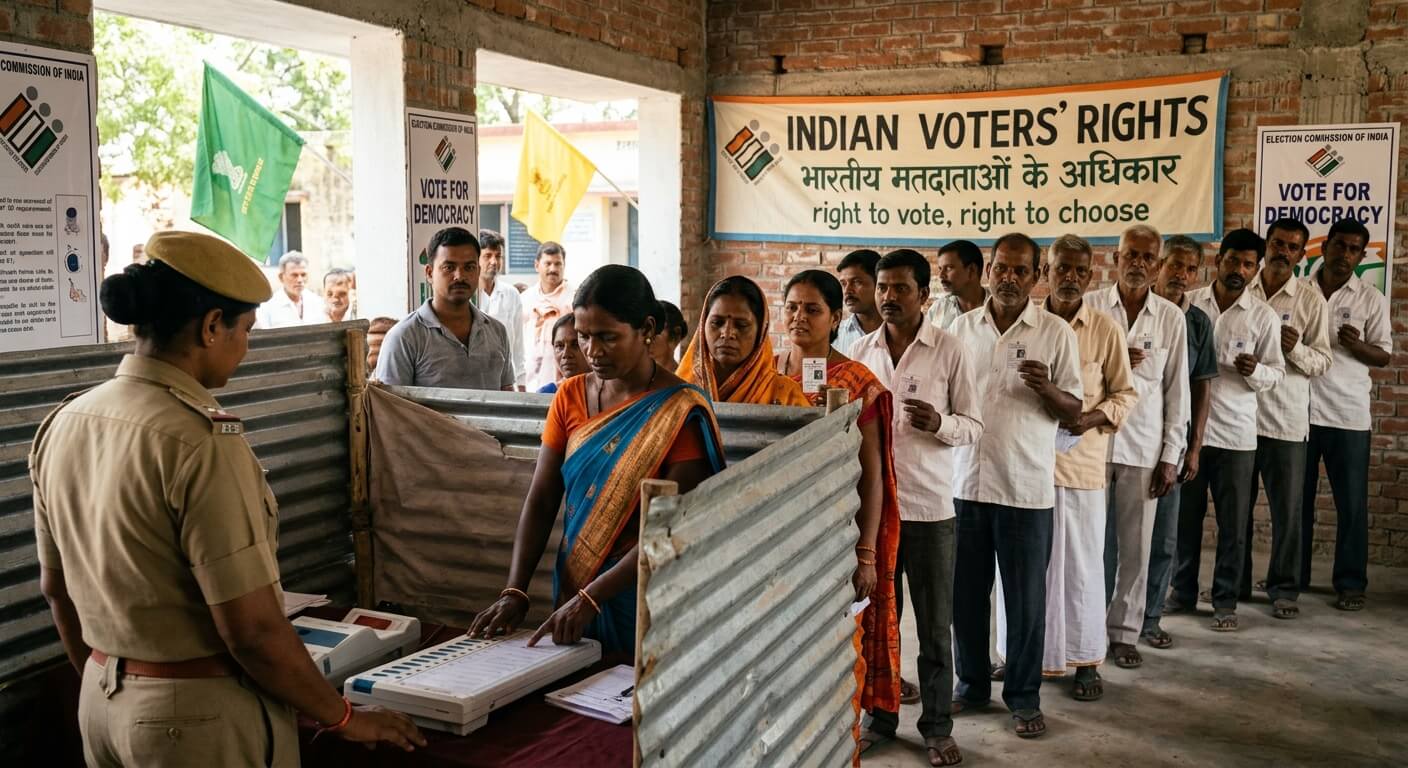
An electoral roll is more than a spreadsheet. It is the official record of who can take part in representative government. Technology can make this register faster, more organised, and easier to use. But without human monitoring, audit trails, and chances to appeal, it can also exclude people very efficiently.
The ECI says that if people get SIR notices because they are unmapped or have logical discrepancies, Booth Level Officers will visit their homes to collect documents and upload them to ECINet. Then, the Electoral Registration Officer will make a decision. Hearings will only be needed in rare cases.
This process might help as a safeguard, but the bigger issue is trust.
When an algorithm affects a citizen’s right to vote, people should know who sets the rules, who controls the database, who can change it, who audits it, and who is responsible if the system makes a mistake.
The ballot box may still be physical, but the democracy behind it has changed.
References
Supreme Court of India, Association for Democratic Reforms & Ors. v. Election Commission of India & Ors., judgement dated May 27, 2026.
Election Commission of India/PIB, SIR Phase III press release, May 14, 2026.
The Indian Express, Ritika Chopra, “14 times in 10 months, two Election Commissioners objected on record…” September 2026.
National Herald, “Over 2,000 citizens write to CJI seeking stay on SIR…” September 25, 2026.
Supreme Court proceedings on Delhi SIR and “logical discrepancy” notices, September 2026.
ECI/PIB press note following the Commission meeting of September 26, 2026.
Arindam Roy
Picture design by AI

Arindam Roy has over four decades of experience in various newsrooms of renowned media houses. He is the Founder, Publishing Director, Editor-in-Chief of Different Truths, and Kavya Kumbh Publishing Consultant (KKPC). He has co-authored ten chapters in six Coffee Table Books (CTBs) of national and international repute and is the sole author of four forthcoming CTBs (Times Group). He has also published four international poetry anthologies as the Publisher and Editor-in-Chief, participated in several poetry and literary festivals, and won awards and accolades. Arindam co-authored the novel Rivers Run Back with an American writer. He stays in Bangalore and Prayagraj.

 By
By

 By
By