
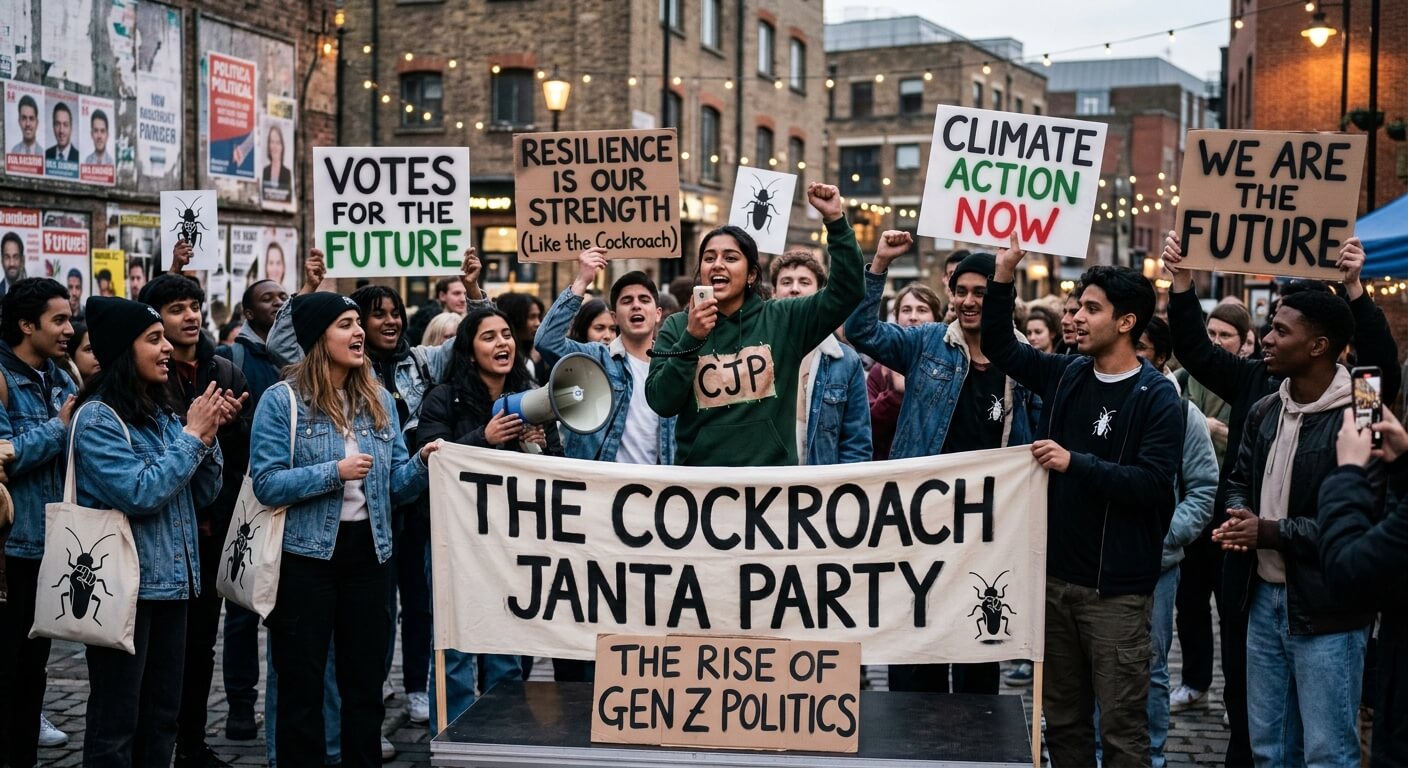

Our Editor-in-Chief, Arindam, explores India’s intense electoral crisis and the rise of Gen Z politics, questioning institutional transparency and the future of democratic accountability on DifferentTruths.com.
Key Takeaways
- Institutional Friction: Reports reveal internal disagreements within the Election Commission, highlighting tensions over digital centralisation and voter roll management.
- Protests and Demands: The Cockroach Janta Party and opposition groups have mounted high-stakes campaigns demanding structural reforms and accountability.
- Concessions and Optics: Recent operational rollbacks and unity optics address immediate ground friction, but deeper questions about democratic architecture remain unresolved.
One Chief Election Commissioner. One Special Intensive Revision. One political street fight. None of these can sum up India’s electoral crisis.
The most interesting question in a democracy is not who protests, but what the protest is asking.
The Cockroach Janta Party, or CJP, as its young protagonists call it, already has a name that sounds almost deliberately unserious. A cockroach survives attempts to kill it, crawls through cracks, shows up where nobody invited it and makes the respectable inhabitants of the house extremely uncomfortable. There is perhaps a metaphor in there.
Having agitated earlier this year in a student-centric manner, the CJP is now trying a riskier move: stepping out of campus and into the thicket of national electoral politics. On 24 September, it issued a 48-hour ultimatum for Chief Election Commissioner Gyanesh Kumar to resign and announced an “Election Commission Thik Karo” campaign. Founder Abhijeet Dipke had warned of nationwide agitations from Mumbai on October 2, Gandhi Jayanti, if Kumar did not resign. There were three clear demands: resignation and accountability of the CEC, freeze of the SIR with restoration of earlier rolls and repeal of the 2023 appointment law.
That is no longer simply student politics. It is a gamble on the political imagination of India’s youth and a dangerous one. “Not that the questions are illegitimate, but electoral politics is a swamp where even legitimate questions can quickly become partisan ammunition.
The Man is Not the System.
Understandably, present-day politics should be tempted to reduce institutional crises to personalities. Lose X. Stop Y. Fire Z. Then all shall be well. And history generally guffaws at such simplicity.
Gyanesh Kumar was appointed CEC on February 19, 2025, after serving as an Election Commissioner since March 2024. The Election Commission of India existed before him and will continue after him. Article 324 provides for a Commission, consisting of the Chief Election Commissioner and such other Election Commissioners as may be provided for, to have the “superintendence, direction and control” of elections. When others are appointed as Commissioners, the CEC is Chairman. The word is Commission. No monarchy. Not the command headquarters. Not Raj CEC.
Constitutional protection does not mean constitutional infallibility. Institutional independence should not become institutional obscurity.
The SIR is Bigger Than the Acronym
The Special Intensive Revision has become the explosive focus of the present dispute. The ECI has ordered the exercise under Article 324 and Section 21 of the Representation of the People Act, 1950—revision of electoral rolls. Dead voters have to go eventually. “We have to count migrants. Eliminate duplicate entries. New citizens reaching adulthood must be added to the rolls. A democracy cannot have a sacred, frozen-in-amber voter list.
But cleaning an electoral roll should not be an exercise in purging citizens from democracy. That is where process becomes content.
The Indian Express reported on 23 September that Election Commissioners Sukhbir Singh Sandhu and Vivek Joshi had raised objections on several occasions—at least fourteen times in ten months—on electoral-roll decisions, Form 6 changes and centralisation of electoral-roll data. Secondary reports say the number of names deleted from the draft lists across states and union territories is about thirteen crore. The ECI has always maintained that notes were part of the decision-making process and that final decisions were unanimous. You can’t just yell past each other.
Source documents to be released. Let the people see them. Let the lawyers look at them. Let the journalists investigate. Let Parliament discuss them. Let the courts decide the legal questions. Democratic institutions are strengthened when evidence is available for scrutiny, rather than when citizens are asked to choose between competing assertions.
Who Will Name the Referee?
The CJP’s intervention here gets potentially more interesting than its one-resignation demand. The organisation is also calling for the 2023 appointments law to be repealed and replaced with a framework that includes wider institutional participation.
Anoop Baranwal v. Union of India (2023) underscores the importance of a fair and transparent appointment process. The law passed by Parliament in 2023 says that the selection committee would comprise the Prime Minister, a Union Cabinet Minister nominated by the Prime Minister and the Leader of Opposition. One of the biggest challenges has been replacing the Chief Justice of India with a Union minister. On September 23, 2026, a two-judge bench was divided on the merits of challenges to the law and referred the matter to a larger Constitution Bench. The constitutional judiciary already faces the institutional question.
The debate must move beyond the question of whether Gyanesh Kumar is good or bad. The question that remains is: what institutional design gives citizens the most reason to trust whoever sits in that chair? That question will outlive CJP Gyanesh Kumar, the Opposition and the present government.
First among equals — or the chair as institution?
Primus inter pares, first among equals, captures something elementary about collective constitutional bodies. The Chairperson is the CEC. The constitutional text refers to a Commission. And the real question is not whether the CEC should have a chair but whether the chair should become the institution.
If the Election Commission consists of three constitutional commissioners, their deliberative role should be visible. Where there is disagreement, the public should be sufficiently informed about the reasoning to understand how a consequential decision was reached. A democracy needs no blind faith in three people any more than it needs blind faith in one. The fourth commissioner is openness. It sits quietly at the table. Otherwise, institutional independence is an abstraction.
Gen Z Walked into the Room
The CJP has demonstrated it can mobilise on student issues. Now it is trying to channel that energy into a national campaign around electoral institutions. That’s a different ball game. National electoral politics is filled with constitutional bodies, Parliament, the courts, competing narratives and the inevitable suspicion that every protester has an electoral motive.
The CJP will have to confront a difficult question: can it be political without being simply partisan? If it says the Election Commission must be reformed regardless of who runs the Union government, that is one kind of argument. If its principles change with the party in power, that is another. History is a ruthless accountant.
The Opposition has a problem too.
Opposition parties are also demanding Kumar’s resignation and preparing parliamentary notices. But taking away a CEC does not automatically fix the Election Commission. You don’t redesign a process to replace a person. Resignations alone will not resolve the issues with the appointment mechanism or clarify whether SIR procedures are sufficiently transparent. The chair changes; the architecture stays the same. If the architecture is flawed, another occupant inherits the same powers, ambiguities and vulnerabilities.
Above the Ballot Box
Democracy doesn’t start on election day. It starts with the voter list, notice before deletion, accessible appeals, transparent data systems, independent officials and institutions that can resist pressure from whichever party is in the executive. The ballot is only the last visible link in a very long chain. Break the chain upstream, and the polling booth may stay clean, but the democracy around it gets fragile.
If the debate is to grow beyond one man, several questions merit sustained attention. Are there plans to overhaul the appointment process? Should internal decision-making and dissent be more transparent? What are the checks and balances for mass revisions? What notice and appeal procedures must be in place before removal of a name? How do you audit election data? What happens when the Election Commissioners disagree? And who is watching the watchman?
Established organisations often have one commodity that young movements lack: impatience. Sometimes that makes them careless. Sometimes it makes them essential. Each generation learns that the democracy it inherits is not assured for its children. The youth did not write Article 324. But they will live with the legacy of those institutions. They have every right to ask uncomfortable questions—but to ask them with evidence, not rage; to demand accountability, not manufacture certainty; and to reform institutions, not destroy institutional legitimacy.
That is politics of a harder kind. And maybe more is required.
The cockroach survives because it doesn’t go away. Democratic questions should also work this way. They have to slip in through doorways, survive being dismissed for political convenience, and keep coming back. Who appointed the ref? The referee is supervised by the What if the refs don’t agree? What happens to the citizen who disappears from the roll? And who ensures that the electoral institution belongs to the Republic, not the government or opposition of the day?
Those questions are bigger than Gyanesh Kumar. Bigger than the CJP. Bigger than the ruling dispensation today and the Opposition today. An election is an occurrence. Electoral democracy is an endowment. And inheritance is not for those who are in office for a short time, but for those who follow them.
That is why India’s current electoral argument should not end in resignation. It should start there.
Sources & References
- Constitution of India, Article 324.
- Supreme Court of India, Anoop Baranwal v. Union of India (2023); reference of challenges to the 2023 appointment law to a larger Constitution Bench, September 2026.
- The Indian Express, 23 September 2026: “14 times in 10 months, two Election Commissioners objected on record to poll panel steps.”
- The Indian Express, 24 September 2026: “Jantar Mantar 2.0: Why EC is Cockroach Janta Party’s latest target”; related reporting on CJP demands.
- The Economic Times / Hindustan Times / India Blooms, 24–25 September 2026: CJP’s three demands, 48-hour ultimatum, and October 2 nationwide protest announcement by Abhijeet Dipke.
- Election Commission of India: SIR framework under Article 324, Section 21 of the Representation of the People Act, 1950, and Registration of Electors Rules; 26 September 2026 press note on unanimous approval and procedural changes.
- The Chief Election Commissioner and Other Election Commissioners (Appointment, Conditions of Service and Term of Office) Act, 2023.
Nirvachan Sadan Photo-Op Fails to Silence Unanswered Questions on Electoral Rolls
In the business of news and nuance, one learns early that when an institution steps before the camera to vigorously demonstrate its harmony, the performance often reveals more than it conceals.
The full Election Commission of India convened at Nirvachan Sadan at 3 p.m. on 26 September 2026. Election Commissioners Dr Sukhbir Singh Sandhu and Dr Vivek Joshi accompanied Chief Election Commissioner Gyanesh Kumar. By evening, the Commission had issued a detailed press note, with a carefully framed photograph of the three men together. The message was clear: there is no rift, decisions were unanimous, and the Special Intensive Revision (SIR) stands on firm legal ground.
An investigation by The Indian Express, based on documents accessed by Ritika Chopra, reported three days ago that Sandhu and Joshi had formally recorded objections at least fourteen times in about ten months — between November 2025 and August 2026 — to decisions and orders they claimed were taken in the Commission’s name without their knowledge. The objections concerned Form 6, the addition and deletion of names, petitions filed in the Commission’s name in West Bengal, and the gradual centralisation of access to ECINet and ERONet, the digital systems that store the country’s electoral rolls. Official files used words such as ‘unauthorised’ and ‘illegal’. The two Commissioners had even written to the Cabinet Secretary independently.
The meeting and note on Saturday were the Commission’s most extensive public response to date.
What the Commission Had to Say
Several claims were made and several operational changes announced in the press note issued after the conclave.
The order dated 24 June 2025 launching the nationwide exercise starting with Bihar and extending to West Bengal and other states and union territories was passed with the unanimous approval of all three Commissioners on the larger SIR architecture, the Commission insisted. It said subsequent schedules were also approved unanimously. The note further added that the Supreme Court had upheld the original SIR order on 27 May 2026.
The Commission in Form 6, the statutory application for new voter registration, said the declaration attached for the SIR period linking applicants to the previous intensive revision through parents or grandparents “has been upheld by the Hon’ble Supreme Court”. Outside the SIR period, the Registration of Electors Rules, 1960, would apply. What the note did not do, as The Indian Express said in its follow-up analysis, was to directly address the online field inserted on ECINet that had prevented applicants from proceeding without answering it, or indicate whether the field had been removed, or identify who had authorised the field’s placement after two Commissioners had objected on file.
In letters to the Cabinet Secretary, the Commission clarified that the communication concerned an officer on deputation and was not a policy matter of the Commission or its IT division. It said the redistribution work orders objected to were never implemented, despite instructions from the two Commissioners, and that the Deputy Election Commissioner never withdrew oversight of the IT division. The note added that field officers still have role-based access to ECINet under their statutory powers. A committee of a senior deputy election commissioner and an independent expert from IIT or IIIT would review ECINet for compliance with the relevant acts and rules.
The most important was a practical softening announced by the Commission for citizens still trapped in the SIR machinery. People who received notices for being “unmapped” or for “logical discrepancies” will no longer have to report to the ERO or AERO offices routinely. Both Level Officers will visit homes, collect documents, and upload them to ECINet for the ERO’s decision. Hearings, if necessary, in exceptional cases, will preferably be online; an adult family member may be authorised to be present. The deadline for claims and objections has been extended – in Delhi, to 30 October 2026 (disposal by 30 November), and in Maharashtra, to 12 October (disposal by 10 November). The Commission directed help desks and special camps for homeless, labourers and other vulnerable groups. For those that aren’t included, there’d still be constant updates.”
The Commission also said agendas would be distributed before meetings and minutes afterwards – a procedural nod to the transparency the internal notes had demanded.
The Political Sphere
The discussion did not end with the photo and note. They just moved it.
The Bharatiya Janata Party on Saturday saw the statement as vindication. The opposition has been “exposed” for building allegations around a “manufactured lie”, said national president Nitin Nabin in a statement. BJP MP Sambit Patra, referring to the unity photograph and the claim of unanimous endorsement, alleged that the Congress had a “nefarious design to undermine the Constitution” and targeted the Commission only when the electoral results were not in its favour. Earlier, Union minister and party leader Anurag Thakur dismissed the original report as baseless, with no facts or official statements, and framed Opposition protests as an attempt to “cover up their defeat”. NDA allies welcomed the clarification, including voices from the LJP (Ram Vilas), JD(U) and TDP, who accused the Opposition of spreading misinformation against a constitutional body.
But the Congress and other opposition parties were unmoved. Congress spokesperson Pawan Khera called the press note “too lame, too little, too late” and said Gyanesh Kumar cannot “hide behind these long press notes” or “simply wash his hands of this mess”. The note confirmed the substance of the Indian Express reporting but left central questions unanswered, the party said, notably who authorised the Form 6 change on the portal after two commissioners had called it unauthorised and illegal. The Commission is in damage control,” Jairam Ramesh said, reiterating demands for the suspension of the SIR and for the Chief Election Commissioner to either resign or be held accountable. The Opposition leader Rahul Gandhi’s line that Kumar should resign or “turn approver” was repeated. Trinamool Congress leader Mamata Banerjee had already demanded Kumar’s arrest. At the same time, DMK leader M.K. Stalin said he had no right to continue and sought a fair probe into what had transpired within the Commission. Removal notices and calls for impeachment still lie on the Opposition’s table.
The Concessions: What They Show and What They Don’t
The operational relief announced on 26 September is not insubstantial. Doorstep collection by BLOs, online hearings, extended deadlines and external technical review of ECINet address real friction on the ground – friction that ordinary electors, not just Opposition parties, have faced. The pressure was clearly visible in the public scrutiny and the internal paper trail that The Indian Express brought out in the open. Institutions that never err keep their procedures, even under the glare of a unity photograph.
Yet a press release does not get rid of the institutional question. The Chief Election Commissioner is primus inter pares – first among equals, not an executive dictator. The Commission will do business by unanimity or majority and allocate work among the three unanimously, as required by Section 10 of the 2023 Act and the Constitution Bench ruling in TN Seshan (1995). If two Commissioners put “unauthorised” and “illegal” on the record, write to the Cabinet Secretary, asking who authorised litigation in the Commission’s name. The subsequent claim that everything was always unanimous invites careful reading of what “unanimous” is being asked to mean: final formal approval or genuine prior concurrence on every operational step.
The note is also silent on some of the hardest points raised in the original investigation, most notably the West Bengal appeals filed ‘on behalf of ECI’ against voters whom judicial officers had included, and the precise authorisation of the online Form 6 field that Sandhu had demanded be removed. Those silences will follow the Commission into the courts and into the next political season.
The Verdict That Cannot be Photographed
Staged optics does not prop up Indian democracy. It embodies process, constitutional parity, and the sanctity of the electoral roll.
When two constitutional guardians are called on to write to the Cabinet Secretary about changes to voter-database protocols, it is not office politics; it is an alarm bell rung from within the sanctum. Months of creeping centralisation in voter management and burdensome Form 6 declarations have threatened citizens’ fundamental right to remain enrolled without undue harassment.
The Commission’s Saturday concessions, on unmapped citizens being spared rigid physical hearings, sending BLOs to verandas, and ordering an IIT-linked review of ECINet, are welcome if belated acknowledgements that the questions raised had force. They show how public scrutiny can still bend the administration’s stubborn pride.
But the press release and framed portrait do not erase the institutional fissure. For the Commission’s decisions to have any real constitutional weight, the dialogue behind closed doors cannot be cosmetic, and dissent cannot be swept under the carpet of forced consensus.
A democracy’s faith in the ballot is not based on whether three men can pose cordially for a camera. It hinges on whether they can listen to each other off-camera and treat the citizen as a rights-bearer instead of a data anomaly to be mapped or sidelined.
References
- Election Commission of India Press Note No. ECI/PN/120/2026, 26 September 2026 (full Commission meeting; decisions on BLO home visits, Form 6, ECINet review, Delhi and Maharashtra deadlines, Cabinet Secretary letter).
- The Indian Express (Ritika Chopra), 23 September 2026: “14 times in 10 months, two Election Commissioners objected on record to poll panel steps”; related exclusives on Form 6, IT centralisation, and Cabinet Secretary letters.
- The Indian Express, 27 September 2026: “Election Commission’s nine new decisions: What changes, what doesn’t.”
- The New Indian Express, India Today, ANI, Hindustan Times, and The Hindu do secondary reporting on the 26 September meeting, the unity photograph, and point-by-point clarifications.
- BJP statements: Nitin Nabin, Sambit Patra, Anurag Thakur; NDA ally responses (LJP, JD(U), TDP and others), 26–27 September 2026.
- Congress responses: Pawan Khera and Jairam Ramesh; earlier demands from Rahul Gandhi, Mallikarjun Kharge, Trinamool (Mamata Banerjee), DMK (M.K. Stalin) and other Opposition reactions, 23–26 September 2026.
- T.N. Seshan, Chief Election Commissioner of India v. Union of India (1995) 4 SCC 611; The Chief Election Commissioner and Other Election Commissioners (Appointment, Conditions of Service and Term of Office) Act, 2023, Section 10; Registration of Electors Rules, 1960.
- Supreme Court order of 27 May 2026 upholding the SIR framework (as cited by ECI).
Arindam Roy
Picture design by AI

Arindam Roy has over four decades of experience in various newsrooms of renowned media houses. He is the Founder, Publishing Director, Editor-in-Chief of Different Truths, and Kavya Kumbh Publishing Consultant (KKPC). He has co-authored ten chapters in six Coffee Table Books (CTBs) of national and international repute and is the sole author of four forthcoming CTBs (Times Group). He has also published four international poetry anthologies as the Publisher and Editor-in-Chief, participated in several poetry and literary festivals, and won awards and accolades. Arindam co-authored the novel Rivers Run Back with an American writer. He stays in Bangalore and Prayagraj.


 By
By
 By
By
 By
By
 By
By