
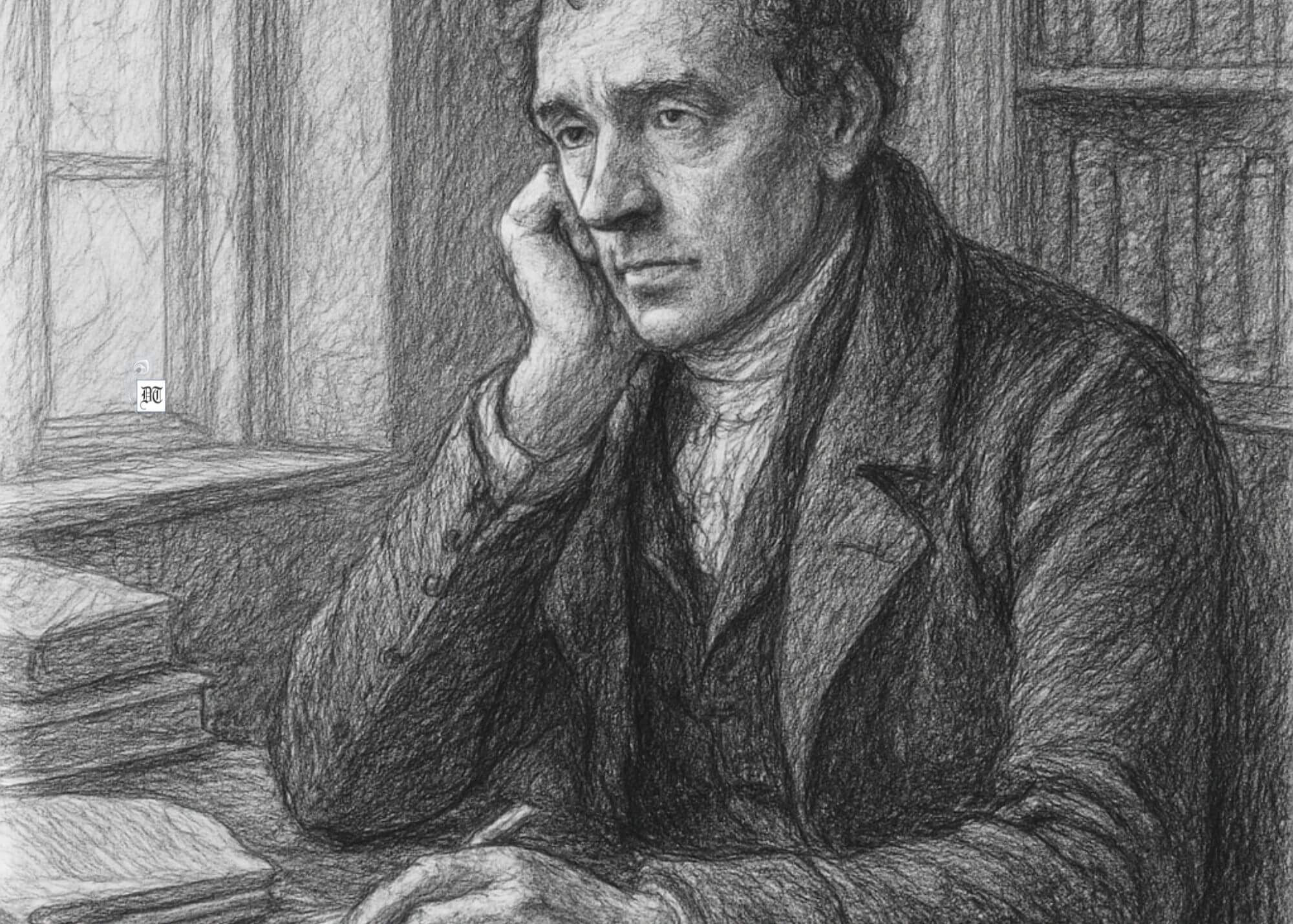
Dr Anasuya explores Charles Lamb’s art criticism on DifferentTruths.com, revealing how his personal essays redefine the boundaries of imagination.
AI Summary
- Literary Persona: Charles Lamb utilises his “Elia” persona to blend personal confession with incisive, scholarly critiques of nineteenth-century British art.
- Artistic Vision: By contrasting classical masters with contemporary painters like Turner, Lamb argues that true imagination transcends descriptive, literal representation.
- Theoretical Depth: The analysis connects Lamb’s views to Neoclassical ideals, emphasising how “wholeness of vision” remains essential to meaningful art interpretation.
This essay is premised upon one of Charles Lamb’s essays, entitled ‘Barrenness of the Imaginative Faculty in the Production of Modern Art’, first published in the Athenaeum in 1833 and later anthologised in the Last Essays of Elia (1833). The said essay not only strikes one by being ‘different’ from the usual bantering tone of Lamb’s style, but it also emerges as, perhaps, one of the earliest pieces of criticism on contemporary, that is, eighteenth- and nineteenth-century British art. The essay thus not only opens up interesting avenues of art criticism but also calls into question the very parameters and reach of the essay genre.
The essay, as is known, is a rather flexible, malleable and sometimes amorphous genre. From its first exponent in Michel de Montaigne to its present writers, the essay has meant several things, from ‘attempts’, ‘trials’, and ‘experiments’ to however an essay would want itself to be understood or translated. In the broadest category, essays would be categorised as formal and informal; among the latter, one would find the personal essay. The personal essay is not only informal but also characterised by an intimate, conversational style, in which autobiographical content is frequent. Charles Lamb (1775 – 1834) distinguished himself as a master of the personal essay and immortalised himself in his created writer-self of Elia. Lamb presents Elia as a jovial and amiable persona. Generally, the essays are full of familiar stories of the latter’s experiences and anecdotes from his life, which Elia/Lamb shares with his readers in playful and confessional banter, where humour has a reasonable place. It is now also a matter of considerable interest whether Lamb used the persona of Elia, which might be an anagram for ‘a lie’, to conceal the bitterness of his own life.
Lamb’s Tribulations
There were, namely, two remarkable aspects of his life: one, the care of his unmarried sister Mary, who was prone to frequent bouts of madness, a care which he gave most ungrudgingly, and two, the drudgery of his clerical occupation in the London branch of the East India Company office. He was temperamentally unsuited for this slavish work, which had, namely, two remarkable aspects of his life: one, the care of his unmarried sister Mary, the much-needed balm from this ennui. We are perhaps unaware of the actual tribulations that Lamb was accustomed to facing as a result of these personal crises.
Nevertheless, there are essays even within his collection that belie the bantering tone usually characterising them. The ‘Barrenness of the Imaginative Faculty in the Production of Modern Art’ is one such example. This essay, instead, offers significant criticism of the visual arts in contemporary Britain. This essay may be read in conjunction with another one, ‘On the Genius and Character of Hogarth: With Some Remarks on a Passage in the Writings of the Late Mr Barry’, which was written for the Reflector in 1811 and did not form a part of the Elia essays. The latter is an essay that particularly expounds on the works of the painter William Hogarth (1697 – 1764), now celebrated as one of the chief exponents of British art.
Lamb’s essay on Hogarth is primarily a tribute to the genius of the painter, especially with respect to the prints of The Harlot’s Progress (1733) and The Rake’s Progress (1734), collections which earned the painter popularity and renown. In the middle of the eighteenth century, when Hogarth was painting, the Royal Academy in London, the institution that taught painting and the fine arts, had already been established. Sir Joshua Reynolds, who was its first president, did not acknowledge artists who believed that painting could be indulged in without formal training. William Hogarth was among those who felt that the Academy would limit thought, imagination, and creativity from blossoming fully. Without going into the nitty-gritty of this opposition, it is, nevertheless, important to acknowledge the presence of this debate in contemporary England.
Hogarth’s Growing Popularity
Hogarth, of course, was gaining in popularity and, apart from his reputation for depicting the comic, was also gaining attention for his portrayal of satire and morality in contemporary London through his paintings and engravings. He has often been compared to Shakespeare in his ability to portray the range and variety of human characters. He was also in close friendship with Henry Fielding (1707 – 54), the contemporary British novelist, known again for his human variety and satirical portraitures. In his essay, Charles Lamb exonerates Hogarth as a supreme painter beyond the constrictions of academic works. From the paeans sung to Hogarth to those now suited for the classical painters of antiquity in the other essay, Charles Lamb only gives precedence to Hogarth’s wish to be considered on a par with the painters of antiquity.
In an interesting and revelatory statement about Charles Lamb, his friend William Hazlitt (1778 – 1830), another exponent of the personal essay, once said,
Mr Lamb has a distaste for new faces, new books, new buildings, and new customs. … He evades the present; he mocks the future. His affections revert to, and settle on, the past, but then, even this must have something personal and local in it to interest him deeply and thoroughly. (qtd in Lopate, Introduction, xxxv-xxxvi)
In the essay on the barrenness of imagination, Charles Lamb not only draws on the classical past, but he also makes it conversational or intimate, even though he speaks in the persona of Elia. On the other hand, the essay qualifies as ‘personal’ since it is an exposition of his individual viewpoints. The essay begins on a note of the contemporary, a period he describes as ‘modern’, when only the painter William Hogarth may be deemed to have an imaginative bent of mind. The writer uses the word ‘stories’, which, as the essay progresses, becomes an exploration of various myths, legends, and even instances from Christian scripture.
In the essay Lamb refers in detail to the works of some classical painters of antiquity: Titian (1488 – 1576), two of his Ferrara Bacchanals, namely Bacchus and Ariadne (1520 – 23) and Diana and Acteon (1556 – 59), find mention here; Raphael (1483 – 1520), Creation of Eve and Building of the Ark; Nicholas Poussin (1594 – 1665); Sebastiano del Piombo (1485 – 1527), The Raising of Lazarus (1517 – 19); and also Giulio Romano (1499 – 1546), the latter two being contemporaries of Raphael and both belonging to the Mannerist School of painting. Some of the paintings by these classical masters are then contrasted with those of two contemporary painters, namely JMW Turner (1775–1851), Garden of Hesperides) and John Martin (1789–1854, Belshazzar’s Feast). Lamb criticises both their works for lacking imagination, as they were overly descriptive and left little for the viewer to fill in. As he quite succinctly puts it, ‘Not all that is optically possible to be seen is to be shown in every picture.’ (Lamb, 217)
There are several things to be understood in the background of this essay. Foremost among them is the epithet ‘modern’ in the case of art as used by Charles Lamb. The word ‘definitely’ has been used in the sense of the ‘contemporary’. Art, during and in the preceding century in which Lamb writes, is of the ‘neoclassical’ kind. This brings us to the understanding of the general movements in art history, as well as neoclassical art in eighteenth- and nineteenth-century Europe. It would be worthwhile, in this instance, to mention the writings of Johann Joachim Winckelmann (1717-1768), who is generally believed to be the father of the discipline of art history.
His book History of the Art of Antiquity (1764) initiated the study of art history and archaeology as distinct disciplines. Not only that, but he is also among the pioneering scholars exploring the art of the antiquarian era and the art of the Classical, Greek, and Roman periods. Winckelmann was credited with introducing the study of antiquarian art to Europe through his work Reflections on the Painting and Sculpture of the Greeks (1765). The result was the birth of neoclassical art, which was deeply influenced by the writings of Johann Joachim Winckelmann. Art contemporary to the eighteenth century and a consequence of Winckelmann’s views on art history, as well as that created according to the high simplicity of antiquarian art, may be termed ‘Neo-classical Art’.
When Charles Lamb criticises ‘modern’ art, or art contemporary to his times, we may assume that he is talking mainly about neo-classical art, which was veering towards Romantic art and Impressionist art, with respect to painters such as John Martin and JMW Turner. In doing so, however, he is holding the mirror of classical art, which would serve as a contrast to the study of this ‘modern’ art. Hence, the comparative study of Titian, Raphael and others with their contemporaries.
Elia’s/Lamb’s opinions are personal, yet striking in their individuality. They surprise us with the writer’s knowledge of myths and legends and of how the latter finds mention and expression in art across the Renaissance, early modern, and contemporary periods. Lamb’s ‘reading’ or even ‘seeing’ of these paintings is, however, from the point of view of the literary artist and not from the perspective of a painter. ‘Reading’ a painting entails the translation/conversion of a visual symbol into a verbal one. The meaning or interpretation thus arrived at constitutes the criticism or history around that form of art. Lamb ‘reads’ into the iconography of the paintings and, therefore, is different in his appreciation of the works from that of a painter. In many ways, the essay is a series of scholarly elucidations or commentaries on several myths and legends, along with the aesthetic concept of ‘imagination’ or how the artist uses imagination to interpret or fill in various aspects of representation in a unidimensional canvas.
Lamb’s Understanding of Imagination
Lamb’s concept or even understanding of ‘imagination’ is, undoubtedly, in agreement with that of Samuel Taylor Coleridge’s (1772 – 1834) elucidation of the same in Biographia Literaria (1817), a treatise mainly on the aesthetics and nuances of poetic composition. Lamb was a contemporary and close friend of Coleridge, and there is much to suggest that he shared his ideas with his friend. To Coleridge, ‘imagination’ is the image-making faculty. It is of an ‘esemplastic’ quality, which not only shapes it into one unity but also dissolves, dissipates and diffuses familiar reality into a new whole, conducive to the poet and his understanding of reality. This faculty, as Coleridge clarifies, is the prerogative of the poet and is further classified as secondary imagination. The primary kind of imagination is, more or less, within the purview of every man.
When Lamb talks about ‘imagination’ in this essay, it is the degree of the wholeness of vision that he is concerned with. He articulates the wholeness of vision through the works of the older masters and finds it lacking in the works of the newer artists.
As a matter of example and demonstration, Lamb mentions Titian’s portrayal of the meeting between Bacchus and Ariadne on the island of Naxos. The present euphoria of Bacchus meeting Ariadne is deftly handled by the sideways glance of Ariadne towards the sea – the glance being symptomatic of her past affection for Theseus, who, although he abandoned her, still shares a place in her heart. In the swift stroke of the painter, the viewer, the interpreter, the poet and the critic ‘read’ into the gap between the past and the present. The faculty that is being exercised is, of course, the faculty of imagination.
Lamb seems to have moved little beyond England, or even London. The question then arises: how did he have access to these works of art, especially those he mentions in his essay? He might have been familiar with these artworks through their prints in journals devoted wholly to the fine arts, such as the Annals of the Fine Arts (running between 1816 and 1820), or even through the few exhibitions that were gradually taking place in contemporary Britain. Mention may be made here of the great Somerset House in the Strand, where the Royal Academy exhibitions were regularly held between 1780 and 1837. Lamb had, perhaps, meticulously studied most of the paintings in the National Gallery of London (set up in May 1824), where, in all probability, he viewed Titian’s Bacchus and Ariadne (1520-23) as well as Sebastiano del Piombo’s The Raising of Lazarus (1517-19). The former painting came to the Gallery in 1826, while the latter was from the collection of John Julius Angerstein, which passed to the Gallery upon his death in 1832.
Lamb and Keats
Lamb’s knowledge of Raphael’s ‘Creation of Eve’ includes a reference to the Vatican Museum, where it is housed, and his references to Nicholas Poussin are perhaps of a kind of popularity that the French painter enjoyed, along with Claude Lorrain (1604 – 1682), in contemporary Britain. John Keats (1795 – 1821), Lamb’s younger contemporary and poet, had a great fondness for the works of Lorrain and Poussin. Interestingly enough, the same painting of Titian that Lamb picks up for observation also finds presence in Keats’s ‘Ode to a Nightingale’ (1820) in the well-known lines ‘… not charioted by Bacchus and his pards / But on the viewless wings of poesy …’, whereby the poet wishes to travel to the world of the nightingale. Once again, it may be reiterated that ‘imagination’ as a creative force has been called upon.
Charles Lamb’s knowledge of contemporary art might have been influenced by his reading of Winckelmann’s writings, which were widely available and quite popular in England in the 1760s and 1770s. Winckelmann’s concept of great art lay in the ideals of ‘noble simplicity and quiet grandeur’; he also believed that greatness inhered in the imitation of the ancients. One cannot discount the possibility that Lamb’s fondness for classicism may be considered a derivative of Winckelmann’s ideas, which played a pivotal role in shaping the ideas of other philosophers like Lessing, Herder, Goethe, Heine, and Nietzsche, among others.
Regardless of Lamb’s slighting remarks about his contemporaries JMW Turner and John Martin, and true to William Hazlitt’s observation about Lamb’s distaste for the present and fondness for the past, one must not forget that both Turner and Martin were not only popular painters but also reserved their own rights to fame in the history of British art. Turner is known for his outstanding landscapes, while Martin has depicted the sublime in various naturalistic capacities. Both painters may be considered formative figures in British Romantic art, alongside Thomas Gainsborough (1727 – 1788) and John Constable (1776 – 1837).
Lamb and Blake
Although Lamb does not acknowledge the composite poet William Blake (1757 – 1827) as a painter, one might quite naturally cite him as an exemplary painter of the age and certainly not devoid of imagination. Turner has also been described as a forerunner of the Impressionist movement in art. Nevertheless, Lamb picks them up on a subject that was, in all likelihood, least their speciality or subject of originality, that is, classical mythology. The paintings under consideration are ‘The Garden of Hesperides’ and ‘Belshazzar’s Feast’. He employs a scale of criticism on a par with the old masters, not a contemporary one. It seems that Lamb uses the scale of antiquity as the only sacrosanct scale on which to measure art. His ideas seem to be imbued with Winckelmann’s rather than with the direction that contemporary art would take in the near future. In fact, as the record tells us, John Martin’s Belshazzar’s Feast was quite a celebrated work in the contemporary period, yet it drew the ire and sarcasm of Charles Lamb.
Towards the end of Lamb’s essay, he develops a theoretical premise, citing the example of the excavated remains of Pompeii. The exploration and excavations of the Roman cities of Herculaneum and Pompeii (in 1738 and 1748) were archaeological discoveries in which Winckelmann was again actively involved. Both his ‘Letter about the Discoveries at Herculaneum’ (1762) and his ‘Report on the Latest Discoveries at Herculaneum’ (1764) were documents from which scholars came to know about the excavations at Pompeii.
Lamb, too, draws upon this archaeological site as the supreme example of the exercise of the imaginative faculty, where one may construct a picture of the whole through the visible parts of the ruins. Reality, he feels, hardly conveys the whole picture; in other words, truth cannot be constructed from the particular or the piecemeal. To understand the wholeness of truth, history, myth or legend, one must use one’s imagination, as one should in the case of the remains of the city of Pompeii. The remains reveal their particular, objectified reality. Still, the agony, loss, fear and despair are truths which one garners through the exercise of ‘imagination’ through the examples of particular realities of the remains. It is, perhaps, this wholeness of vision that Lamb wants to see in contemporary paintings.
Charles Lamb’s essay inaugurates certain challenging aspects of viewing art, not only from the chronological point of view of art history but also by tracing the ontological trajectory of art from the classical to the contemporary, as well as anticipating the imminent future graph of art. A piece of individual insight, Lamb’s essay combines the subjective with the objective, the personal with the impersonal and certainly typifies the romantic artist’s predilection for the past.
Works Cited
Lamb, Charles. Selected Prose. Edited by Adam Phillips. Penguin Classics, 1985.
Pater, Walter. Studies in the History of the Renaissance. Edited with an Introduction and Notes by Matthew Beaumont. Oxford World’s Classics, 2010.
Lopate, Phillip. The Art of the Personal Essay: An Anthology from the Classical Era to the Present. New York: Anchor Books Doubleday, 1995.
Picture design by AI

Dr Anasuya Bhar is an Associate Professor in English and teaches at St Paul’s Cathedral Mission College, affiliated with the University of Calcutta, India. She has several national and international academic publications to her credit, as well as a book of published poems in English. Dr Bhar’s specialisation is in nineteenth-century studies of India and Britain.


 By
By
 By
By
 By
By