
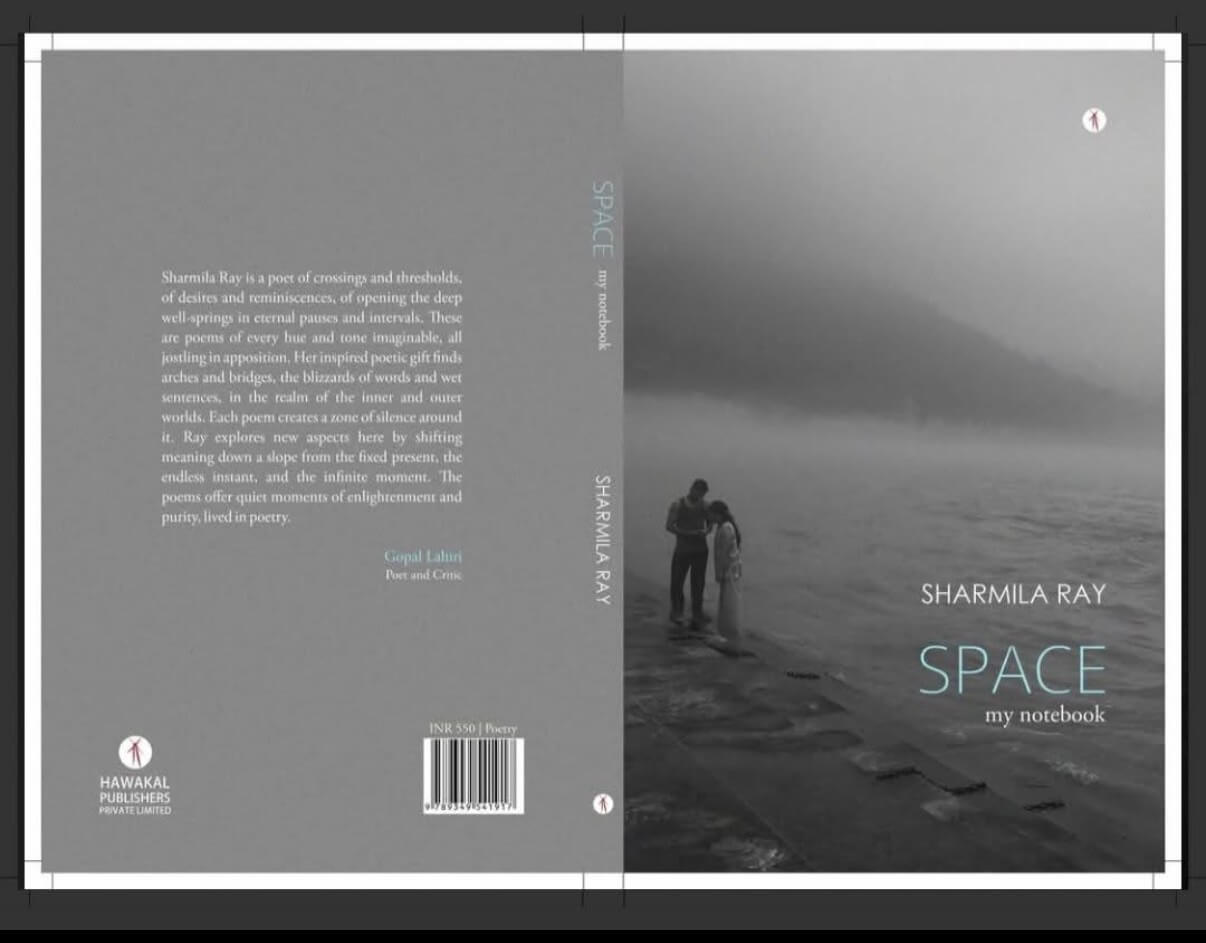
Dr Anasuya reviews Sharmila Ray’s Space – My Notebook, exclusively on DifferentTruths.com, exploring her visceral, introspective, and visual poetic journey.
Inbox
AI Summary
- Sharmila Ray’s twelfth collection, Space – My Notebook (2026), masterfully blends prose and verse, creating an intimate, introspective, and visually evocative experience for readers.
- Drawing from her background as a painter, Ray employs vibrant colour metaphors and interdisciplinary allusions that transform the mundane into profound, universal art.
- The poems reflect an inner compulsion, capturing urban life, personal memory, and historical depth with a unique, soulful, and signature literary voice.
Sharmila Ray’s twelfth book of poems, entitled Space – My Notebook (2026), was published in May 2026 by Hawakal Publishers, India. A collection of sixty-six poems, they are a medley of prose and verse, almost in the form of a chapbook, or a veritable notebook, where the poet lays her mind bare. The poems demand space, isolation, and confidence from the reader, who may fear losing herself in their powerful truths, and they invite solitary reading. The poems materialise out of a passionate compulsion, which also typifies some of her other collections, namely, With Salt and Brine (2013) and Varanasi within Varanasi (2022), which, as the poet confesses, were written at one go, as if they had to get written. This collection, too, is typified by a language that uses powerful metaphors and images, written out of an inner compulsion and passion, as if marked by a visceral touch that makes her poetry stand out among contemporary Indian poets writing in English.
Ray’s poetry is introspective and typified by a personal utterance that indicts the individual’s privacy. In Space, she takes her reader into confidence, engaging her in an intimate conversation. This is very clear in the first poem of the collection ‘The Jar’, which begins rather shockingly –
I have burnt two poems
and photographed the fire.
The first two lines bring in a riot of sensation—it is, simultaneously, a negation of the poet’s ability to self-preserve through art. On the other hand, it underscores the poet’s supreme ability to rewrite poetry in superlative imagery by virtue of its presence in print, now and here. Imminently, the poet resigns—
It was a notebook which I could only read
with quiet nerves and intense desire.
…
How could I explain that it contains letters
…
a thick river of consciousness
wafting over awareness and lilies. (13)
Her world of introspection continues in poems such as ‘Eyes’ and ‘My Eyes’. In the former, she says—
Eyes are thresholds,
to a known and unknown universe.
Some have autumn in them …
Eyes are storytellers
speaking in a language
where the alphabet ceases to exist. (40)
Sharmila Ray has, most notably and quite strikingly, a visual quality about her poems. This, as she herself says, is due to her love of painting and her own practice as a painter. The visual metaphors not only summon pictures but, through their numerous allusions to paintings, both Western and our own, create a maze of interdisciplinary texts and subtexts that enrich the tapestry of her lines. She even uses various colours as metaphors in a uniquely personal way, creating a signature style. She herself acknowledges this in her Preface to the collection—
I have a very vivid visual memory, and paintings motivate my creative process. I love to see everything in terms of colours and metaphors. … you may say your smile is deep scarlet, and my response would be that it is burnt sienna. (11)
Her subjective use of colour may remind one of Van Gogh. In ‘Calligraphy,’ for instance, we read—
Your hands stretched
burgundy night.
Your fingers entwined
platinum stars. … (16)
‘Pastries Infinite’ is a poem that amuses with not only visual metaphors and the presence of Gustave Klimt or Van Gogh but also with the sensuous riot of colours in the painter’s own palette. In the ‘You’ poems, one meets Pissarro, Van Gogh and Monet, and one finds Apollinaire in debate. One finds the easy stroll of M.F. Husain in ‘Barefoot.’
Barefoot you walk
softly among tall grasses –
…        among
muted shades and diffused light.

The city sleeps.  (33)
Ray’s lines might appear as an enigma to a new reader, but with time the reader feels compelled to build familiarity with them and gets to penetrate her thought processes. In Space, Ray alternates between verse and poetic prose, a feat she has rarely achieved in her previous collections. Ray is also a non-fiction essayist known for subjective, autobiographical, and memorial prose found on her blog and other websites, but not yet in print. We feel thankful to Ray for including her prose poems here. She, quite succinctly, describes her choice of verse and prose in her Preface to this collection,
Poetry can be in free verse, in meter, or as a prose poem; it depends on the theme and my state of mind at that time. (10)
Some of the pieces in this collection also offer formative insights into her thoughts and often hint at the intricacies of her craft. For instance, in ‘A Horse Idea, a Zebra Idea, or …’ she ends conclusively, when she says,
I move upwards through my thought pattern, sprawled like a net across my being, slowly transforming into sunlight spirals, leaving behind the air grafted with a ballad. (18)
Sometimes, it is a sustained flow of thoughts that ease out through the stretch of both verse and prose, as can be seen in the three poems on ‘Home’ (1, 2 and 3). What dictates form, it seems, is the sentiment, as these lines from ‘Home 3’ would suggest –
Home is inside and all around us. The moment you enter the threshold, it dissolves the metal in your soul, and like a prophet, you turn water into wine, burden into lightness. (44)
Prose ratifies poetry as a final stop, just as home becomes the ultimate refuge. At other times, it is a prosaic poem, with sentence-like lines with poetic thought—one sees this in ‘I’ve forgotten how to write a Love poem’—there is doubt and incoherence, which perhaps bear it out best in the searching utterances—
I’ve forgotten how to write a love Poem. …
It belonged to Lorca and Jibanananda and came down to me
ridding the slopes of dawn. … (47)
Yet in others, like ‘Past Tense,’ we have the happy co-existence of both prose and verse, where one gets the feeling of peeping through a private epistle—
I just can’t concentrate, so I decided to write to you. …

And did you think of me
now that the air is sharp
the sky indigo
and the earth pale with frost? (45)
Here is the utterance of the confused lover, undecided in her choice of language, rhyme, and meter; and therefore, there is both prose and verse.
The repertoire of Ray’s poetry in this collection is extensive and varied—from personal memory to urban sites, even historical locations (for instance, ‘Jallianwala Bagh’), and to the experiences during the trying times of the Covid pandemic (‘The Dry Shadows of March 2019’). In Ray’s poetry, the many city faces of Calcutta, the Bengal landscapes, Tagore, and Jibanananda coexist laterally. Nevertheless, her poems never suffer from the limitations of the local. There are as many other Indian cities and phenomena as there are mentions of the international. Hence, in many ways, the local transcends into the national and the national into the universal. What remains is poetry, irrespective of its expression in a specific language or about a specific region or country.
In almost all poems, the tone is introspective, self-questioning, and assuredly replete with the doubts and banalities of urban existence, as the sentiments from ‘Mundane Little Things’ bear it out—

… Plants in tiny earthen pots on the verandah, patina-covered furniture, clothes piled up, waiting to be pressed, and the sound of pots and pans from the kitchen—all have a sense of belonging. (38)
Here, for instance, one also finds the homely woman who builds a niche around her everyday routine—the potted plants, the kitchen sounds, the flavours wafting, and the banal transforming into beauty.
One would rather not stop in this endless, dreamy sojourn with the poet. Yet the end must come. The last poem, ‘Why do I write?’, quite succinctly and roundly answers her query as to why she writes—’I ‘write because / it is the only place I can return to undisturbed’ (82). Writing provides Ray with ultimate shelter, and readers like us would want to carry her poetry with us, sharing book spaces, bag spaces, and mind spaces.
Cover photo sourced by the reviewer

Dr Anasuya Bhar is an Associate Professor in English and teaches at St Paul’s Cathedral Mission College, affiliated with the University of Calcutta, India. She has several national and international academic publications to her credit, as well as a book of published poems in English. Dr Bhar’s specialisation is in nineteenth-century studies of India and Britain.

 By
By
 By
By
 By
By
 By
By