
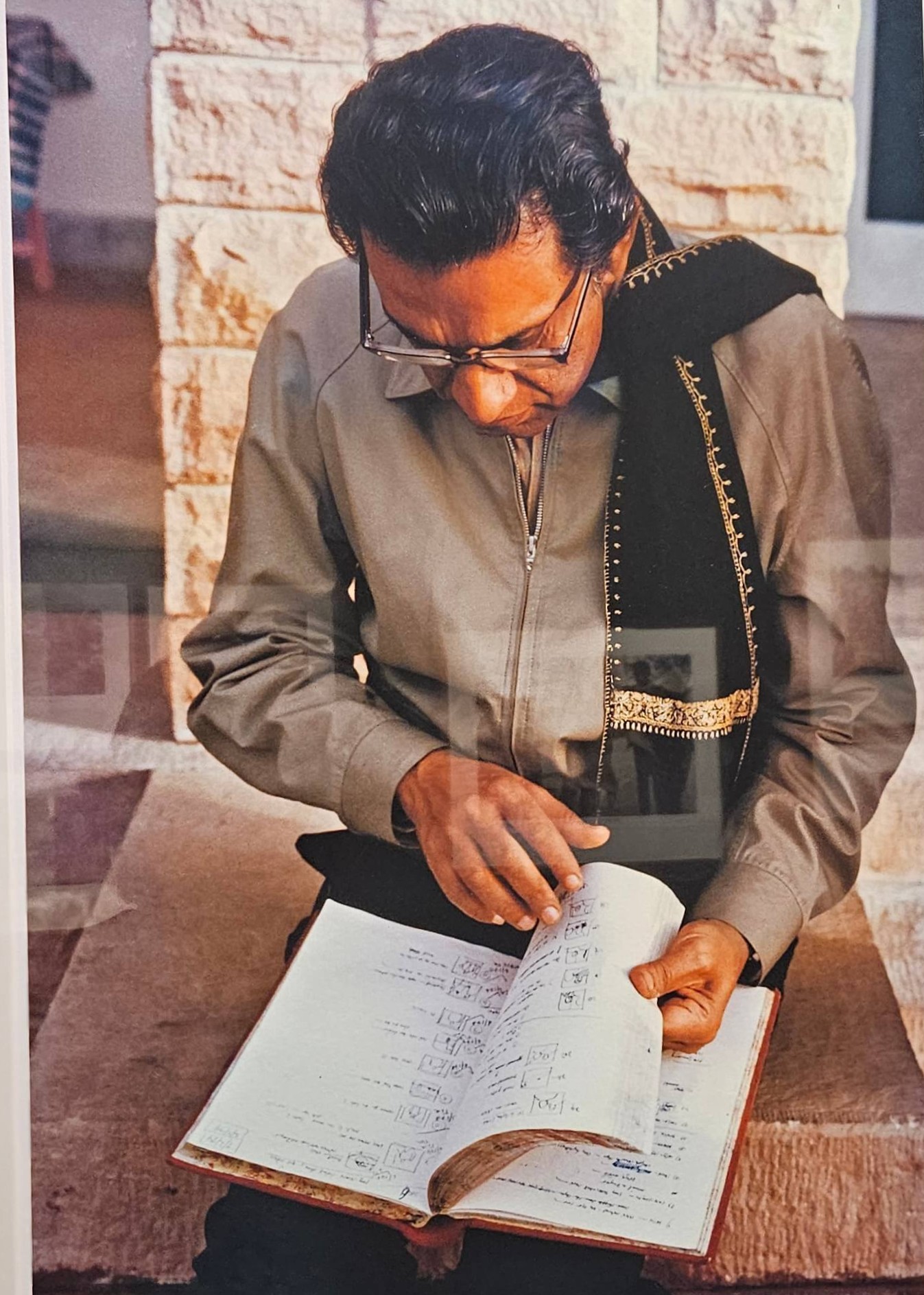
Explore Satyajit Ray’s creative universe through Nemai Ghosh’s rare photographs, reports Aseem for DifferentTruths.com. A must-see exhibition in New Delhi.
AI Summary
- Rare Visual Archives: The DAG exhibition features rare colour photographs by Nemai Ghosh, capturing intimate family moments and Satyajit Ray’s creative process.
- Cinematic Masterpieces Revisited: The display highlights Ray’s diverse genius, spanning political histories, caste critiques, and poetic documentaries like The Inner Eye.
- Inspiration for Gen Z: The archives showcase the intense discipline, sketching, and deep research behind timeless, high-impact artistic excellence.
Recently, I visited DAG in New Delhi with my student Sahiba, who is learning filmmaking through Aseem Asha’s Community Media Initiative Platform. What began as a gallery visit gradually transformed into a journey through the creative, personal, and intellectual universe of one of cinema’s greatest masters, Satyajit Ray.
Through the Lens of Nemai Ghosh
The ongoing exhibition, Faces and Facets: Satyajit Ray in Colour, presents a remarkable collection of rare colour photographs taken over nearly twenty-five years by Ray’s friend and visual chronicler, photographer Nemai Ghosh, often described as Ray’s “photo-biographer.” The exhibition not only documents a filmmaker but also captures an entire ecosystem of creativity—Ray at work, at home, in conversation, in contemplation, and among his family. Photographs of his wife, Bijoya Ray; son, Sandip Ray; daughter-in-law, and grandson offer intimate glimpses of the human being behind the legendary artist.
The quality of the photography is extraordinary. Nemai Ghosh’s images go beyond documentation. They possess the patience of observation and the sensitivity of portraiture. Ray appears immersed in writing, sketching, composing music, directing actors, studying frames, or simply reflecting. Colour adds warmth and immediacy, allowing viewers to experience the textures of his world in a way black-and-white images often cannot. These photographs are simultaneously historical records and works of art.
Revisiting the Films
Particularly fascinating were the photographs and contact sheets connected with some of Ray’s most significant works. Images from Shatranj Ke Khiladi (1977), set against the backdrop of the British annexation of Awadh, reminded viewers of Ray’s remarkable ability to combine political history with human irony. Photographs from Sadgati (1981), based on Munshi Premchand’s story, revealed Ray’s uncompromising critique of caste oppression and social injustice. The images from Ghare Baire (1984), adapted from Rabindranath Tagore’s novel, reflected themes of nationalism, gender, and personal freedom.
The exhibition also featured references to Ray’s later masterpieces. Ganashatru (1989), inspired by Ibsen’s An Enemy of the People, examined the conflict between scientific truth and social prejudice. Shakha Prashakha (1990) explored corruption, morality, and fractured family relationships in modern India. Agantuk (1991), Ray’s final feature film, remains a profound meditation on civilisation, identity, and what it means to be truly educated. Many cinephiles continue to regard Agantuk as one of Ray’s most philosophical works.
As a lover of Ray’s cinema, I was delighted to encounter material related to Sonar Kella (1974), the beloved Feluda adventure set in Rajasthan, where memory, mystery, childhood imagination, and detective fiction come together with breathtaking cinematic elegance. The exhibition reminded me how effortlessly Ray moved between realism, adventure, satire, documentary, and philosophical inquiry.
Equally moving were references to Ray’s documentaries. The Inner Eye (1972) is a sensitive portrait of the blind artist Benode Behari Mukherjee and stands as one of the finest films ever made on artistic resilience and perception. Bala’s (1976) documentary on the celebrated Bharatanatyam dancer Balasaraswati captures the relationship between tradition, performance, and artistic devotion. There were also photographs recalling Sikkim (1971), Ray’s visually stunning documentary portrait of the Himalayan kingdom before its merger with India. The Inner Eye remains a landmark example of Ray’s ability to transform documentary filmmaking into poetic reflection.
One particularly memorable discovery was a photograph connected to the documentary on Satyajit Ray made by filmmaker Shyam Benegal. It served as a reminder of how deeply Ray influenced generations of filmmakers who followed him. The exhibition thus becomes not only a portrait of Ray but also a record of his continuing legacy.
Curation, Context, and Ambience
The curatorial quality of the exhibition deserves special appreciation. Every photograph, sketch, contact sheet, and written document is accompanied by detailed contextual information. The exhibition never assumes prior knowledge. Instead, it gently guides viewers through Ray’s creative process, making even complex cinematic histories accessible to newcomers while rewarding those already familiar with his work.
The ambience of DAG contributes significantly to the experience. The beautifully maintained galleries, quiet atmosphere, thoughtful lighting, and cool halls encourage slow looking and reflection. One does not merely walk through the exhibition; one inhabits it.
Why It Matters Today
What struck me most was how relevant such an exhibition is for Generation Z. In an age dominated by scrolling, instant content, and shrinking attention spans, these archives reveal the labour behind artistic excellence. They show young filmmakers that great cinema emerges from observation, research, patience, sketching, rewriting, collaboration, and a lifelong commitment to learning. Ray’s notebooks, drawings, photographs, and contact sheets demonstrate that creativity is not sudden inspiration but a disciplined practice.
After spending nearly two hours inside the exhibition, Sahiba and I realised that we had only scratched the surface. The experience left us inspired, humbled, and eager to revisit Ray’s films with fresh eyes.
The exhibition continues at DAG, New Delhi, until 4 July. For students of cinema, photography, visual culture, and storytelling, as well as anyone interested in the creative process, it is an unmissable experience. To walk through these galleries is to enter the living world of Satyajit Ray—not as a distant legend, but as a working artist whose questions, ideas, and humanity continue to speak to us today.
Photograph sourced by author

Aseem Asha Usman is a Delhi-based independent arts writer and cultural observer who writes on classical dance, theatre, music and interdisciplinary performance practices. His writings explore the emotional, literary and socio-cultural dimensions of performing arts in contemporary India.

 By
By
 By
By
 By
By