
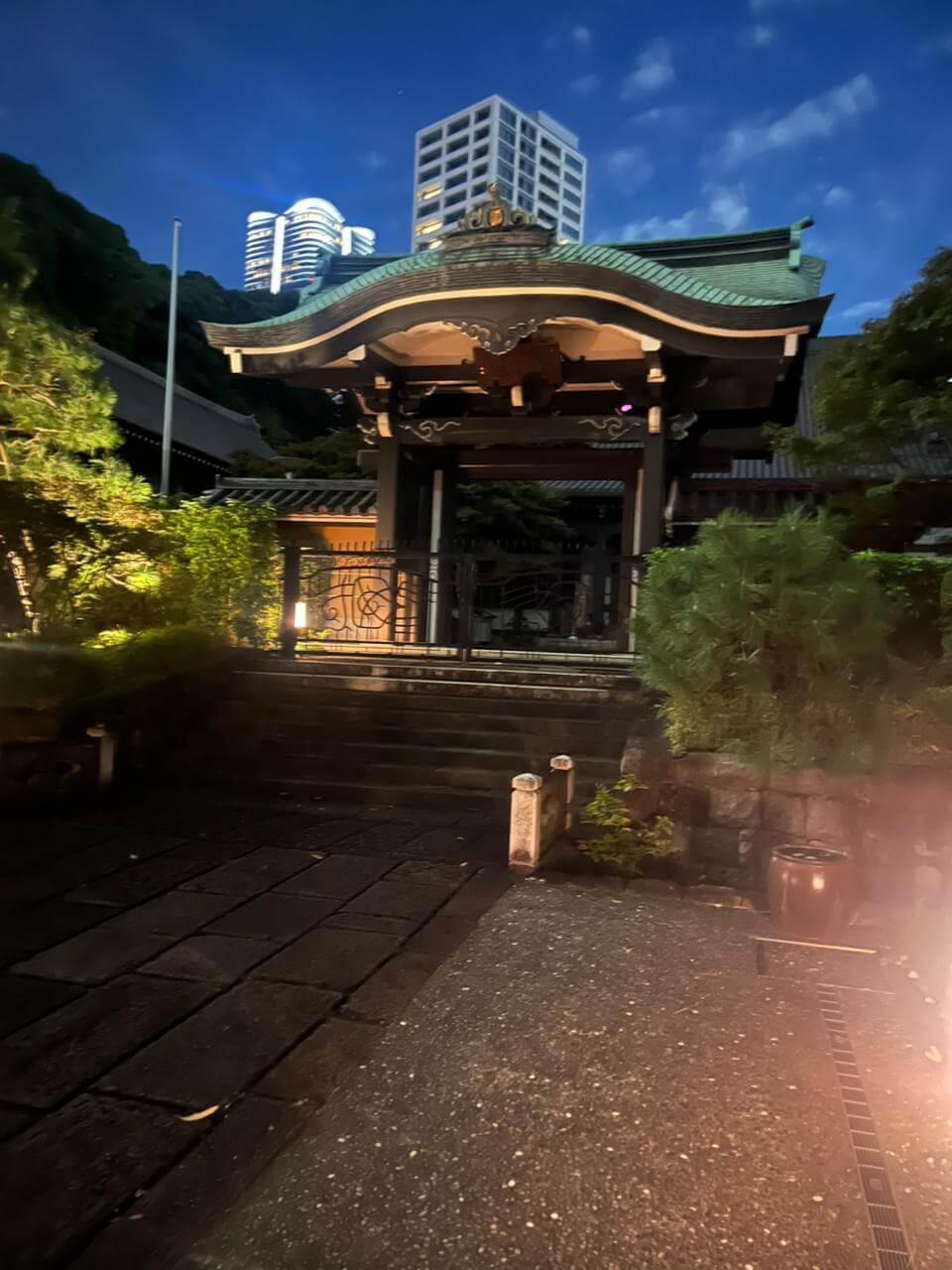

Dr Paramita savours a delicate Tokyo kaiseki dinner — memories and insights shared on DifferentTruths.com.
AI Summary:
- Family’s final Japan evening in Tokyo: Escorted to a preserved traditional wooden restaurant, removed shoes, and entered a heated tatami-style room with garden views.
- Multi-course kaiseki meal: Exquisitely plated vegetarian dishes, plum wine toast, delicate seasonal garnishes, and attentive kimono-clad servers creating a sensory feast.
- Memorable cultural close: A lantern-lit garden, a 15th-century pagoda, and the Tokyo Tower backdrop – a lasting, intimate travel memory.
It was the last day of our family vacation in Japan. We had been to three main cities of Japan – Osaka, Kyoto and Tokyo. We were to fly back to India from Tokyo. A Japanese friend of my husband took us to a traditional Japanese dinner in Tokyo. He drove us down to this traditional wooden house where we had to take off our shoes outside the main door and get in. In reality, it was a restaurant that preserved traditional culture. We were taken to a room by a beautiful kimono-clad Japanese lady, and the sliding wooden doors were opened to let us in.
I looked with thrill in my heart at a typical Japanese room, just like I had read in books and seen in movies. A large table was at the centre, which was not much above the ground, and there were no chairs around. I remembered that at a traditional dinner in Japan, we had to sit on the floor or on a low table. But now they have modernised the system, and we could slip in and sit with our feet down as they have kept space to dangle our feet beneath the table. The floor was heated, so it was warm and cosy.
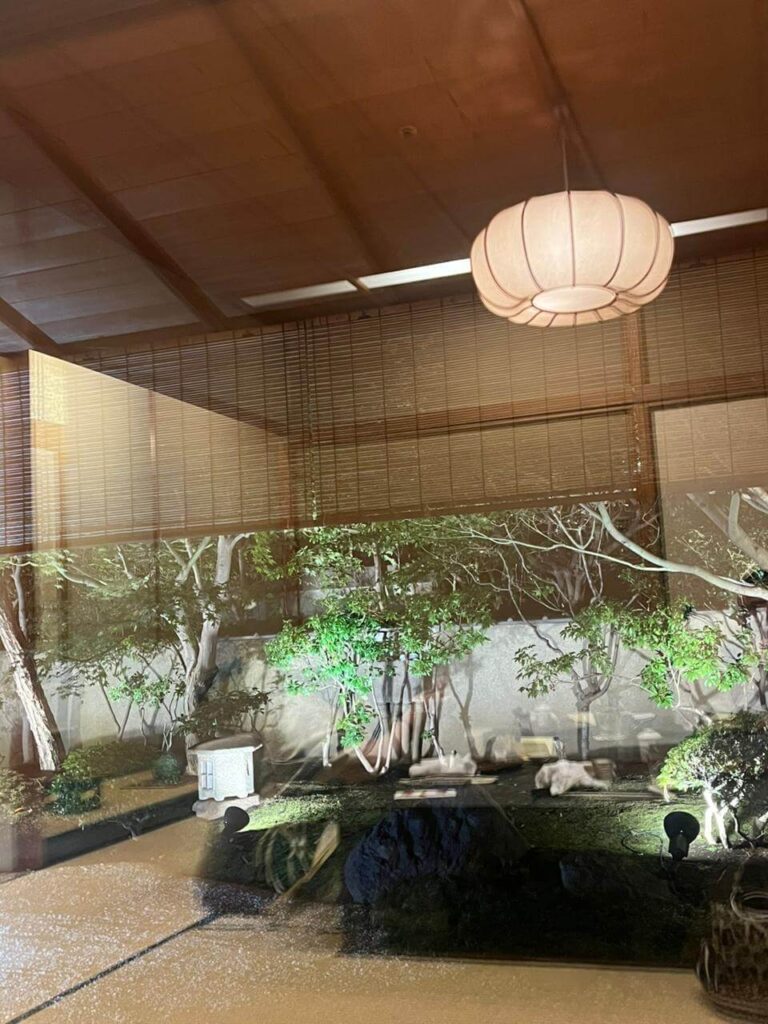
The floor around the table was covered by bamboo mats. On the left, there was a long glass window overlooking a fairy tale garden with beautiful green bushes and bonsai1. The garden was lighted up in a soothing, soft light. The room was decorated with birds done with paper origami2, and there was a painting of a bamboo bush with vertical Japanese writing beside it… This, too, was framed in a bamboo mat. One of the wooden walls had an in-built sealed window where light could come in. There was a bonsai on a tiny wooden table near the painting. I was soaking in the beauty of the room with my family when the sliding door glided, and two beautiful kimono-clad ladies came in with food trays in their hands.
There was a warm napkin already kept in front of each one of us to freshen ourselves and clean our hands. The ladies put a round wooden plate in front of each one of us. On the right side of the plate was a small glass of umesh, which is plum wine; a quadrangular glass plate at the upper centre had rice, pumpkin, sesame and edamame beans all in small round balls, and on the left was a cylindrical bamboo container with jelly. Every food was decorated so delicately that it was a feast for our eyes. We started with the plum wine and said ‘Kempai’, which is ‘cheers’ in Japanese.
Chopsticks were given in a paper wrapper, and the menu, in a soft yellow paper, was also so delicate and soothing to look at. Once we finished, the ladies came in and took away the round wooden plate, and the next course was served. A bowl with a small boiled turnip in soupy gravy with leek leaves and lemon rinds. Then came a medium bowl of soba noodles, and on the side, there was an onion-mustard paste and seaweed. We slurped up the noodles with the chopsticks and mixed the condiments for taste.
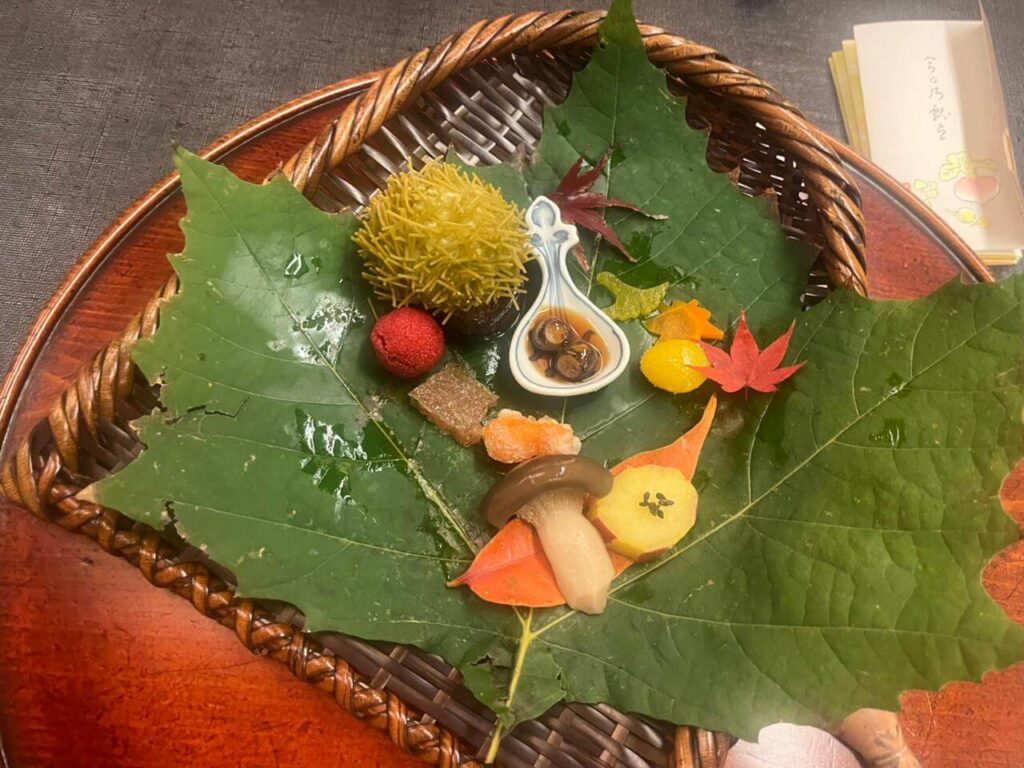
Oh, the next was so delightful! There was a flattened bamboo container, and the food was on a maple leaf…the maple leaf added grace and beauty. The food included chestnuts covered and decorated by potato paste and dry noodles, and there was ginkgo3, a big slice of mushroom, berries, yams, jellied potato and tempura carrot. What a colourful sight! All my senses were thrilled with this course. A few tiny red autumn leaves made the dish more enticing.
We need to learn from the Japanese how simple things can be made extraordinary by decoration. Then came an elongated wooden plate. On it was kept tempura of spinach, root and ginger. How beautifully a rice grain stalk with grains of rice and some popped ones was balanced on the rest. There was a slice of lemon on the right-hand side. Then came eggplant, miso pastes and mushrooms in a quadrangular porcelain bowl. The lady waiters then served soup in a round, elongated porcelain bowl with seaweed and ginger.
For the next dish, the round wooden base plate was taken away, and a woven plate was put in its place. A bowl of rice and mushroom porridge in a big porcelain bowl was placed on the woven plate, and a tiny porcelain plate with onion paste and wasabi was paired with it. Roasted green tea was in a bowl along with it.
Although my husband and daughter are experts in eating with chopsticks, I am not very comfortable, so they gave me a chunky wooden spoon and fork and a soup spoon too.
We were quite full not only gastronomically but also satisfied with our olfactory and visual senses, and the girl announced that the last dish, the dessert, was on its way. A florally designed round porcelain bowl with pouched Japanese persimmon fruit was brought in. The slightly sweetened persimmon was a happiness factor, as it did not overshadow the taste of the rest of the food but added a lingering sweetness to our taste buds. After having different non-vegetarian cuisines from Japan for the whole of the vacation, we were quite happy to experience a totally vegetarian dinner.
We were all so satiated and happy. We went out through the main door, put on our shoes and were taken to the dimly lit garden on the other side. A man with a traditional lantern showed us the way. We saw the colourfully lit-up Tokyo Tower behind us and took some lovely family photographs there. In a dimly lit backyard was a small pagoda, which was built in 1476. Then we got into the car to go to our hotel.
The memory of this delicate and beautiful Japanese traditional dinner will stay with us for a long time.
__
1bonsai: miniature trees
2origami: art of folding paper
3ginkgo o: a type of plant
Photos by the author

Dr. Paramita Mukherjee Mullick is a scientist, a globally loved, award-winning poet, editor and a literary curator. She has published 11 books and her poems have been translated into 41 world and Indian languages. Paramita promotes peace, multilingual, global and indigenous poetry. Her writings also make people aware about conservation and climate change. Apart from numerous awards from Indian organisations she has received the Gold Rose from Buenos Aires (MS Productions) and the Panorama Literature award in 2022 from Greece. She heads two forums in Mumbai.



 By
By
 By
By
 By
By
Vivid and engaging write!