
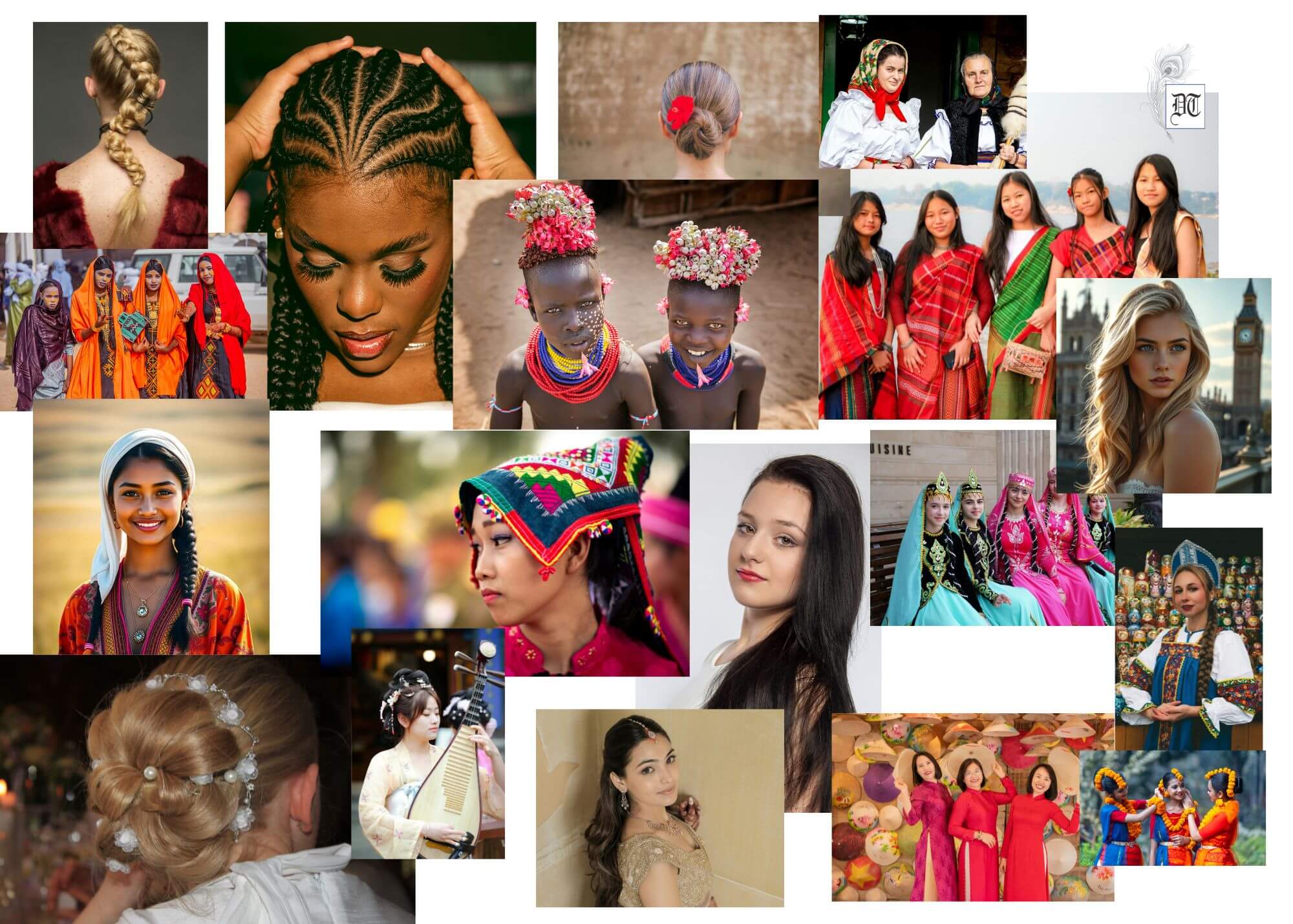

Ruchira explores the cultural tapestry of hair on DifferentTruths.com, examining how this “crowning glory” shapes global identity and spiritual devotion.
AI Summary
· Cultural Identity: Hair transcends biology, serving as a powerful symbol of gender, age, and social status across diverse civilisations.
· Global Diversity: Textures and styles vary by geography, from European auburn tones to the iconic raven tresses of Asian cultures.
· Spiritual Significance: Major religions—including Sikhism, Hinduism, and Christianity—attribute profound meanings of modesty, strength, and rebirth to human hair.
The other day, while I sat in my rocking chair on the balcony reading, a sudden breeze blew my hair into my face. As I tucked a stray wisp of hair behind my ear, I had a quirky thought: How would human lives be without this “crowning glory”? How would we go about flaunting hairless, bald scalps?
Hair is not merely a biological feature; it plays a crucial role in human identity. It serves as a personal and social symbol, expressing individuality and the entire gamut of emotions. A hairstyle can convey information regarding gender, age, and social status.
The texture and colour of hair are greatly influenced by climate, geographical location, and human habitation. For example, golden or blonde hair is often associated with people from Scandinavia and Northern Europe. Brunette, prevalent in Europe, may also be seen in West Asia, North Africa, and the Americas. Auburn hair is common among individuals of Northern and Western European descent, particularly in Britain and Ireland.
The bulk of the Asian race is characterised by long, raven (read dark) tresses, both long and voluminous.
As centuries went by, civilisations and kingdoms rose and fell, but hair remained a vital element of daily life and lifestyle. It served as a giant canvas on which aesthetically inclined and beauty-conscious individuals poured out their imagination, fantasies, and ideas on beauty. It’s mind-boggling to observe the evolution of braids, plaits, ponytails, buns, and cuts, which seem to number in the innumerable, like stars in the sky. With every passing day, the list grows bigger.
In most civilisations and societies, men generally sported short hair. Royals, noble warriors, and priests varied the lengths of their hair to denote power and status.
In Oriental societies like China and Japan, men traditionally wore plaits, while the sumo wrestlers sported distinctive topknots.
Various African and indigenous cultures worldwide have significantly contributed to hair fashion, creating delightful styles that incorporate tiny braids interwoven with colourful beads and pins.
In the subcontinent, traditional hairstyles for women were largely confined to plaits. Schoolgirls (read teenagers) typically wore a pair of sleek, symmetrical plaits, while females attending high school or college opted for a single one. After marriage, hairstyles got transformed; the ‘bun’, symbolising sobriety and maturity, became the order of the day. However, braids remained in vogue, subject to the pleasure (or displeasure) of venerable in-laws.
On the other hand, throughout the centuries, men had limited options. Some wore shoulder-length hair; others sported a central parting, while scholars and priests often had bald pates with a tuft of knotted hair (known as shikha). With the influx of external and colonial influences, these hairstyles were replaced with sleek, well-groomed cuts featuring side partings; some opted for a simple ‘brushed-back’ style.
During the 1960s and 1970s, Bollywood played a significant role in popularising women’s hairstyles, with some buns resembling birds’ nests or (in a more imaginative sense) even pressure cookers.
Worldwide, legends, myths, scriptures, and folklore are filled with tales linked to the symbolism of hair. In Christianity, hair signifies spirituality and social virtue. In the New Testament, Paul’s first letter to the Corinthians describes a woman’s long hair as her “glory”.
Samson, a Biblical hero, possessed immense strength bestowed upon him by God to fight his enemies, and his power lay in his uncut hair. However, his relationship with Delilah led to his betrayal and downfall, resulting in his hair being chopped. Later, Samson regained his strength miraculously, and – in a final act of vengeance – he brought down the pillars of a temple, killing himself and thousands of Philistines in the process.
In many Christian traditions, women wear long hair as a mark of piety and unwavering faith. Hair also symbolises repentance and humility, as illustrated by Mary Magdalene washing Jesus’ feet with her cascading hair.
The “Amish” community (a Christian sect) primarily residing in Pennsylvania, Ohio, and Indiana believes in simple living, plain dressing, and, importantly, wearing unshorn hair.
In Islam, hair is associated with cleanliness, dignity, and personal grooming. Women are generally required to cover their hair, particularly in public, as an expression of modesty and religious devotion.
In Orthodox Judaism, hair, especially for women, is linked to modesty and spiritual duty. Married women habitually cover their hair in public with scarves, hats, or wigs, signifying privacy and commitment.
In Sikhism, wearing uncut hair (Kesh)—applying to both genders—is an important practice that reflects respect for God’s creation and acceptance of natural life. Sikhs believe that the human body is sacred, and altering it goes against the laws of nature and God’s will. Kesh symbolises devotion and submission to God’s will (Hukkam) and serves as a bastion of faith and identity, helping individuals stay connected to the teachings of the Gurus. Maintaining Kesh promotes a sense of equality among the masses.
In Hindu sacred texts, we read and hear of rishis, munis, and yogis (hermits, ascetics, and sages), who are portrayed with jata (matted hair or dreadlocks). Even otherwise, hair is associated with many important rites of passage. A newborn baby’s hair is typically shaved (aka mundan) between the ages of 1.5 and three years old.
Orthodox Brahmins perform the Upanayana, or sacred thread ceremony, for their teenage sons, usually between the ages of nine and sixteen. During this ceremony, boys undergo tonsuring as a symbol of rebirth.
Orthodox devotees of both genders often shave their heads, offering their hair as a token of gratitude to the deities at famous shrines, such as Tirupati in Andhra Pradesh, India. This practice might take place upon the fulfilment of a long-held desire or otherwise.
However, there are some disturbing rituals historically associated with hair. In the past, newly widowed wives were compelled to chop off their luxuriant hair as a mark of mourning and grief. Thereafter, they had to wear tonsured heads or maintain closely cropped hair for the rest of their lives.
Fortunately, such harsh practices have now become obsolete, thanks to societal progress.
Picture design by Anumita Roy

Ruchira Adhikari Ghosh brings a liberal, wide-ranging outlook shaped by extensive travel across India and abroad. Educated at Holy Child School, New Delhi, Sacred Heart Convent, Ludhiana, and Panjab University, Chandigarh, she holds a Master’s in English Literature and a postgraduate diploma in Journalism and Mass Communication. With three decades in media, she writes on travel, books, music, performing arts, women’s issues, and especially food, drawing inspiration from rich life experiences. She is our Features Editor.

 By
By
 By
By
 By
By
 By
By