
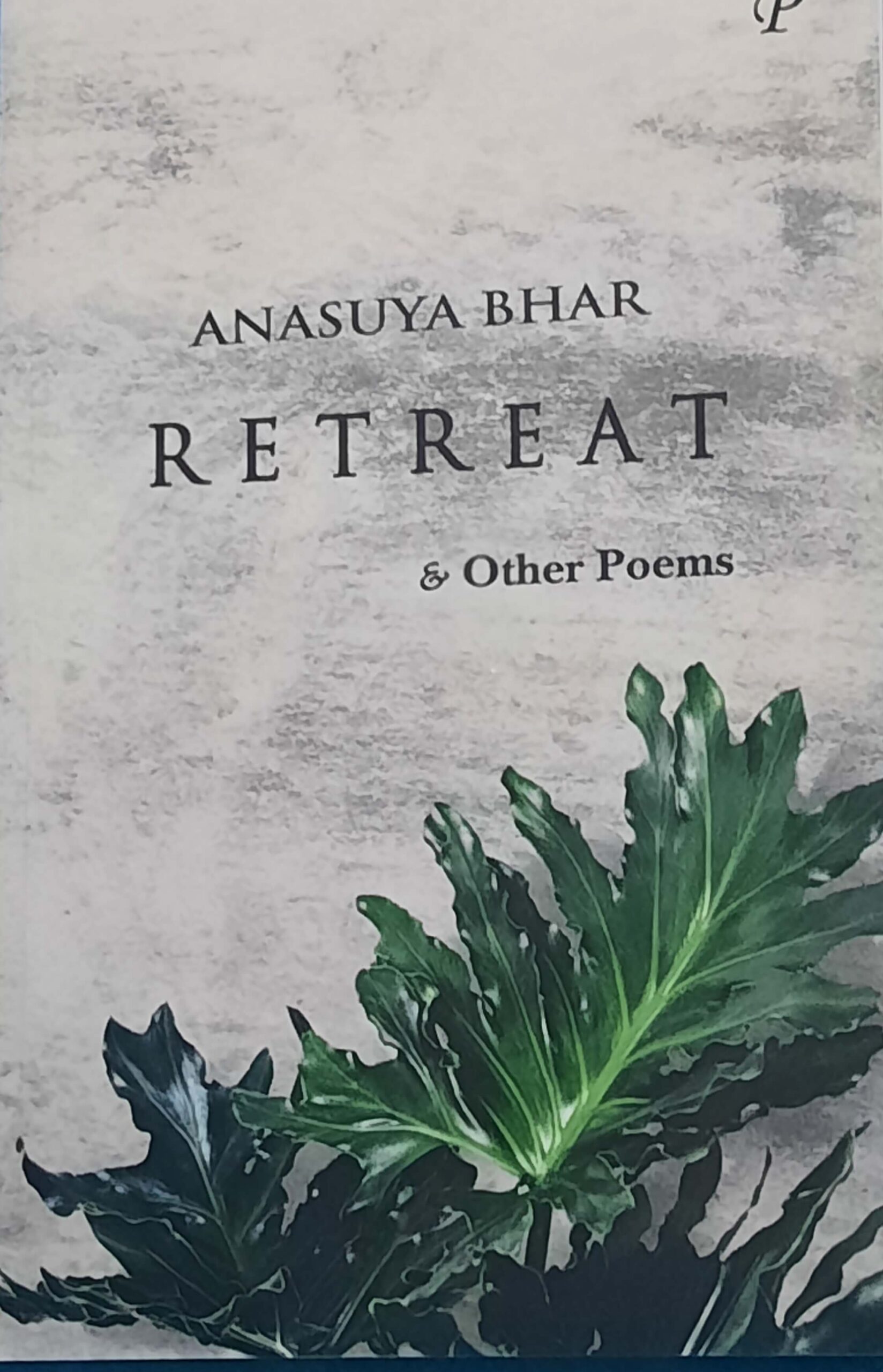
Dr Ajanta pens a profound review of Anasuya Bhar’s poetry, exploring themes of silence and soul in DifferentTruths.com.

AI Summary
- Meditative Philosophy: The collection transitions from a soulful cry for “new poetry” to a stoic acceptance of life’s “absences”.
- The Outsider’s Journey: Poems like “Periphery” explore modernist alienation, finding peace within the “utter quietness” of the social margins.
- Spiritual Awakening: Bhar employs nature and “exfoliation” of the self to reach a core of truth and enlightened consciousness.
Dr Anasuya Bhar’s Retreat & Other Poems, published by Penprints Publication in 2023, is like a stream, calm and unhurried, deep with secrets, and a gurgling lifeline of history, breaking occasionally into the ripples of an unassuming wisdom.
The first poem, “Resolution”, is a call, not strident with simmering slogans, but a soulful cry for change where the emotion dictates the form.
     Break the old boundaries.
     The fences of the mind,
     Create new pathways
     Out of new thoughts
    And give voice to new poetry.
So, from the very beginning, the poet is concerned with the creation of a “new poetry” that will free man from his old habit of servitude and set new directions to follow.
In the poem “Confidences”, she reflects:
It is always the going,
The quest that matters,
Investing romantically, the journey or “quest” has greater significance than the arrival at the destination itself.
And the journey is not in vain, as we learn in the poem “Routine”:
We return with stories all

       Of loss and care
       Stowed in our bags
       To travel anew on tracks
       Of routine familiar.
In other words, contemplative excursions provide one with the insightful experience required to ply the regular routes of life.
Alienation, with its modernist moorings, is a very personal experience here. In the poem “Periphery”, for instance, the speaker rues:
To be always left
As an outsider,
Even beyond the utmost periphery
Is common to my lot –
The voice is matter-of-fact, but the pain is deep. This theme is repeated in the poem “Codes”, where the speaker maintains that people have to subscribe to certain patterns of behaviour to be able to belong to the inner circle, which renders them peripheral:
The presence of the other
Called the outsider
Who seems to intrude
Into your closed circles
Of intimacy or conspiracy.
The eternal interloper, the speaker is consigned to haunting the edges of relationships and the borders of social interaction. Yet, she is not unhappy in this state of being, as she quite readily acknowledges in the poem “Musings on an Afternoon”:
I am content here,
In this little space
Of semi-darkness and
Of utter quietness.
In the poem “Absence”, the speaker characteristically confesses:
I have learnt
To live with these absences
To accept all the vacuity
That fills up my life.
It is this capacity for resignation and contentment on the part of the speakers which reflects the positive philosophy of the poet and the steady, stoical spirit that pervades the collection.
This spirit of acceptance, crucial to the meditative temper of the book, is, I feel, the first step towards an apprehension of the infinite. In “Hands-free”, the speaker wonders if categorisation and labelling could be replaced by what she calls “ebb and flow” and “continuum”, where all differences are obliterated by an ontological onrush of
…moving
From one moment to another…
From the present to the everlasting?
The quest for truth is an arduous search in all poetry. In Retreat & Other Poems, the poet seeks it in nature, both the physical variety and the inner reality. She seeks it in words, only to be disappointed. In “Emptiness”, she comes close to it:
Somewhere
The truth hammered in
Through the fog of memory.
In the poem “Exfoliation”, where the speaker explains about exfoliating oneself and reaching a core, she achieves a spiritual purification that is, perhaps, the goal of all poetry. She says:
All those that the layers concealed,
All those that one would hide
Are now real, true.
And the one only,
Stands stark, lonely.
These lines bear echoes of Dante’s “multifoliate rose” from the final cantos of Paradiso in The Divine Comedy, representing heaven as a celestial, multi-petalled rose.
All these intimations of the supernal gather into a crescendo of spiritual awareness in the poem “The Awakening”, where the Romantic symbol of the flute “enchants”, beckoning
from
beyond the veil of centuries
To reverberate deep
Into the clearing of understanding
Or, the enlightened consciousness,
Of self, life, and continuity
The present, the past and evermore.
This is poetry where quietude quickens and immersion in the infinite, no matter how momentary, speaks to the soul.
There are moments in the book when the poet describes the birth of her art. In the poem “Pollination”, for instance, she speaks about the creative cross-fertilisation that takes place in the poet’s mind:
My mind rests from moving thought
To thought in the happy resignation
Of paper to pen.
Such felicity of creation is again encountered in the poem ‘Confusions” where, through chaotic energies, is wrought “the symmetries of a poem”.
Anasuya’s poems, for the most part, are ruminative in tone, serene in temper and uplifting in mood. Echoes of William Wordsworth, Robert Frost and Philip Larkin cling to the underside of experiences in poignant evocations of memory and meaning. In the title poem “Retreat”, for instance, when the speaker says,
I wish I could just retreat into
A deep sleep, or forgetfulness
It is essentially reminiscent of the languor of Frost’s “After Apple-Picking”, when hard work in the New England orchards induces a lethargy that craves sleep.
The broader, contemplative passages in some of the poems, such as “Imminently, then”, “Retreat” and “Pollination”, have the tonal quality of Wordsworth’s rhythmic utterances, while those dealing with everyday occurrences, such as “The Possible”, “Landscapes” and “Routine”, recall Larkin’s quiet celebration of the quotidian.
The book turns on a fulcrum of faith that imparts an emotional balance to the pieces aligned to an overarching vision of the vagaries of life. The poet says in the Preface that she offers “many moments, many moods, and occurrences” which “may or may not be real” … “like whiffs of fragrances, half-glances, or explorations of colours and tones.” It is this variety of subjects, subtle in sequence and teasing in its essence, which invests the collection with its indubitable charm.
This elegantly produced, slim volume with an eloquent cover design speaks to me in several tones and registers, warbles tranquil melodies, and rejoices in the smell of the earth, all the while regaling my senses with its vivid and varied imagery.
Book cover photo sourced by the reviewer.

Dr Ajanta Paul is a poet, short story writer and literary critic. Currently, she is the Principal of Women’s Christian College, Kolkata. A Pushcart nominee, Ajanta has published in literary several journals of repute, including The Statesman and The Atticus Review. Her publications include The Elixir Maker and Other Stories, American Poetry: Colonial to Contemporary, From the Singing Bowl of the Soul: Fifty Poems, Beached Driftwood: Poems and Earth Elegies.

 By
By
 By
By
 By
By
 By
By
Thank you for publishing this wonderful review of my book of poems.