
Ruchira explores Satish Gujral’s centenary tribute for DifferentTruths.com, celebrating the visionary artist’s legacy through three evocative exhibitions in New Delhi.
AI Summary
· Three New Delhi exhibitions honoured Satish Gujral’s 100th birth anniversary, showcasing his artistic evolution.
· His works—spanning Raas, Industry, Liberty, and Panchatantra—revealed themes of resilience, myth, and human endeavour.
· Sculptures and self-portraits reflected Gujral’s strength, sensitivity, and lifelong creative spirit amid personal challenges.
If he had lived, Satish Gujral, the renowned sibling of former Indian Prime Minister Inder Kumar Gujral, a noted painter, would have celebrated his 100th birthday last December. To honour this significant milestone, three exhibitions featuring his lifetime of work were held for the public in New Delhi during the first quarter of this year. The venues included the Gujral family home in upscale Lajpat Nagar, the prestigious National Gallery of Modern Art at Jaipur House, and the splendid Bikaner House, located just a short distance away.
Notably, the third exhibition, titled “Gujral Within: An Introspection”, featured an exclusive private collection curated by the artist’s daughter, Raseel Gujral Ansal, who is an interior designer by profession.
This trilogy of exhibitions, held concurrently, vividly highlighted Gujral’s personal challenges and triumphs. At the tender age of eight, he suffered a serious accident that left him bedridden for nearly six years, temporarily robbing him of both speech and hearing. During this crucial period, his parents encouraged his passion for art, fostering a creative impulse that would shape his life. Decades later, while Gujral was in his seventies, a cochlear implant briefly restored his hearing, reintegrating him into the rhythms of life and inspiring a series of works that reflect sound, music, and the joyful chaos of everyday life.
At Bikaner House, Satish Gujral’s paintings were displayed and categorised into four groups: Raas, Industry, Liberty, and Panchatantra.
Raas – the most popular and prominent of them all – etymologically signifies beauty, fluidity, softness, love, passion and more… Raas Leela, the divine playful frolic of Lord Krishna with the gopis, is all too well known. The paintings in this section amply highlight the theme.
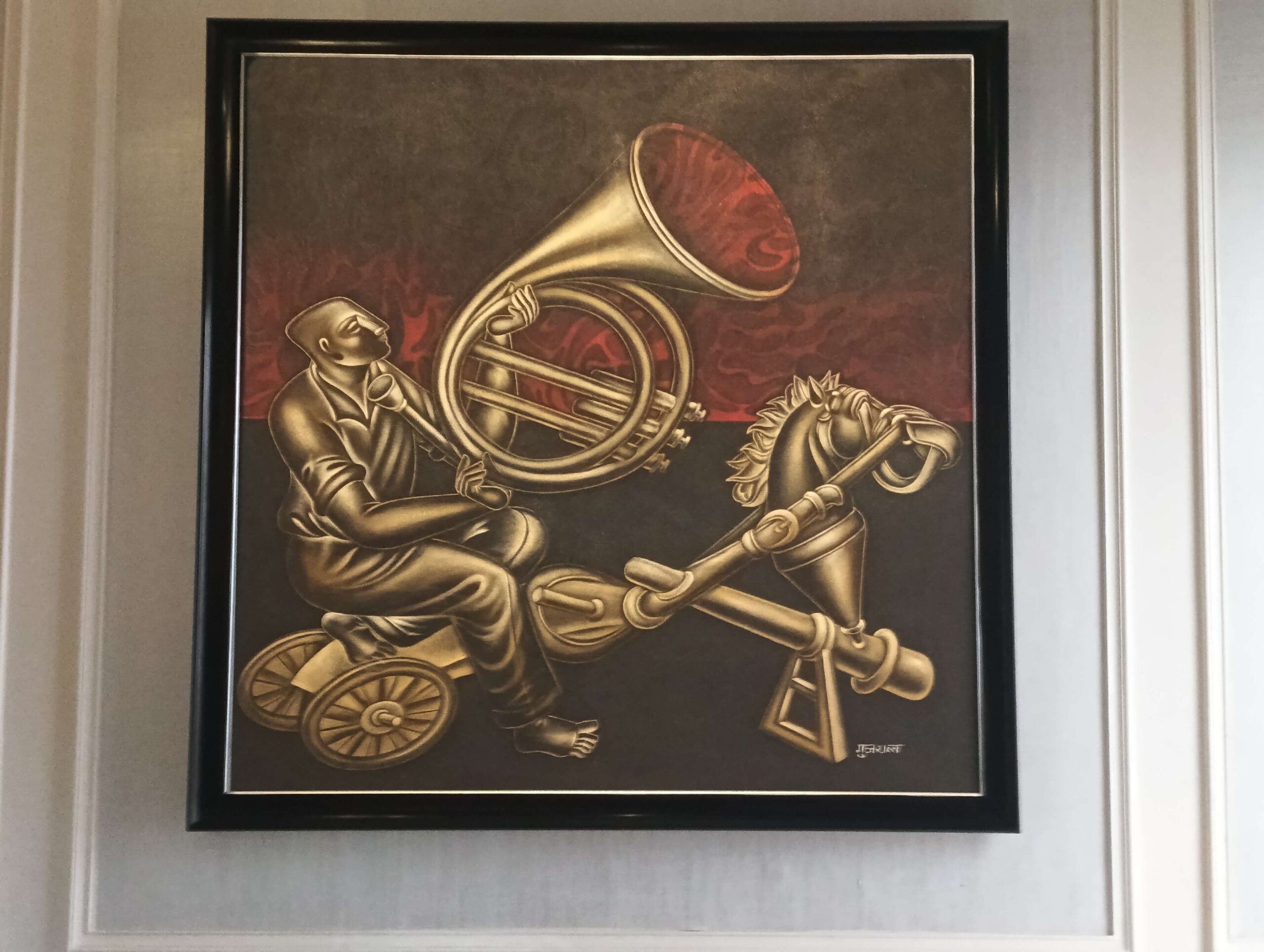
The paintings in the Industry section, by contrast, were quite ordinary and mundane, exuding a strong masculine, metallic vibe. They demonstrated a profound understanding of the relationship between human ingenuity and mechanised progress, portraying industry as a catalyst for resilience, identity, and transformation.
The paintings in the Liberty series explored the paradoxes of freedom, including its longing, its costs, and ultimately, its contradictions. The use of gold (read paint) lent an ethereal touch to the artworks, transforming the motifs and figures into mythical symbols that transcend the boundaries of time.
Rooted in Gujral’s experimental works dating back to the 1960s, the Panchatantra series recreated his explorations in drawing and collage through the lens of folklore and myth. Playful yet sophisticated, the series depicts the artist’s fascination and exploration of the intertwined human and animal forms. Relying on the timeless fables of the eponymous literary work (originally in Sanskrit), Gujral interpolates moral parables into visual narratives.
One painting that caught my eye was a self-portrait by the artist. It depicted him casually seated on a comfortable single-seater sofa, his face relaxed, with some decorative artefacts meticulously arranged near him. Artists are human after all, aren’t they?
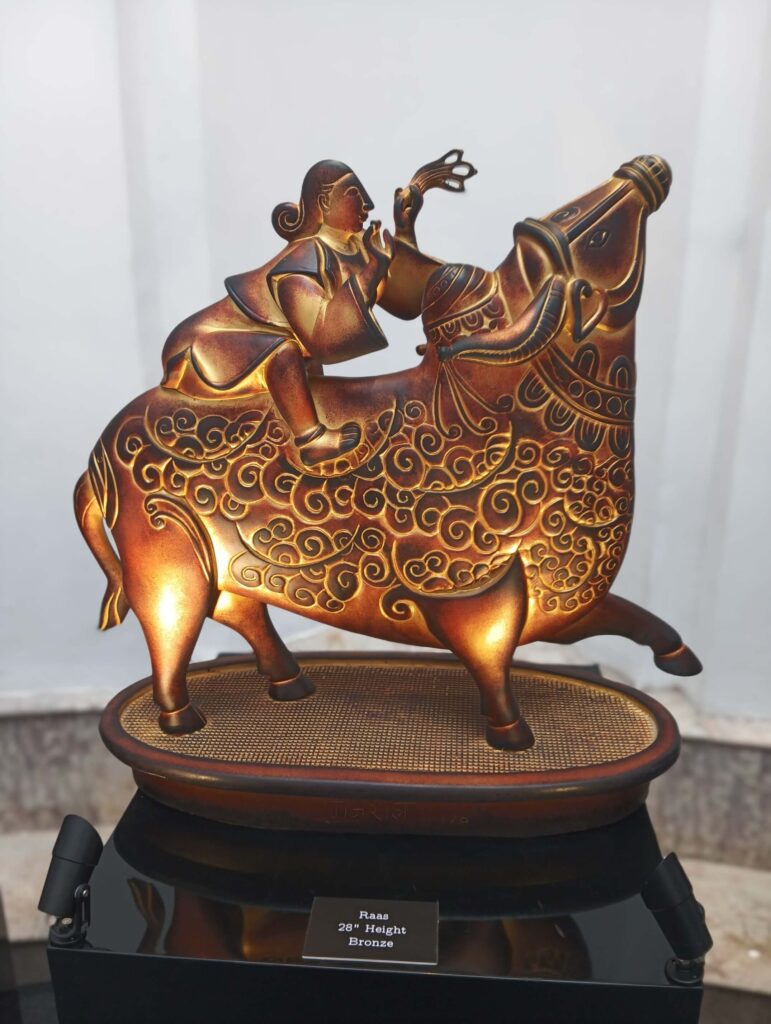
Additionally, there was an exclusive section showcasing impressive and breathtaking sculptures by Gujral. The sculptures embodied strength, a vital life force, and vibrant imagination. Carved in bronze, they incorporated geometric designs as well as indigenous motifs, which possessed a lyrical quality.
In conclusion, hopefully the discerning viewers were able to delve deeper to feel the pulse of the creative genius who constantly battled his inner demons yet refused to lower the banner of his art.
Visuals sourced by the reviewer.

Ruchira Adhikari Ghosh brings a liberal, wide-ranging outlook shaped by extensive travel across India and abroad. Educated at Holy Child School, New Delhi, Sacred Heart Convent, Ludhiana, and Panjab University, Chandigarh, she holds a Master’s in English Literature and a postgraduate diploma in Journalism and Mass Communication. With three decades in media, she writes on travel, books, music, performing arts, women’s issues, and especially food, drawing inspiration from rich life experiences. She is our Features Editor.
 By
By
 By
By
 By
By