
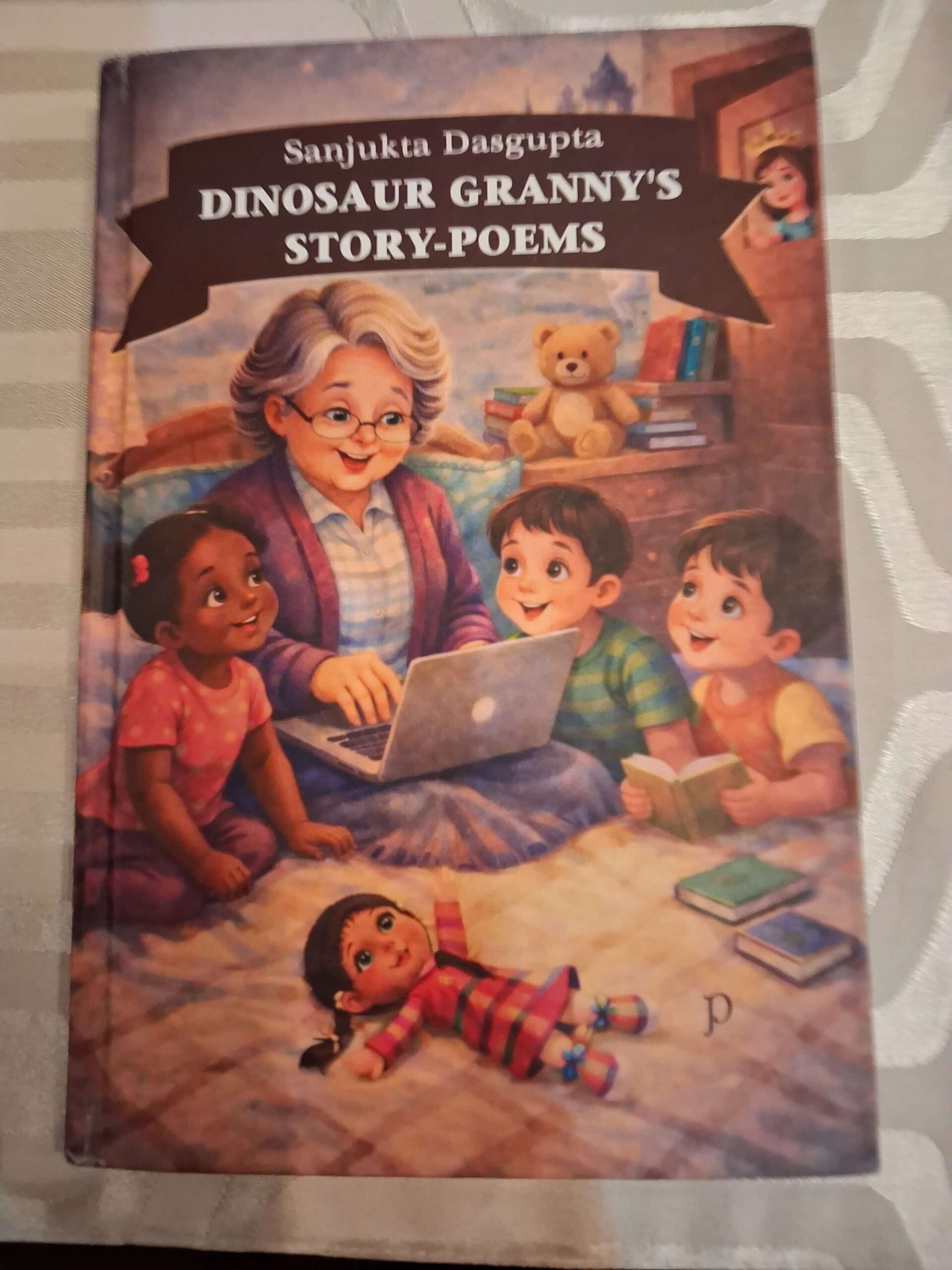
Dr Lakshmi unveils Sanjukta Dasgupta’s Dinosaur Granny’s Story on DifferentTruths.com—a whimsical bridge between millennial kids and timeless granny wisdom.

AI Summary
- Sanjukta Dasgupta’s debut children’s book blends story-poems of a “Dinosaur Granny” sharing animal tales, tech evolution, and cultural wisdom with millennial grandkids.
- Illustrated vividly, it targets 8-18-year-olds and “kids at heart”, fostering ecological awareness, multilingual harmony, and intergenerational bonds.
- Praised for evoking innocence amid modern changes, it seeds compassion through tributes to Tagore, Nazrul, and freedom fighters.
Granny, Granny/ I love dinosaurs a lot/ I love you a lot too/ You are my sweetie/Dinosaur Granny
The page on the left shows a cuddly, bespectacled dinosaur, a pile of books by her side, her spectacles in place and her grandchild snuggling up to her.
Sanjukta Dasgupta, an eminent academician with a formidable track record who carries all the creative weight of being a poet, critic, short-story writer and translator lightly, offers this book with a disarming humility that it is her ‘first venture into writing for children’. As you begin to read, you note that she hugely enjoyed writing it. One can tell. One also notes, very shortly, that it has a different ‘feel’ from other children’s books. That may have a lot to do with her parameters, which include readers who are ‘KIDS at Heart’. With prestigious awards such as the WEI Kamala Das Poetry Award (2020), the Governor’s Scroll of Honour (2024) and the CLRC National Lifetime Achievement Award (2024) tucked under her belt, Dasgupta, the Granny, never forgets that she was once a grandchild.
Story time is always bedtime. The alluring cover design by Supriyo Chakraborty shows a granny on a bed with an open laptop and the kids sprawled on the bed, all ears to hear her. Inside, the book has captivating pictures, illustrationsand pen-sketchesof birds, a pup, a kitten, a mongoose, a snake, a white mouse, along with trees, flowering plants and a smiling moon, the timeless Chanda Mama. There are pictures of Granny’s mom playing on an esraj, a bowed string instrument with a sitar-like neck, for the little girl, Granny, and a picture of Granny’s granny.
The Dinosaur Granny addresses children between 8 and 18 and the ageless ones who have not killed the child within them (To the Readers). Keenly aware she is talking to ‘millennial grandkids’ who are exposed to the life-altering changes in the ‘global and local ecosystems’, she approaches her story-poems with an adventurous spirit. We catch the infection. ‘She has succeeded in making children out of us,’ says Basudhara Roy, poet and co-presenter of the onlineprogramme The Heart Within (Foreword).
Granny notes the kids now converse with their parents in English and hear the vernacular only as background sound bites used for their domestic help. Devaleena Das reminds us they are part of ‘the drifting map of diasporic childhood’ in her Afterword. The book is unique in the genre of children’s books because it gives a sense of continuity and time and shows how Granny herself evolved through the changes in her time.
It may be helpful to first take a look at today’s grandchild before we move on to all that went into the making of Dinosaur Granny. The child makes sure her Granny knows about Harry Potter and proceeds to tell her how the orphan lived in a cupboard under the stairs, was ill-treated by the relatives he lived with, met the wizard Hagrid and joined the Hogwarts School of Witchcraft and Wizardry. She tells her Granny she wants to be like Hermione Granger, and we respect her for that. She identifies herself with Greg the Wimpy Kid,who tells her the root of all troubles from adults is their craving for money. She calls Barbie a “bore”, so we respect her a bit more. Asks the kid, with her high heels, how she can climb trees. She would rather play with her puppy and Hermione. Even when she has a fight with her Granny over emojis, which shrink vocabulary, she declares stoutly,‘My nutty granny/Was the best.’
Parents have no time to play with their kids. ‘We are busy. Where are your tablets?’ they ask. Into this world steps the Dinosaur Granny, a bridge between the now and the past. The child opens her heart to her: ‘You are Thammi/Not Granny/You are my Friend’. She has a healthy curiosity about her brainy Granny’s life: ‘Granny, did you play/ When you were like me?’ The long list of all that her Granny had done must have surprised her.
This proximity to each other makes them live within a charmed circle that pulls us in. The Granny completely accepts she is a ‘walkie-talkie Dinosaur’ to her grandchild, who wants to hear the story of Mithu, her Granny’s golden-brown hen, even if it ends sadly. “The Age of Innocence”, a set of three poems, shows the growth in the child with her innocence amazingly intact in the third poem, despite all the devices she has grown up with. She asks her Granny to carry her mobile when she goes to Heaven so that they can talk.
Granny tells the child that she was nearly thirty-eight when she got a desktop computer, a PC. Then followed a laptop, mobile phones, a camera on a phone for selfies and groupies, an iPad and so on. Before that, she was a little girl who made friends with Bulbulie, the bird; Pitu, her white mouse; Tom, the puppy; and kittens. Jhumroo, the mongoose, is a ‘hero’ because he is unafraid of snakes and sits on the arm of her Kalu Dadu to hear him play on the piano. Granny shares her sense of wonder about the animals, birds and reptiles around her.
Dinosaur Granny remembers her own grandmother as a framed sepia picture on a wall. She gets to know about her through her mother, who describes how she would sing while playing on the esraj, which is now with Granny’s son (the grandchild’s father). Granny’s mother played on the harmonium while she sang along. Granny’s best friends were her books, and she wrote real letters, not emails or WhatsApp texts.
However, this friendly dinosaur is one clever Granny. Since it is story time, she slips in knowledge about various things. Her poem “Mother Tongue/First Language” gently untangles the commonplace quarrels between the two. IfBangla is a mother tongue, English is a foster mother tongue, ‘Like Krishna’s two loving mothers/Joyously merged with each other’. For a moment, we reflect on the unstated dignity of Devaki and Yashoda, who never stooped low to fight over ‘who’ was the mother of baby Krishna. Then there are story-poems on deities such as Durga, Lakshmi and Sarasvati and festivals like Holi and Easter Krakow, when ‘The House of God beckons/… Youngsters and the very old/all walk to church.’ The old woman in “What is Freedom” says Freedom is the right to speak/ Freedom is the right to act/Freedom is the right to dream.
Granny’s story-poems bring out an ecological awareness, beginning with our immediate environment. “Death of a Deodar Tree” describes the disturbing memory of a very tall tree that was felled, then chopped, dismembered, and sliced. ‘Where Have all the Sparrows Gone?’ is answered by the terse line, ‘one sees them in books.’ They include tributes to the Bard of Bolpur, Rabindranath Tagore; Kazi Nazrul Islam, who was jailed for his poems, and the great social reformer Ishwar Chandra Vidyasagar, who changed the lives of widows. She takes her grandchild to the jail museum that reverberates with stories of revolutionaries, some of whom gave up their lives for the cause of freedom. The sensitive child does not touch fish and chips, her favourite snack ordered by Granny.
Truly, as Devaleena Das says, ‘each story becomes a seed in the child’s open mind’ (Afterword). We hear the Dinosaur Granny story-poems with rapt attention as we journey through time, space and other worlds beyond ours. ‘Ubuntu’ in the name of Ivaana translates as ‘I am because we are’, says Granny. Humanity, compassion, solidarity and many other qualities radiate the emotional energy of the book. One is grateful to Ivaana Ubuntu for asking her Dinosaur Granny to read her story-poems.
Note:
The esraj is a bowed string instrument with a sitar-like neck with twenty frets, used as an accompanying instrument in Rabindra Sangeet.
Book cover photo sourced by the reviewer

Dr Lakshmi Kannan, PhD, is a distinguished bilingual novelist, short story writer, poet, and translator. Her Guilt Trip and Other Stories (Niyogi Books, 2023) earned “Best Book of the Year 2023” in the India section of Literature, Critique and the Empire Today (UK). She was a Resident Writer at the International Writing Program, Iowa, USA; a Charles Wallace writer at the University of Kent, Canterbury, UK; a British Council writer at Cambridge, UK; and a Fellow at the Indian Institute of Advanced Study, Shimla.
 By
By
 By
By