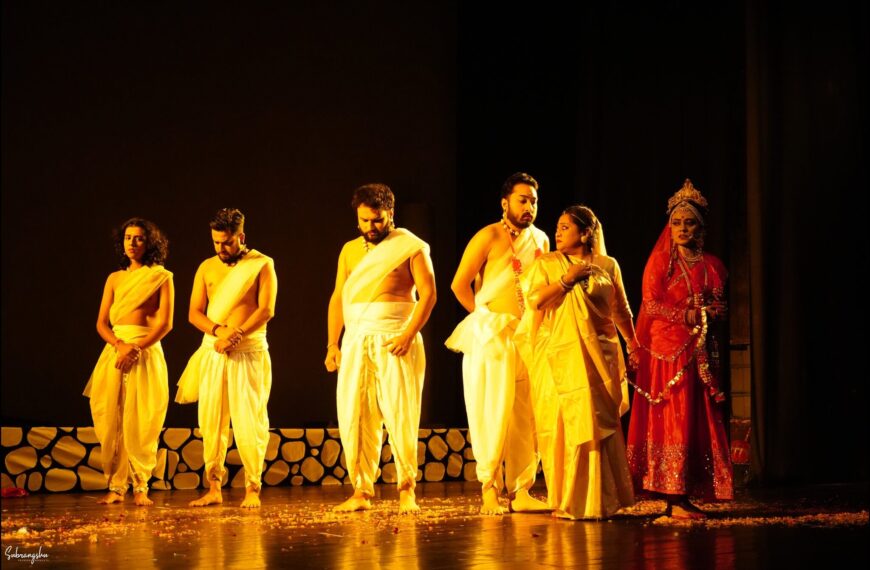

Ruchira on DifferentTruths.com celebrates Tagore’s Raktakarabi centenary: Nandini’s love and freedom triumph over greed in this timeless allegory.
AI Summary
· Tagore’s Raktakarabi critiques materialism’s dehumanising grip, with Nandini embodying love, vitality, and rebellion against tyranny.
· Her free spirit awakens oppressed miners to revolt, blending tragedy (Ranjan’s death) with triumphant optimism via songs and sacrifice.
· A Delhi theatre production by Nabapally Natya Sanstha vividly captures its themes of freedom and harmony.
For literary enthusiasts, the current year, along with the last quarter of the previous year, holds significance as it marks the centenary of Tagore’s masterpiece, Raktakarabi (Red Oleanders). Originally titled Yakshapuri, the play was written during the poet’s time in Shillong between 1923 and 1924 and finally revealed to the world around 1926.
In Raktakarabi, Tagore explores how the relentless pursuit of material wealth and mechanical power separates humanity from its true essence. The male characters in the play embody a profound greed for wealth, demonstrating a disconnection from the nurturing, creative, and vibrant life force.
However, the arrival of Nandini, a character who embodies beauty, femininity, and the vitality of life, disrupts this balance, bringing a breath of fresh, invigorating air to a stifling atmosphere. Her presence disrupts the oppressive influence of greed and power, illustrating how love and emotional fulfillment can liberate individuals from their self-imposed constraints.
The play serves as an allegory for unchecked materialism, which leads to a loss of joy, human emotions, and sentiments. In contrast, embracing love and nature restores true harmony and fulfillment.
In a dark and dismal world, a ruthless and greedy king forces his subjects to mine for gold. The protagonist, Nandini, adorns herself with bright red oleanders, wearing them as a tribute to Ranjan, the man she loves. She is depicted as a youthful woman full of joie de vivre, mirth, and a bubbly spirit. She is incapable of harming others or harbouring malice; instead, she embodies freedom and love, which she is capable of reciprocating in equal measure.
The king comes across as an ambiguous and enigmatic figure, intrigued by the outside world, which he believes he can control. However, he is aware that this notion may be a deception he has created for himself, a realisation that Nandiniunderscores.
As the drama unfolds, the king spends the greater part of his time behind a metallic lattice, finally emerging under the open skies only when the play is nearing its end.
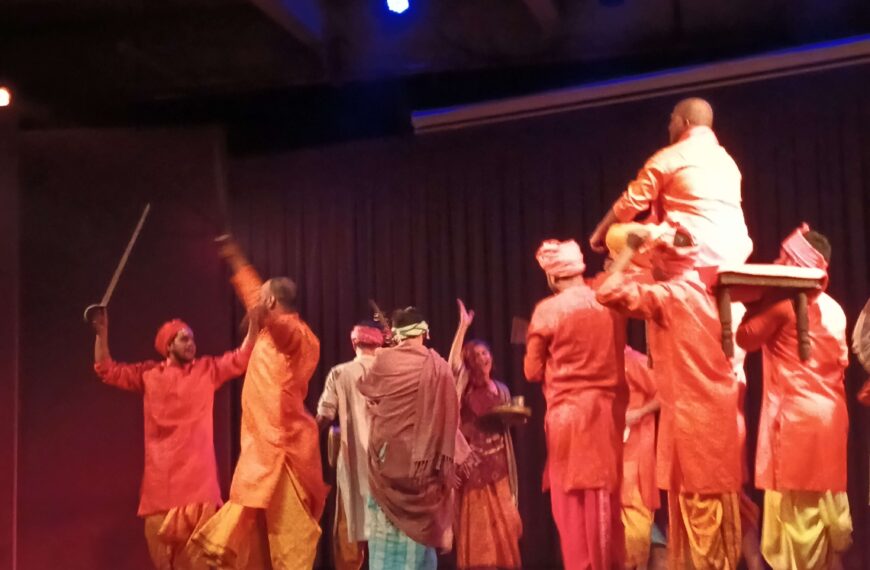
In sharp contrast to Nandini’s free-spirited nature is the Sardar (security official), whose fierce persona is accompanied by his well-dressed henchmen, eager to carry out all of his commands.
There is Kishore, another admirer of Nandini, who derives sheer bliss from their mutual interactions. He demands nothing from his lady love except her consent to procure red oleanders from a secret tree in a dumpyard.
What maintains an element of suspense throughout the play is the enigmatic character of Ranjan, Nandini’s true love. Although he is a central figure in the story, Ranjan only appears in the final act, and even then, as a corpse. It is heart-wrenching to witness Nandini wailing over his lifeless body.
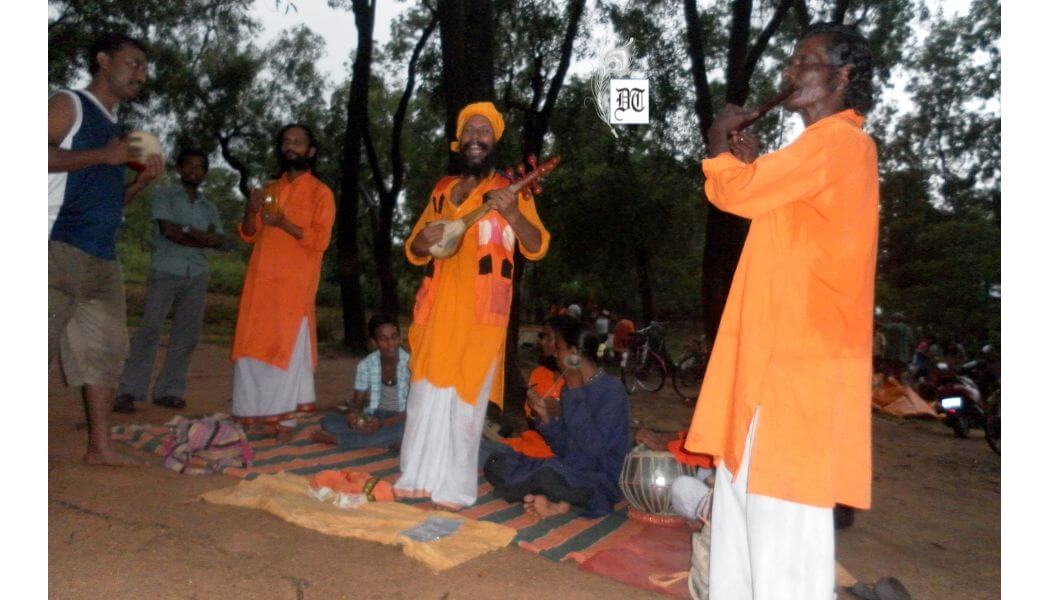
The synchronisation of the vocal music with the actors, beginning with Bishu Pagol—an avid fan of Nandini—singing “Tomaye Gaan Shonabo”, creates a natural rhythm throughout the play that aligns with Nandini’s blithe spirit. Additionally, several songs interspersed within the main script effectively heighten the moods and emotions of the performance. For example, the group dance performance of “Poush Toder Daak Diyeche” signals the arrival of the harvest and the promise of better times ahead. In contrast, “Chokher Jawler Laglo Jowar” expresses the profound sorrow of miners, who are perpetually burdened by the monotony of their routines and the demands of hard labour.
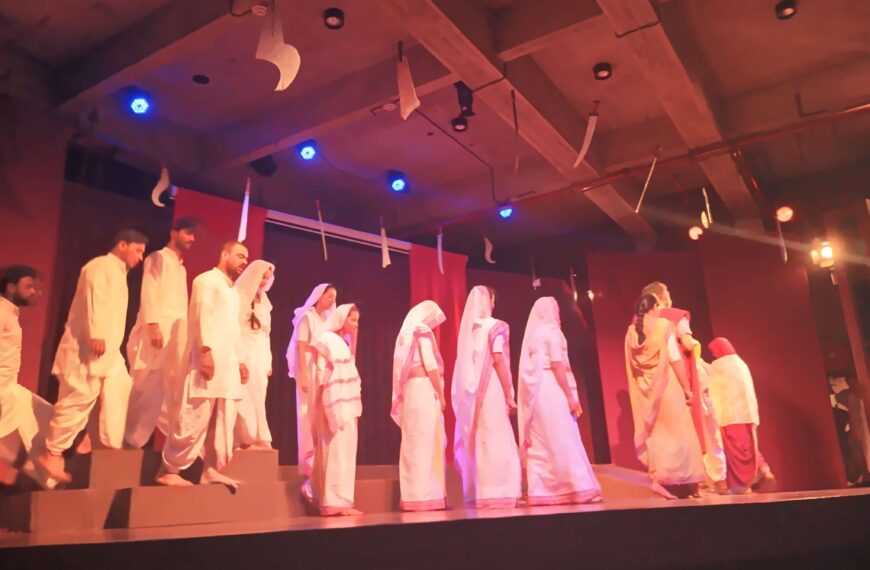
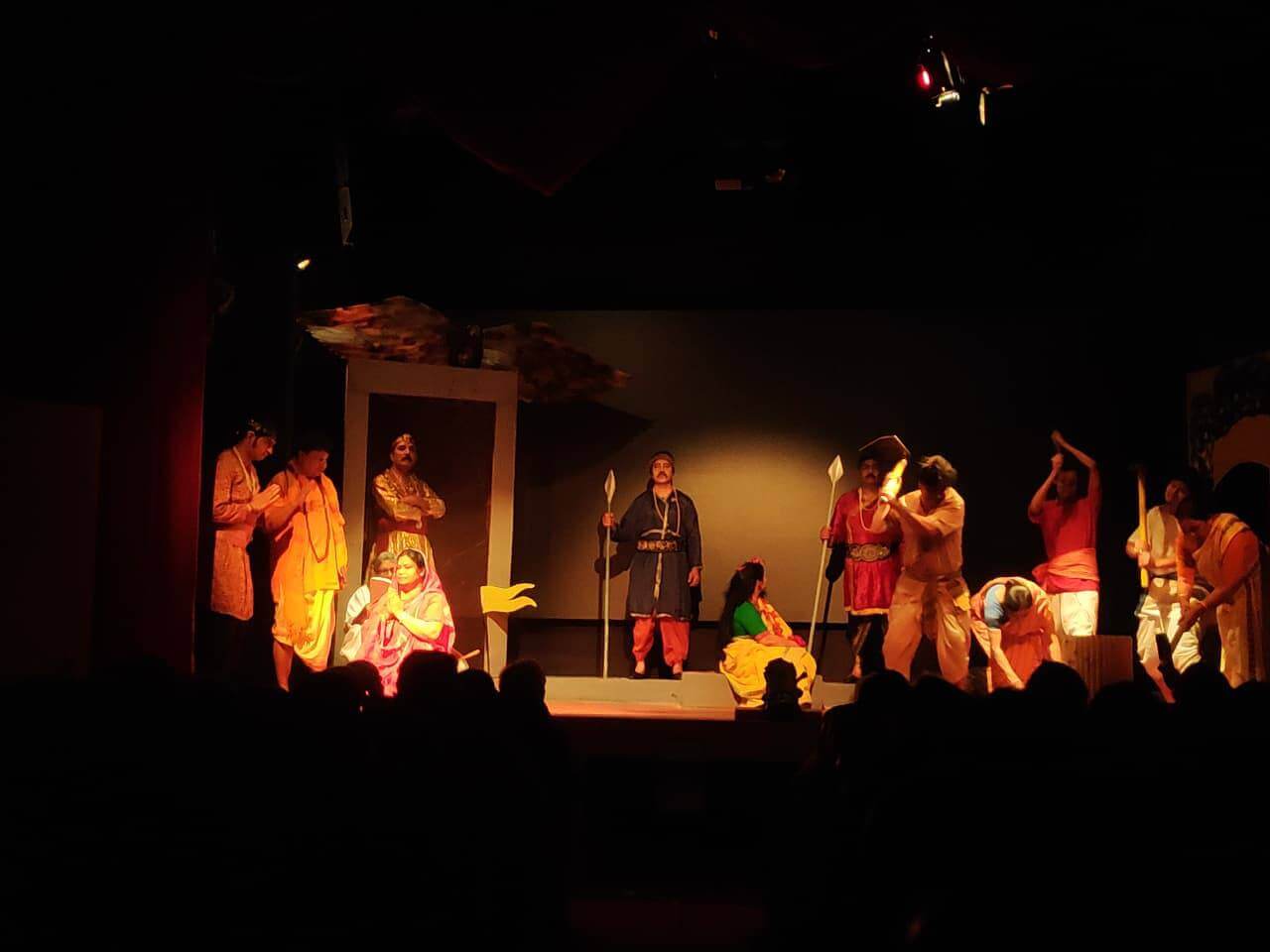
Raktakarabi powerfully highlights layers of constant repression experienced by the weak at the hands of the mighty—particularly in the context of labour and capitalism. Nandini represents individual freedom, embodying a natural and unrestrained essence, like a river overflowing its banks. With her fearlessness and unbounded enthusiasm, Nandinigradually and relentlessly awakens the somnolent, terrified folks to revolt against oppression and tyranny. The miners and other labourers tear down the walls of the prison, release the prisoners, and march in unison towards freedom to pick up the threads of life. The viewers watch in amazement as Nandini successfully motivates the King to abandon his hiding place and step out into the realm of reality.
However, at this juncture, a tragedy occurs: Ranjan, whom Nandini constantly projects as a harbinger of liberty and freedom and a high priest of love, is brutally slain by the ruthless authorities. Heartbroken yet still defiant, she continues to urge the denizens to march forward. To put it succinctly, it is through her supreme sacrifice that Nandinitriumphs, holding her banner of love and liberty aloft. The play ends on a highly optimistic note with the crowds vigorously singing “Bandh bhenge dao…”
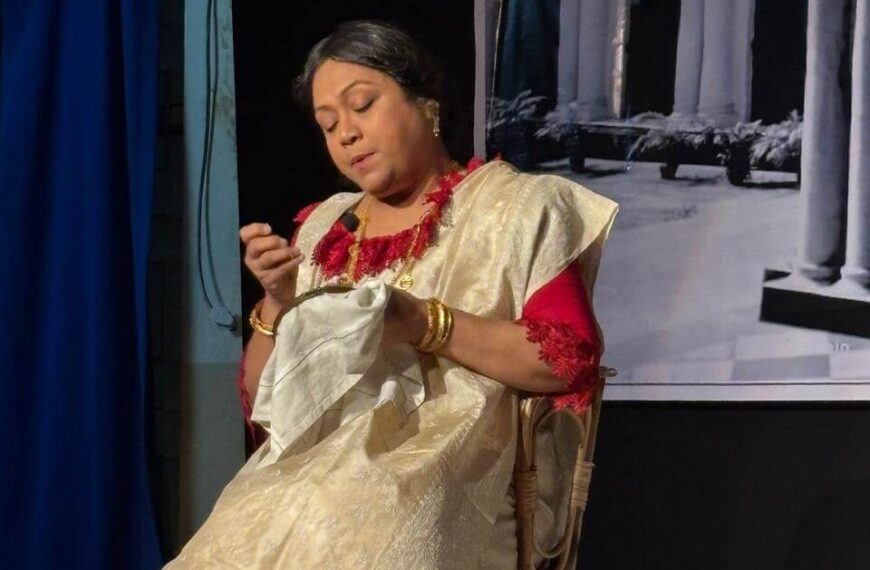
By a happy coincidence, I had the opportunity to witness a version of the play at a local theatre, presented by the Delhi-based Nabapally Natya Sanstha. The performances by Raja (played by Prodip Ganguly), Nandini (Soma Sinha), and Bishu-Kishore(both played by Tushar Chanda) were commendable. Male singers Shambhunath Sarkar and Tushar Chanda also delivered impressive performances. However, the highlight of the evening was Kaushiki Deb’s haunting lyrics. The technical crew behind the scenes also deserve recognition for their excellent work.
Photos sourced by the author

Ruchira Adhikari Ghosh brings a liberal, wide-ranging outlook shaped by extensive travel across India and abroad. Educated at Holy Child School, New Delhi, Sacred Heart Convent, Ludhiana, and Panjab University, Chandigarh, she holds a Master’s in English Literature and a postgraduate diploma in Journalism and Mass Communication. With three decades in media, she writes on travel, books, music, performing arts, women’s issues, and especially food, drawing inspiration from rich life experiences. She is our Features Editor.