

Dr Madhumita explores Betty Friedan’s The Feminine Mystique on DifferentTruths.com, dismantling gender myths as social constructs, not biology.
AI Summary:
- Friedan critiques gender roles as fluid social constructs, varying across cultures and time, not fixed by biology.
- She rejects biological determinism, arguing modern intelligence frees women from motherhood-only identities.
- Adolescent identity formation traps girls in domestic fantasies, fuelling the “feminine mystique”—a changeable cultural myth.
Betty Friedan’s The Feminine Mystique (1963) is considered a landmark text in modern feminist thought. In this work, Friedan offers a profound critique of gender roles, female identity, and socially constructed notions of femininity. Based on the given excerpts, it becomes clear that Friedan does not view gender as a fixed biological truth but as a cultural and social construct.
Friedan first emphasises that the roles of men and women are neither universal nor permanent; rather, they change across time and cultures. She observes that sometimes a quality is assigned to one sex and sometimes to the other. In some societies, women are seen as weak, while in others they are considered more suited for heavy labour (Friedan, 1963, p. 160). This variability demonstrates that gender roles are not natural but socially constructed. Differences in the status of women across religions and cultures further reinforce the argument that women’s roles are not based on any universal truth.
In the second excerpt, Friedan critiques biological determinism. While she acknowledges that female biology may remain constant, she argues that the human relationship to biology evolves (Friedan, 1963, pp. 166–67). In modern societies, human intelligence and knowledge have made life more complex and multidimensional. Therefore, defining women solely based on their biological traits is limiting and unjust. Friedan challenges the assumption that a woman’s identity should be confined to motherhood or her physical body. She argues that reducing women’s nature to biological differences restricts their potential and agency.
In the third excerpt, Friedan highlights the difference in identity formation between boys and girls during adolescence. According to her, boys primarily define themselves through their occupational or vocational identities, whereas girls’ identities are often shaped around marriage and family roles (Friedan, 1963, p. 187). Boys actively plan their futures and explore multiple possibilities, while girls are often absorbed in romantic fantasies shaped by social expectations. This difference is not merely personal but deeply structural, reflecting societal norms that confine women to limited roles. Friedan identifies this as a part of the “feminine mystique”, a cultural ideology that restricts women to domestic life and romantic fulfillment.
The significance of Friedan’s ideas lies in her ability to present gender as a social construct rather than a fixed reality. She demonstrates that confining women’s identities to biology, marriage, and domesticity is a cultural myth that has long shaped societal expectations. Her analysis suggests that genuine liberation for women is possible only when they are allowed to define their own identities and pursue their full range of capabilities.
Ultimately, The Feminine Mystique remains a foundational text not only for feminist discourse but also for gender studies more broadly. Friedan’s arguments continue to be relevant today, as they help us understand that gender roles are not natural or inevitable but constructed and therefore open to change.
Reference
Friedan, Betty. The Feminine Mystique. W.W. Norton and Company, New York & London, 1963, pp. 160, 166–67, 187.
Picture design by Anumita Roy

Dr Madhumita Ojha, a Hindi literature scholar, specialises in folk literature, cultural studies, gender, and marginalised narratives. She earned an MA and PhD in Hindi from Presidency University, plus a BEd from Mahatma Gandhi International Hindi University, Wardha. Author of Folk Literature and Culture, she has published extensively on Kinnar narratives, LGBTQ representation, women’s studies, and Dalit literature. She serves as a guest lecturer at the Hindi University, Howrah, Kolkata.

 By
By
 By
By
 By
By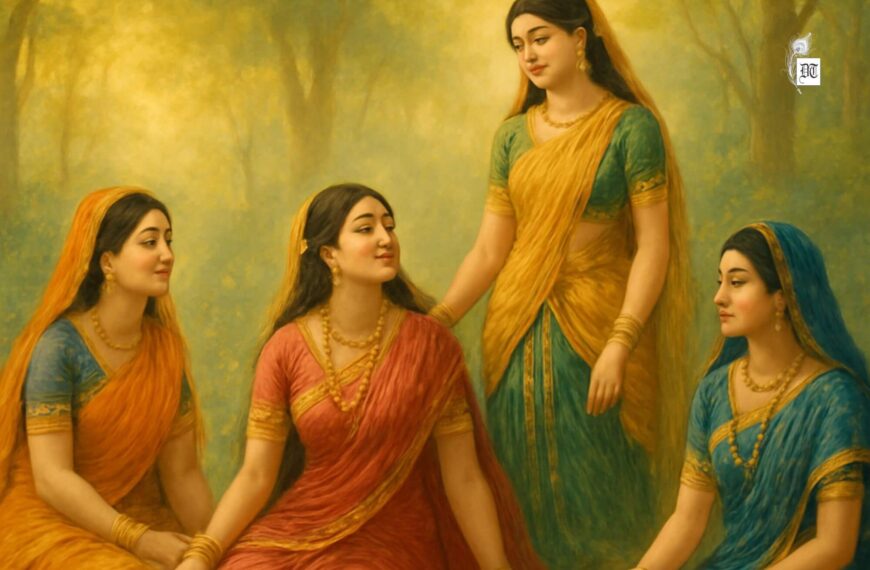
 By
By