
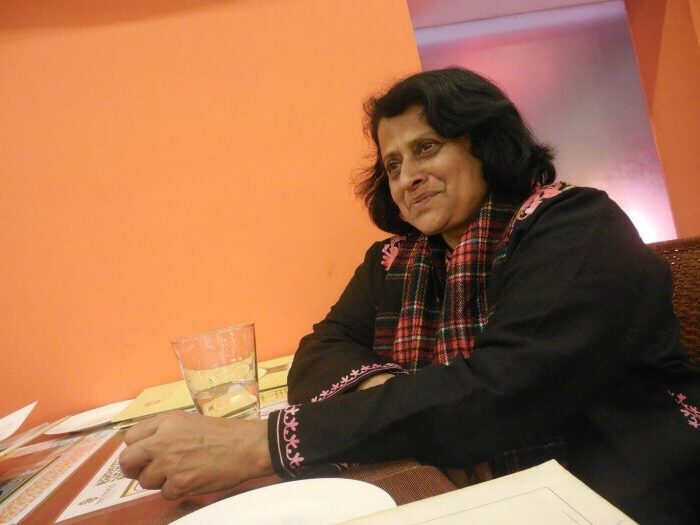

Lopamudra interviews award-winning author Dr Santosh Bakaya on DifferentTruths.com, exploring her humorous essays in ‘Din about Chins’ and other works.
AI Summary
- Dr Santosh Bakaya, winner of the Reuel (2014), Setu (2018), and Eunice D’Souza (2023) awards, discusses her 31 books, motherhood vignettes in ‘Din about Chins’, and literary evolution.
- Highlights blend humour, memories, and imagination in essays tracing her daughter’s growth, with poetic strains and literary allusions from Dickens to Roald Dahl.
- Emphasises writing as fulfilling her father’s dream, polyphonic voices across g,enres, and advice: stay “drunk on writing” per Ray Bradbury.
“I consider myself more a storyteller, rather than anything else.” ~ Santosh Bakaya
Winner of the Reuel International Award (Poetry, 2014), Setu Award (2018), Eunice D’Souza Award (2023) (WE Literary Community), Dr Santosh Bakaya, PhD, poet, essayist, novelist, biographer, TEDx speaker and creative writing mentor, has written 31 books across different genres. Ballad of Bapu (a poetic biography of Bapu/Mahatma Gandhi) and Only in Darkness Can You See the Stars [Biography of Martin Luther King Jr.] have won international acclaim. Her TEDx talk on the Myth of Writer’s Block is very popular in creative writing circles.
My interaction and camaraderie with author and academician Dr Bakaya had started in 2015 when she became a contributing writer for the short story anthology ‘Defiant Dreams’, and in the years that followed, we worked on four important anthologies together, kept reading and supporting each other’s literary journey, and today, I see her mostly as a prime voice in the firmament of Indian Writing in English, a voice that can be a beacon of hope for all of us trying to solidify our spaces in the literary arena.
In this literary dialogue with Dr Bakaya, I have tried to touch upon various salient aspects of her essays and other prose narratives, with special emphasis on her recent publication, ‘Din about Chins’ (Penprints, 2024).
Lopamudra Banerjee (LB): Welcome, Dr Santosh Bakaya! I have seen you evolve over many years as a poet, a biographer (with your book on Martin Luther King Jr.), a storyteller, and an essayist, since I first read your collection ‘Flights from My Terrace’. That very first book of essays penned by you was a “remarkable odyssey of childhood memories, nostalgia, and a vivid internal journey capturing universal human feelings” (quoting from an old interview with you that I had the privilege to conduct). Some years down the line, and we have your two other collections, ‘Morning Meanderings’, published serially by LnC-Silhouette mag and now ‘Din about Chins’, your most recently published endearing essays about your journey in motherhood. How has this personal journey of essay writing in the domain of Indian English Literature been, and what gave you the impetus to transition from ‘Morning Meanderings’ to‘Din about Chins’?
Santosh Bakaya (SB): Thanks for all the praise that you have heaped on a puny me! I insist that people just call me a Mad Writer, which I am convinced I actually am. There is a mad streak in me, which any discerning writer or reader can see.
I have no qualms about reiterating that my sense of humour can be pretty wacky. I was always a storyteller, never a poet – I consider myself more a storyteller, rather than anything else.
I remember you interviewed me for my book of essays, Flights from my Terrace. Well, this book is very close to my heart. Actually, I used to write short snippets almost every day on Facebook. It was indeed edifying that readers liked those snippets very much and wanted me to get the essays published in book form. Joyce Yarrow, a very dear friend and an internationally acclaimed writer, was also after me with her insistent cajoling.
So, it was done, first as an e-book on Smashwords, and then as a thick printed book of 400 pages. I was overwhelmed by the unprecedented response that the book received.
Morning Meanderings, my weekly column in Learning and Creativity, also started as essays on Facebook, and part of it was published as an eBook. Morning Meanderings became so popular that it went into three seasons.
Din about Chins is a book of thirty crisp vignettes about a daughter’s growing-up years, written by a fond mother tracing her growth from the days of cherubic innocence, to her mercurial, high- spirited teen years, to a young lady, with compassion in her heart, wit on her tongue, and dreams in her twinkling adult eyes.
Many of these pieces were first published in Learning and Creativity.com, whose dynamic editor, Antara Nanda Mondal, added her brilliant touches to them.
Peppered liberally with humour, I wrote many of the pieces while the scenes were unspooling before my eyes, much to the chagrin of my daughter!
Dr Anita Nahal, who wrote the back-page blurb, found the book ‘delightful and heartwarming’. She further says, ‘that the daily interactions are transformed into cherished nuggets containing manifold wisdom, humour and a smidgeon of unspoken motherly magic.”
Let me add something here. The magic is also due to my publisher, Penprints Publication, Sreetanwi Chakraborty and Supriyo Chakraborty, the driving forces behind it, and also the amazing cover design by Kushal Poddar, whom I call a genius. Incidentally, he is also illustrating my next book, this time for children.
My journey in the literary firmament has been very satisfying to me, in the sense that I have made many good friends, all of them excellent writers, from whom I learn a lot.
Moreover, my father was very keen on publishing his handwritten poems and a novel after his superannuation. But he was snatched from our midst before his dreams could be realised. So, whenever I finish writing any book, I feel that father up there is happy, and giving me the thumbs up sign.
That is my greatest reward and award.
Maybe he finds it incredible that his brat of a daughter can stick to one place and write!
The writer in me keeps pushing me on, from one book to another.
With my eyes fixed on Time’s Winged Chariot, which seems to be heading near,
I amin a perpetual hurry to finish my books, so much so that these days, I have found myself working on six projects simultaneously.
Who knows when the Grim Reaper comes knocking!
LB: It is said that in famous works of creative nonfiction/personal essays, it is the “marriage between memories and imagination” that lies at the heart of the ruminations of the author, for which the personal comes out of the intimate consciousness and gets merged with the universal sensibilities.While penning your book of vignettes, ‘Din about Chins’, did that interplay between your motherly memories and your own writer’s imagination happen? What was the creative process?
SB: My creative process? Well, it was sheer madness! Honestly speaking, there was no process in it, only insanity!
I merely pulled out these vignettes from my memory box, and wrote them down, then garnished these helter-skelter recollections with my imagination.
Well, this book is without doubt a “marriage between memories and imagination”. That every writer has a fertile imagination cannot be denied. These funny, nostalgic, personal snippets have erupted out of the intimate consciousness and merged with the universal sensibilities. That is why readers said they identified so much with the snippets in the book.
LB: The book ‘Din about Chins’ opens with a very endearing poem titled ‘Hush, what is That?’ from which I would love to quote these lines: “Her speech, like a brook gone haywire. /In squeaky tones, she screams, I beseech.” This is kind of a prelude written in the garb of poetry through which you depict the storming deluge of your emotions as a mother while transitioning from a new mom to a seasoned mom, and it is a refrain embedded in your narrative that runs as a subterranean stream throughout the chapters. How do you feel about this poetic strain that runs throughout your descriptions in the book?
SB: “Her speech, like a brook gone haywire. /In squeaky tones, she screams, I beseech. /Suddenly her eyes gleam in serendipitous glee. /Alas! I am whacked on the head with a fly swatter/by my three-year-old daughter.”
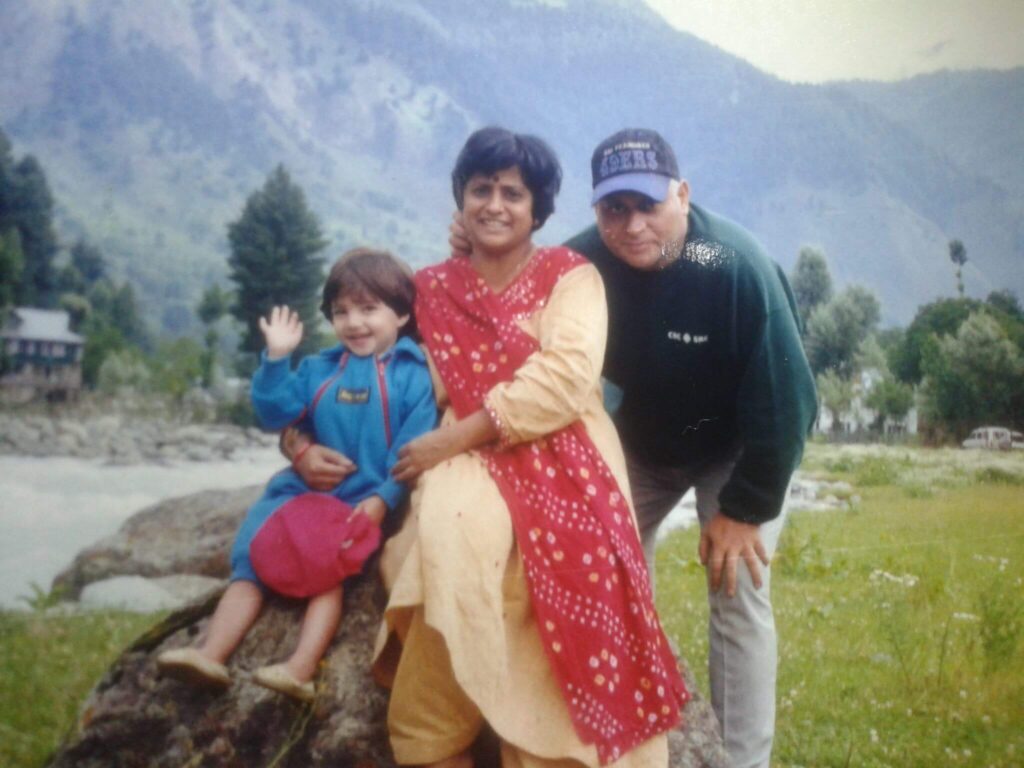
Well, this is one of my favourite poems. Iha was married last year. Now, when I recall how I used to chase her with a pair of socks, it makes me burst into laughter. After reading the book, many readers called me saying that they could identify with this scene so much. The elegant sketch of Kushal Poddar on the cover depicts that scene.
No mother in the entire world has not run after her child with a pair of socks. Yes, that poetic refrain is embedded throughout the book. There was a time when I was trying to serenade her with spontaneously created limericks, and she would clap in juvenile glee, responding by way of topsy-turvy limericks!
LB: What is your own take on such an unusual, quirky title of your book of essays as ‘Din about Chins’? I know it is named after the first chapter with the same name, in whichthere is an amusing repartee of words exchanged by mother-daughter, raising a hue and cry about the projection of double chins in a photo captured mistakenly. Does this voluntary celebration of words, confusion and chaos in everyday life lie at the centre of the book?
SB: You said it!
Since all three of us have a background in literature, literary quips and repartees are very much a part of our everyday existence. Iha has this habit of playing with words, and also uses puns a lot in our daily conversations. The moment I say something funny, she gives her own twist to it, and the whole household erupts in laughter. So, this title is also a part of her rejoinder to me.
Yes, the book is named “after the first chapter with the same name, in whichthere is an amusing repartee of words exchanged by mother-daughter, raising a hue and cry about the projection of double chins in a photo captured mistakenly.” She cannot digest anything critical being said about her father, so when I retorted, “Why do you worry? I know a man with triple chins!” She whirled back to remark,
“What is this unnecessary din about chins!”
“Flurry about Egg Curry” was an alternative title, also one of her cheeky remarks.
LB: Deepti Menon, in her delectably presented foreword to the book, writes: “What is different about this love-filled narrative is how adeptly mother and daughter throw literary allusions at each other…” In this connection, she cites the example of wide varieties that become part of your style, including Scarlett O Hara’s seventeen-inch waistline, Oliver Twist’s ill-fitting apparel and also Alice’s statement in “Through the Looking Glass: “whether you can make words mean so many different things.” Since I have already witnessed how you wield your sense of humor into your descriptions of everyday happenings, which we most often tend to overlook, why do these allusions make you create a world of ‘your own making’?
SB: I carry my own world within myself, brimming with my fads, foibles, whims and idiosyncrasies. As a school-going girl, in a bid to impress my father, I had read every book in his huge library, and loved the characterisations of Dickens, the humour of Edward Lear and Oscar Wilde, The Raven being my favourite poem of Edgar Allen Poe.
I remember many quotes of famous writers, and they still erupt while I speak. Reading all books in our home library had almost become an obsession with me, hence my parallel world was peopled with Alice, Hansel and Gretel, the Raven, the White Rabbit, Madame Defarge, Gabriel Oak, Bathsheba Everdeen, Scarlet O’Hara and many more characters stealthily creeping into my mindscape.
My school friends often called me Little Johnny Head in the air, because I would always imagine things.
My imagination continues to run at a tangent, even now.
I find myself snugly ensconced in a world of my own making, where there is only love.
LB: The allusions come in quick succession in some of the chapters, like ‘Injustice’, where the narrative alludes to the speeches of Martin Luther King Jr., and Edgar Allen Poe’s imagery of the Raven, almost in a single breath, in the course of the mundane conversations between Iha, your daughter and yourself.In the chapter titled ‘I Am Jiggered’, the entire narrative seems to be centred on the idea of Roald Dahl’s birthday, in which certain unusual words and coinages of Dahl come alive with a twist in your own descriptions, which I found particularly engrossing. Did you pen this collection as a literary and cultural commentary on such classic writers’ works, adapting them to your own everyday truths, your surroundings and your modern sensibilities?
SB: No, I did not pen this collection as a literary and cultural commentary on such classic writers’ works, adapting them to my own everyday truths, my surroundings and modern sensibilities.
Actually, this was the time my daughter was greatly under the spell of Roald Dahl. She would converse with me in his funny word coinage. So, instead of looking like an utter fool in front of her, I read every Roald Dahl book in the house, and like an excited mother-daughter duo, started conversing and sparring in Roald Dahl vocabulary, to the absolute amusement of Lalit.
One day, to my befuddlement, I saw this man, a lover of Dickens, Hardy, David Baldacci, and John Grisham, furtively flipping over the Pages of Roald Dahl books. He had no intention of being left behind in this Dahl- sparring!
LB: In your earlier works of narrative nonfiction, ‘Flights from My Terrace’, and also in ‘Morning Meanderings’, your narratives seemed to thrive on creating a ‘memory avalanche’, portraying the metaphorical truths of your life in connection with your intimate physical surroundings, while also depicting interpersonal relationships in myriad unforgettable ways. In this book too, the focus is on the interpersonal relationship between the mother-daughter, and the way you remember your journey as a mother and also the way you evolve into a thinker-cerebral mother is also noteworthy. Was this a conscious exercise, or did you just go with the flow of your organically woven narratives?
SB: No, this was not a conscious exercise, but I “went with the flow of (my) organically woven narratives.”
Morning Meanderings, my column in Learning & Creativity e-mag, which was greatly appreciated by the readers, was based on the mundane and the quotidian that I came across on my morning rambles.
Yes, here I would like to point out that I have never seen myself evolving into a cerebral mother. I continue to be the absent-minded, disorganised,” little Johnny head in the air” sort of a mother, forgetting and misplacing things.
LB: In your earlier nonfiction book, ‘Only in Darkness Can You See the Stars’, your beautifully crafted biography of the life and times of Martin Luther King Jr., there is a lot of serious narrative in the historical context of the politics of segregation, and how King’s vision regarding his legacy of nonviolent activism gained momentum in his short life span. In that biography, your voice is that of a historian, an archivist and a humanitarian who retells global history. In your personal essays, on the other hand, your voice is that of a simple, discerning narrator chronicling little nuggets of your life in an autobiographical mode. What do you think about this transition of voices that you have?
SB: I believe that every writer is a polyglot who can effortlessly transition from one voice to another.
Let me relate something interesting. When one of my readers read a very serious post of mine, he called me, completely flummoxed. “I thought you wrote only humour! This is a completely new you, I am reading!”
I told him, “I speak in many voices, the voice of the humorist being just one of them.” In Din About Chins, my voice, as you say, “is that of a simple, discerning narrator chronicling little nuggets of your life in an autobiographical mode.”
In other books, it is different.
Just grab your idea of what you want to scribble about, then flip to a completely different voice from the one rattling in your mouth!
I have also studied Political Science and History, and the Civil Rights movement has always intrigued me. In Only in Darkness Can You See the Stars’, I write about the life and times of Martin Luther King Jr. As you know, I also wrote a poetic biography of Bapu, “Ballad of Bapu”, which is soon going into its next print.
LB: Another very notable literary work of yours in the recent times is your novella ‘A Skyful of Balloons’, which in essence is a love story, but more than that, it is a human story of universal love, yearnings and loss in the backdrop of the idyllic landscape of Kashmir, the pristine Kashmir, now volatile and war-stricken, which also forms the core of your persona as a writer and poet. It has been an integral part of your personal essays, as you string the scattered pearls of your childhood and bring them together alongside reflections on your present life. How has Kashmir in your lens evolved when you wrote some of the chapters in ‘Din About Chins’?
SB: Well, I have my roots in Kashmir, my motherland. The mention of pines, poplars, lakes, rivers and snow- covered peaks invariably creeps into my writings. Communal harmony has always been an integral part of Kashmir, with a rich culture of Sufism, and the poetry of Mehjoor, Lal Ded, and Habba Khatoon on the lips of everyone. My father relocated to Jaipur to join the English department of Rajasthan University. My granny could never get over her longing for Kashmir, and would sit under the neem tree in our garden humming Lal Ded Songs, and talking to everyone in a smattering of Kashmiri, her subtle way of not letting go off her roots. I have just finished writing my book of poems, exclusively on Kashmir, The Tottering House on the River Jhelum, which will give you an idea of how Kashmir has evolved through the years.
LB: Thirty-one books in various genres (poetry, novella, essays, biography, etc.) and counting, many of which have received international acclaim, do you still have any unsatisfied yearning to write on a subject you haven’t touched upon to date?
SB: I am really honoured and touched by the fact thatfour of my recent books: Sunset in a Cup, What is the Meter of the Dictionary?, The King of the Crickets had it, and At Thirty Minutes Past One and Other Poems have received anunexpectedlyoverwhelming response. Needless to say, I am very elated. But the craving to write on and on will never go, till my last breath, because I believe I am merely fulfilling my father’s dream, which he couldn’t realise because of his premature death.
I am vicariously living my father’s dream.
Well, you know, at one time I had been greatly influenced by Alexander Pushkin and wanted to write something like The Bronze Horseman. A Tale of St. Petersburg. “All down its length, the marshy coast,
A few moss-covered huts could boast.”
I keep recalling lines from it.
Someday soon, I will start writing it, I am sure.
LB: With life being a conundrum of myriad voices, actions, and dilemmas, do you have any quote or message for the readers which you want to share, which implies the role of literature in your life? Any quote that you intend to share as part of your enduring legacy as an intellectual thinker and wordsmith?
SB: Let me reiterate that one has to have that mad streak in oneself to write or writhe on paper. Ray Bradbury has been one of my favourite writers, and I keep quoting him off and on. He says, “You must stay drunk on writing.”
Let me address the promising young writers with whom I have interacted in many seminars, webinars, and creative writing workshops, and echo Bradbury’s words,
“You fail only if you stop writing.”
Well, let me be candid enough to confess that I have always been high on life, often moving around, in what others might think is some sort of drunken stupor. The simple fact is that I am drunk on life. Another quote of Bradbury comes to mind,
“Love. Fall in love and stay in love. Write only what you love and love what you write.”
“Jump, and you will find out how to unfold your wings as you fall.”
Keep writing, keep experimenting. Don’t listen to the naysayers.
Onwards and upwards!
Thanks for your excellently crafted questions. I am humbled that you thought me worthy of this interview!
Photos sourced by the interviewer

Lopamudra Banerjee is an author, poet, translator, and editor with nine solo books and six anthologies spanning fiction, nonfiction, and poetry. Her work has earned recognition in India and the USA. Recent notable books include a collaborative poetry collection with Priscilla Rice, We Are What We Are (1st Prize, New York Book Festival 2024); her translation of Mallika Sengupta’s Kabir Bouthan as The Bard and His Sister-in-Law (Honorary Mention, Paris and Hollywood Book Festivals 2024); and Draupadi theke Nijashwi (2025).

 By
By
 By
By
 By
By
Thank you, Lopa Banerjee , for your threshhold to Santosh Bakaya’s perceptive and insightful works.