
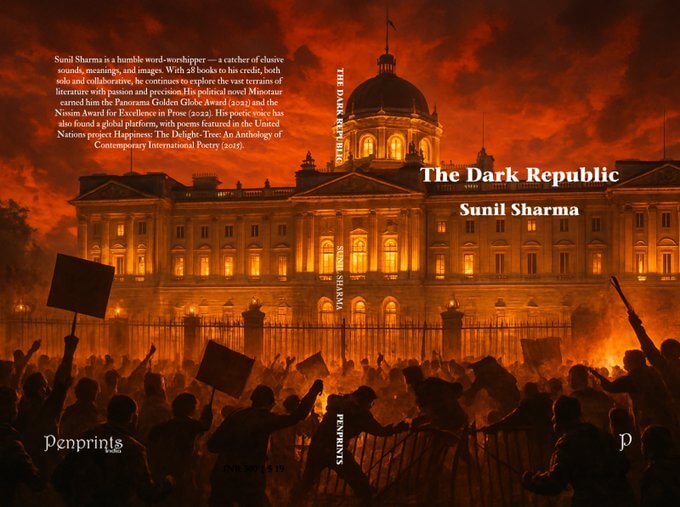
Dharampal reviews Dr Sunil Sharma’s The Dark Republic for DifferentTruths.com, providing an intellectual dissection of modern, technologically advanced authoritarian systems.

AI Summary:
· Dystopian Allegory: Explores the fragile transition from democracy to a technologically advanced, surveillance-heavy tyranny.
- Psychological Depth: Examines the “god complex” of autocrats and the internalisation of state-sponsored oppression.
- Narrative Fusion: Combines journalistic reportage with fictional diaries to create a dense, multi-layered philosophical inquiry.
Dr Sunil Sharma is a Toronto-based senior author with 29 published books (solo and joint) of poetry, short fiction, novels, and critical studies. He is the recipient of several prestigious awards.
His second political novel, The Dark Republic—a publication of Penprints, India, published last year—is drawing wide attention from readers as well as critics.
Divided into nineteen chapters, the novel is a dystopian political allegory that explores authoritarianism, the seduction of power, and the fragile nature of democracy.
The story opens in Hong Kong during mass pro-democracy protests. Through the eyes of journalist Marco Columbus, Sharma examines state violence, public resistance, and the gradual decay of democratic ideals. The novel introduces the idea of a secret, authoritarian, and technologically advanced hidden state. Democracy’s slow mutation into tyranny becomes the philosophical foundation of the book. Marco is interrogated by the regime’s brutal officials, setting the tone for the unfolding oppression.
Sharma explores the god complex of the autocratic ruler of the Dark Republic, himself a former revolutionary. His psychology, shaped by paranoia and obsession with control, is sharply portrayed.
“Prison Diaries” of Arya and other narratives present harrowing accounts of imprisonment and psychological torture. The republic becomes a monarchy in disguise. Eventually, the emperor himself becomes trapped within the very system he created. The story takes a mythic turn: power consumes its creator.
The Dark Republic is a structurally ambitious novel that interrogates the erosion of democratic institutions in the modern world. It adopts a multi-layered structure, combining journalistic reportage, fictionalised diaries, historical reconstruction, and mythological symbolism. This creates a reading experience of multiple temporalities and coexisting perspectives. It is a fusion of political allegory, philosophical inquiry, and narrative fiction.
Situated within the lineage of dystopian literature, the novel addresses transformations of power in a post-liberal, technocratic age. Unlike classical dystopias that focus on centralised state oppression, Sharma’s work examines the diffuse, networked mechanisms through which authoritarian control is normalised and internalised. This layering gives the novel intellectual density. The reader feels immersed in life inside authoritarian systems and connects deeply to the storyline, making the novel richer.
The text is dense and metaphorical, serving the purpose of exposing a surveillance-heavy state and the suffocating world of The Dark Republic. Sharma writes: “The system has entered your mind, colonised your conscience, and taught you to applaud your own erasure.” The novel’s power lies in its collision of ideas. The details of interrogations, imprisonment, and ideological confrontation hit hard. The violence is psychological before it becomes physical; the horror is bureaucratic and chillingly polite.
Sharma does outstanding work in conceptual originality, engagement with current global realities, and his deep understanding of authoritarian psychology.
The Dark Republic is a political meditation disguised as a narrative and a moral inquiry into how societies willingly surrender freedom. It challenges the reader.
Spanning 447 pages, the novel is demanding. Sharma prefers conceptual depth over narrative economy, and this results in an intellectually stimulating work. The novel prioritises systemic critique to meet its ideological objectives and offers a sobering diagnosis of modern political life. Its significance lies in provoking intellectual unease – a quality that secures its relevance in the current global context.
Cover photo shared by the reviewer

Dharmpal Mahendra Jain is a Toronto-based author who writes in Hindi and English. He has thirteen published books: a novel, eight collections of satirical essays and four collections of poetry. His English poetry has been previously published in Setu, Poetry Pause, Fresh Voices, Harbinger Asylum, Akshara, Impspired, Piker Press, Scarlet Leaf Review, Dissident Voice, etc.

 By
By
 By
By
 By
By