
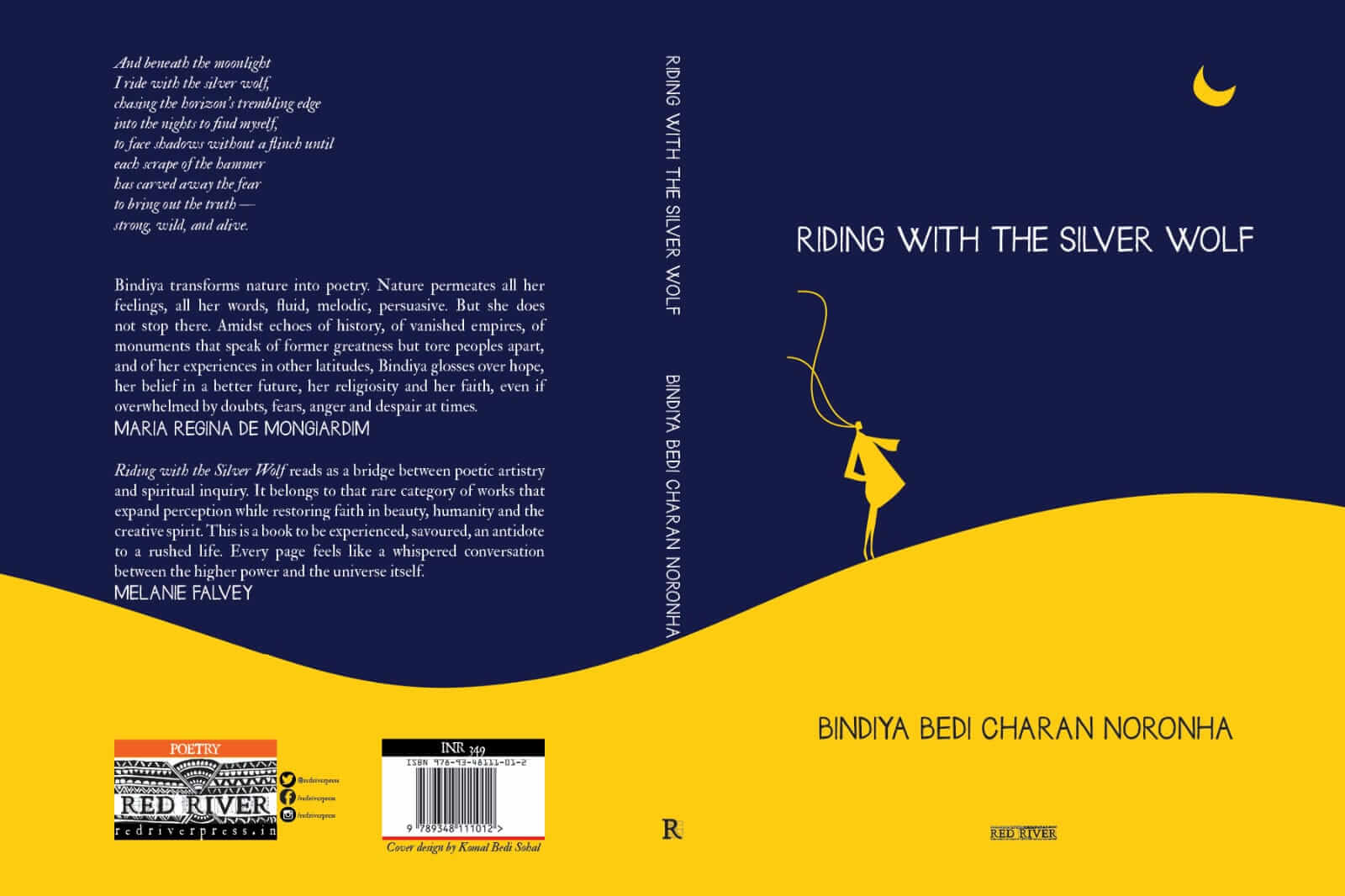
Mandira reviews the verses of Bindiya Bedi Charan Noronha for DifferentTruths.com, capturing a soul’s journey through spiritual and metaphysical landscapes.

AI Summary
- Thematic Depth: Explores 86 verses spanning spiritual growth, the influence of motherhood, and the “Smiling Buddha’s” message of compassion.
- Global Perspective: Blends contemporary experiences with nostalgia for Paris, contrasting nature’s beauty with the harsh realities of the Indian monsoon.
- Social Consciousness: Employs powerful metaphors and oxymorons to highlight human vulnerability, specifically the plight of widows in Varanasi.
Riding with the Silver Wolf by Bindiya Bedi Charan Noronha is a distinct collection of 86 verses starting from the poem titled ‘My Mother’s Song’ and concluding with the verse ‘The Wild Hymn’.
The verses very well suggest her journey, whether spiritual, metaphysical or from her contemporary experiences. This volume, dedicated to her husband and son, speaks of her ability to internationalise contemporary poetry with subjective metaphors in search of a humane world.
Mother dominates her work, which is both modern and traditional, thematically. She is grateful to all mothers – whether her biological mother or Mother at Aurobindo Ashram.
She pays her tribute to her mother in the first poem of the volume, titled My Mother’s Song, and the following lines speak of her regard for her mother, who has moulded her life:
I once heard my mother
Sing the Sukhmani
Ignorant of its wisdom
I hummed the song
By singing Sukhmani, she has reached a state where she can act as a flying crane rising above the flames. She can leave this earth and reach the sky, transcending. earthly matters.
Nature is appealing to the poet.
In the poem, Poet and the Sea, she pens down the following lines:
The sea remembers the poet who
Returns to the same shore year after year....
As she creates nature as her ally, in her own words, she experiences freedom in nature and ecstatic bliss.
Ephemeral Love talks of compassion that Buddha has spread in this inhumane world.
Her advice sways with Buddha’s advice as she writes the following significant lines.
Love and be loved
Be the Smiling Buddha.
Monsoon, especially the Indian monsoon, captivates the Indian poets. But she writes on the contradictory side of monsoon that brings disease, deaths and calamity.
The poet has been a globetrotter, and like many creative people, the city of Paris fascinates her. Therefore, the poet writes:
Paris haunts her/ a city etched in her memory
Remembering Paris, nostalgia whispers.
A lovely memory of a lovely city.
The poet turned into a philosopher as metaphysics dominated several poems. She pens down the doctrine of Karma, the theory of cause and effect.
In silence, she realised
Cause and effect
She may be a spiritual poet, but the plight of the widows shakes her, and, very appropriately in her poem Varanasi, with great sensitivity, she writes of the widows:
Abandoned by family
Embraced by Varanasi
In imperfect white
The term ‘imperfect white’ used as an oxymoron speaks volumes of the poet’s command over the language.
She is well-versed in several languages. As a polyglot, her universality will fascinate the readers.
Equally matched by sketches in black and white, Red River has produced the volume with great creativity and craftsmanship. A must-read for all lovers of poetry.
Book Cover sourced by the reviewer

Mandira Ghosh, author of 23 books is an eminent poet and author, editor and secretary of the poetry society, India. She is awarded with a Senior Fellowship from the Ministry of Culture Government of India and also is the Guest Editor of the Special Indian Edition of the Seventh Quarry Swansea Magazine from Wales published and anthologised in several journals she is recipient of numerous awards; Dr. Radhakrishnan Award In Teaching, Dr. Sarojini Naidu International Award For Working Women, Bharat Nirman Award, Author of the Year Award, Editor s Choice award from National library and the International Society of poets, USA.


 By
By
 By
By
 By
By
 By
By