
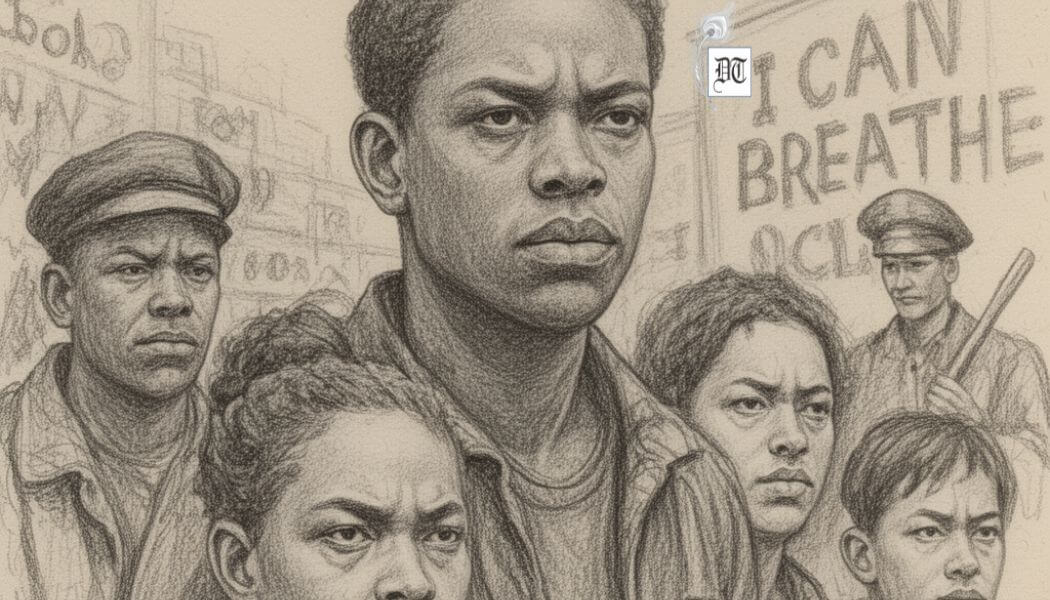

Sayantani’s insightful analysis on DifferentTruths.com traces the Black Power Movement’s evolution, connecting historical struggles for self-determination to modern activism.
AI Summary
- Historical Roots: The Black Power Movement (1966–1975) emerged from the Civil Rights era, prioritising Black self-sufficiency, cultural pride, and militant anti-racism.
- Modern Evolution: Contemporary movements like Black Lives Matter (BLM) rediscover these ideologies to combat systemic targeting and humanise victims of violence.
- Global Parallels: The struggle for equality extends beyond the U.S., finding deep resonance with India’s pervasive caste and skin-colour discrimination.
“If there is no struggle, there is no progress,” Frederick Douglass said about the Black Movement. Therefore, to understand the Black Power Movement, we have to look back in history.
The Black Power Movement opposed racial discrimination and segregation in the mid-1950s. It was a social and political movement to ensure the equality and self-sufficiency of Black people and African Americans. Stockley Carmichael, a leader of the Student Nonviolent Coordinating Committee, first articulated Black Power. Many news organisations, such as the Black Panther Party and the Black Women’s United Front, emerged with new cultural, political, and economic ideologies. As those beliefs were fresh, they were often regarded as anti-white, anti-law enforcement, and violent. African Americans primarily used nonviolent methods to express their protests. They pleaded, petitioned, and addressed government officials to achieve the gradual improvement of their status.
The Black Power Movement aimed to emphasise Black self-determination and self-confidence. The adherents of the Black Movement believed that African-Americans should secure their human rights by fostering political and cultural awareness and integration that serve their interests. The movement encouraged the people to embrace Black art, history, and beauty. It ensured the confidence to take control of their own lives and to empower themselves culturally, politically, and economically.
Black Power and Its Relation to the Civil Rights Movement
In 1954, the Civil Rights Movement emerged as an effort to improve the quality of life for African Americans. Nonviolent disobedience, Black militancy, and legal action were among the strategies of the Civil Rights Movement. Martin Luther King Jr appeared as the leader of the Montgomery Bus Boycott. It was the first mass immediate operation of the concurrent Civil Rights Movements and guided activists’ struggles throughout the country.
Although the Civil Rights Movement achieved notable victories, including the outlawing of racial discrimination and the widespread awareness of African-American culture and heritage, its unfinished work was transformed into “Black Power”. The phrase ‘Black Power’ might be unique, but the underlying meaning was not new. The Black Power Movement began in 1966 and lasted until 1975. It was a militant anti-racist action, and unlike the Civil Rights Movement, it supported even violence if required to cease racial discrimination.
‘Black Lives Matter’: A Journey
The theories of the leader Malcolm X, who was assassinated before the rise of the Black Power Movement, were woven with the fights for global human rights and anti-colonial traits. The Black Power Movement empowered a range of Black activists and leaders, giving them role models and an innovative way to end racism in the U.S. In the 1960s, the ‘raised fist’ became a symbol of Black power and the ‘Black Lives Matter’ movement. It is the rediscovery of the Black Power Movement today.
After the deaths of Trayvon Martin and Michael Brown, Black Lives Matter continued to flourish. This phrase was a tribute to these and other deaths, honouring and humanising Black lives. It intends to be a political and ideological mediation in a culture where Black lives are ordered and deliberately targeted for decreasing. Its goal is to reconstruct the Black freedom flight.
This American social movement was first established by Alicia Garza, Patrisse Cullors, and Opal Tometi to acknowledge the loss of teenager Trayvon Martin due to a gunshot. Day by day, it became an integral organising force and gained more comprehensive visibility.
Opposition to Black Lives Matter has arisen from plenty of associations and organisations, which have challenged the progress of being anti-law enforcement while at the same time scrutinising the movement’s specific focus on Black lives and the problems.
Black Lives Matter has stimulated the arts, and depictions of protesters, leaders, and victims of police brutality have appeared in various films and literary works, both fiction and non-fiction. The appearance has been obtained on apparel, flags, and numerous protest symbols. The protestors have demonstrated, displaying placards with illustrations and paintings as memorials. The beautiful offerings of Black Lives Matter can be found in multiple murals across the globe. These remain symbols of struggle and signs of a liberated future.
Responses and Criticisms
The Black Lives Matter activists published a set of issues, including goals, top priorities, and a platform as “Vision For Black Lives” on August 1, 2016. It was collaborated on by more than fifty organisations interested in refining and improving colour. Black Lives Matter is pledged to increase awareness of gender-based violence against Black women and girls, transgender, and gender non-conforming individuals.
Critics of the Black Lives Matter movement made several calls. They said systemic racism and prejudice do not exist in the United States. They also criticised and alleged that the Black Lives Matter movement had encouraged violence against police. Some new opposition groups were also formed in response to Black Lives Matter, including Blue Lives Matter (which supports law enforcement) and White Lives Matter (a white nationalist group).
The Black Lives Matter Movement strives to shift public opinion in America away from discrimination and inequality. If a country has entered a post-racial community, why is such a movement needed to affirm? Many people have shifted the focus of this movement, saying that it is not just Black lives that matter. Every life matters, and all lives are equally valuable. Anti-Black Lives Matter organisations began using slogans such as “All Lives Matter” and “Blue Lives Matter” in 2012. However, the truth remains as it is even at this point.
Closing Words
Racial oppressions have similarities throughout the world, and India is not outside of this social darkness. Though race and caste have different meanings, America’s racial inequalities have parallel caste inequalities in India. Along with that, India’s colour discrimination is rampant. The darker-skinned people, especially women, face discrimination in school, work and even in love and marriages. The demand for fairness cream in India is higher than in other countries. Although Indian law and the constitution prohibit social injustice, such as discrimination on religious, cultural, and social grounds, inequality continues in almost all areas of society and its norms.
In this pandemic situation, when George Floyd was killed in America, the voices of people against discrimination reached the whole world. The world is going through so many crises and suffering; the issues that reflect inhumanity and unkindness should be removed from our minds and hearts. Life is special and unstable; we should overcome all mental blocks that bring nothing but hopelessness.
Today, the new plans and policies are expected to emerge in support of the Black Lives Matter Movement. However, the most effective way the Black Lives Matter Movement can educate in the future is to promote equality and non-racism, which will help it gain more public support.
Picture design by Anumita Roy

Sayantani Mukhopadhyay is a writer with a bold passion for journalism and empowerment. She holds a background in English Literature, Human Resource Management, and Mass Communication and Journalism. Her work blends critical inquiry with people-focused insights, centring on sustainability, social issues, and conscious living. Through authentic and research-driven storytelling, she strives to amplify voices, challenge norms, and inspire collective awareness and action.


 By
By
 By
By
 By
By