
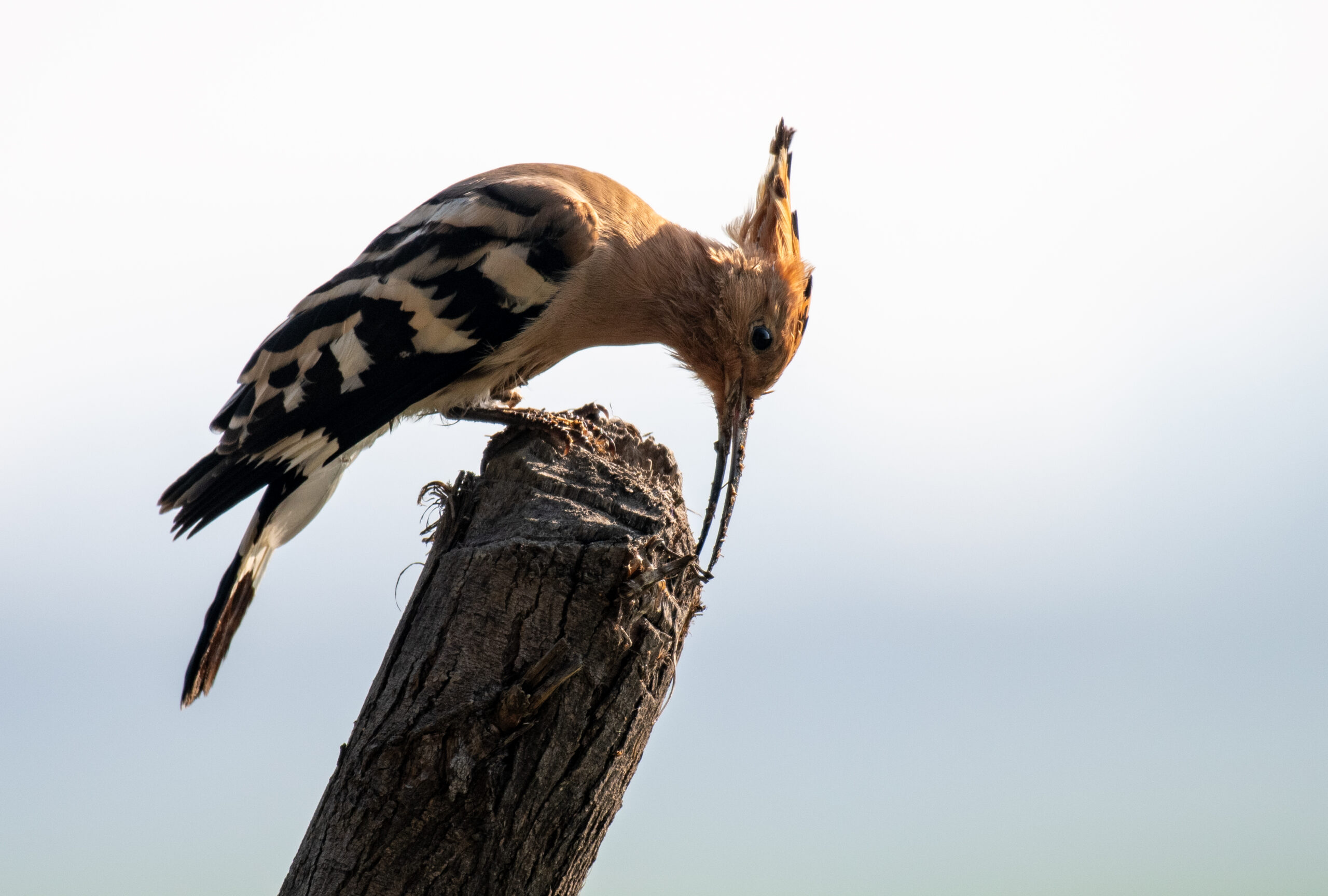
Discover the Hoopoe’s Mohican crest and punk charm in Prof Swaraj’s vivid encounter at DifferentTruths.com—nature’s original rebel bird, blending myth, poetry, and backyard wonder.
AI Summary
- Prof Swaraj witnesses a fearless Hoopoe foraging insects in Sunam, captivated by its punk-like crest, staccato moves, and criespsis amid tailor birds and babblers.
- Explores Hoopoe’s global lore—from the Sanskrit ‘Putrapriye’ in Ramayana and the Quran messenger to Montale’s “ambassador of spring” and Updike’s witty “Pooem.”
- It highlights its farmer-friendly insect diet, foul-smelling nest defence, and “original punk bird” status, turning observers into birdwatchers.
It was the morning of March 20, 2021. We were at our son’s home in Sunam. Having a spacious lawn in the back surrounded by flower beds, it’s a home to many birds, too. Two lemon plants and a grapevine are an added attraction to frugivorous birds. I was just lazing in the first-floor bedroom when I heard the loud, piercing keow-keow of a peafowl. It was perched on the parapet wall, and the moment it saw me opening the bedroom door, it flew away.
When I looked down towards the lawn, I was pleasantly surprised to see a Hoopoe on the ground. Two tailorbirds were flitting about the branches of the lemon plant, and a flock of boisterous Jungle Babblers was creating a loud ruckus in the grapevine. I was fascinated to see the Hoopoe picking insects from the soil with its decurved bill. Since I had never seen a Hoopoe from up so close, I was tempted to take its photographs.
Picking up my camera, I tiptoed towards where it was. What a fearless bird it turned out to be! It saw me but went on with its breakfast near an earth-brown anthill. In between, it was making muffled, low-pitched sounds, hoo poo poo, hoo poo poo, to invite a mate or to mark its territory.
With its high level of crypsis owing to its cinnamon and rufous plumage, it would often disappear into the background, a no mean feat for a bird known for its remarkable light cinnamon-pink-brown plumage, crest and zebra-like markings on its wings that make it resemble a butterfly when in flight. Its movements on the ground, though graceful, were not smooth. It would probe the ground with its bill, move on swiftly, halt abruptly to continue picking the insects and then move on equally abruptly and swiftly. Its staccato mechanical movements were like those of a battery-driven toy.
It was a delight to watch the Hoopoe at its chores. It would spread its splashy, fanlike crest for a brief moment and then shut it tight to make it resemble the punk hairstyle that immediately reminded me of the West Indian cricketer Andre Russell. It became alarmed only when I crouched on the ground to take ground-level photographs, raised itself to its full height and took to wing, fanning the remarkable crest for the last time. Its amazing Mohican glory left me transfixed.
Later on, when I saw the photographs, the Hoopoe’s wonderful crest brought back the memories of the crest-wearing native Huron warrior Magua and his followers in the American historical epic movie of the early 1990s, The Last of the Mohicans. As well as the haunting Mohicans Cover by the Peruvian Alexandro Querevalú played on the folk instruments –the Quenacho and the Pan Flute. Images of today’s youngsters with punk-inspired spiky hairstyles also flashed upon my mind.
Is it likely that the Mohicans, the Algonquian-speaking North American Indian tribe in the upper Hudson River valley in New York, US, were also inspired by the Hoopoe’s crest to have a spiky hairstyle? But whether they did it after the Hoopoe’s crest, our Hoopoe that came to us that morning was surely a Mohican, “the original punk bird” as David Chandler and Dominic Couzens refer to the Hoopoe in their book 100 Birds to See Before You Die (2008). According to them, the “Hoopoe is a bird that the birdwatchers enjoy … a bird that has the potential to turn a non-birdwatcher into a birdwatcher.” (108)
Breeding in much of Europe, Asia and Northern Sub-Saharan Africa, the Hoopoe(Upupa epops), the national bird of Israel, belongs to the family Upupidae. Both the common and scientific names – Hoopoe and Upupa epops – are onomatopoeic, derived as they are from its characteristic call. A bird of open spaces, it nests in hollows in trees or walls. Since its diet consists mainly of insects, caterpillars and locusts, it is a friend to the farmer.
There are many references to the Hoopoe in mythological and modern secular literature. According to KN Dave, author of Birds in Sanskrit Literature, it was a much-loved bird in ancient India, as it finds respectable mention both in the Ramayana and the Mahabharata. Its Sanskrit name, ‘Putrapriye’ – devoted to one’s offspring – is derived from its love of progeny as well as its distinctive ‘pooh-pooh’ call, echoing ‘putra-putra’ – literally meaning ‘son-son’ in English. And its alternative name in Sanskrit, which it shares with the woodpecker, is ‘Kuthaku’. This too is onomatopoeic. The Punjabi name for the Hoopoe is ‘Chakkiraha’. My father, who belonged originally to Banur in Punjab, had once told me that in his part of the world, the Hoopoe is called ‘Thokam Thahhiya’, again an onomatopoeic expression like ‘Kuthaku’.
References to the Hoopoe are found in some other cultures also. In ancient Egypt, it was considered to be a sacred bird associated with inheritance. Known as “Hudhud” in Persian literature, it is associated with wisdom and virtue. In the Quran, it is considered King Solomon’s messenger who searches for water for him. In Farid Ud-Din Attar’s The Conference of the Birds, written in the 12th century, there’s an allegorical tale in which birds of the world, led by a Hoopoe, gather together for a journey to meet God.
However, it was not adored in all cultures. For example, in Scandinavia, it was thought to be a harbinger of war, and was linked to death in Estonia. In Greek mythology, the gods punish King Tereus by transforming him into a Hoopoe as a punishment for his tyrannical acts.
A remarkable feature of the beautiful Hoopoe, for which it was slandered, is its foul-smelling nest and nesting habits. The female alone incubates the young ones. The male provides the food to the female till the young don’t fledge. Once the female leaves the nest, both parents feed the fledglings. The most peculiar feature of the whole nursing process is that the mother Hoopoe’s uropygial gland becomes overactive during the breeding season. It produces antimicrobial and antiparasitic secretions which protect the mother and the nestlings against microbes and ectoparasites. These secretions are extremely foul-smelling, and the mother coats the nestlings with them. The stench from the nest repels the predators.
The Genoese poet Eugenio Montale, the 1975 Nobel laureate, rescues the Hoopoe’s reputation in one of his poems from vilification by some other poets, such as Giuseppe Parini and Ugo Foscolo. “Hoopoe, happy bird maligned / by poets”, writes Montale, is an “ambassador of spring” for whom “time stands still” and “February never rues, and everything beyond bends down / going where your head is going, / crazy winged thing, and you don’t know it.”
The Hoopoe’s strange appearance, as well as the American poet John Updike’s own unsuccessful attempt to see a Hoopoe in urban settings, are the twin subjects of his humorous poem titled “Pooem”. Even the title of Updike’s poetry anthology in which this poem appears is “Waiting for a Hoopoe” (1959). And the very title of the poem that rhymes with the Hoopoe’s name and its song indicates Updike’s use of clever wordplay to describe the bird and his own failure to see it:
I, too, once hoped to have a hoopoe
Wing its way within my scoopoe.
Crested, quick, and heliotroopoe,
Proud Upupa epops.
He waits for the Hoopoe for an eternity on a “grassy sloopoe”, weaving “snares of finest roopoe”, and gazing through a “telescoopoe”. Finally, his quest ends bizarrely when he receives a “crusty enveloopoe” from a “far-off friend” with a note in it advising him to “Abandon hope, you doopoe; / The hoopoe is a misanthroopoe.” This wonderful poem full of hilarious neologisms ends with the idea that the Hoopoe doesn’t care two hoots for admiration by human beings; an incisive, satiric comment on the human vanity that makes us seek praise.
Unlike Updike, I didn’t need a “telesccoopoe” to observe my Hoopoe that came with its splendourous Mohican beauty to make my jaw droopoe.
Photos by the author

Prof. Swaraj Raj is a Patiala-based freelance writer, translator, a keen photographer, and nature enthusiast. He retired as Professor of English and Dean, Faculty of Languages, Sri Guru Granth Sahib World University, Fatehgarh Sahib. He has more than 70 publications to his credit in journals and books.


 By
By
 By
By
Very well written article depicting this beautiful bird’s body language, habits , habitat and in addition, mythology around it in Epics . Interesting to note author’s keen interest in this particular nature’s beauty.
Thank you so much, Prof. Virk Sir.
Captivating writing as always.. beautiful description of the hoopoe..
Esteemed Sir
Your blog is quite insightful and gives an extensive and intensive knowledge about hoopoe bird. Moving from its looks to its protective attitude towards its fledglings, its pragmatic approaches and the subtle nuances of its demeanour, everything is so intriguing. Historical, cultural, mythical and scientific aspects you discussed, make one live the wonderous beauty at work in nature and the world across cultures in different times. In short, this impeccable read takes the near to magical creation of Almighty in this world driven by reels.
Read the article with growing interest as it went along mentioning different names of the bird in different languages and different books in which the bird called Chakkirah in Punjabi. Swaraj a great nature lover is particularly interested in studying and photographing birds at their different locations
Thanks a lot, Sir.
Good one!
Though the Hoopoe doesn’t care about human admiration, I’m sure it’ll make an exception for this masterpiece – you’ve got it hooked 😄