
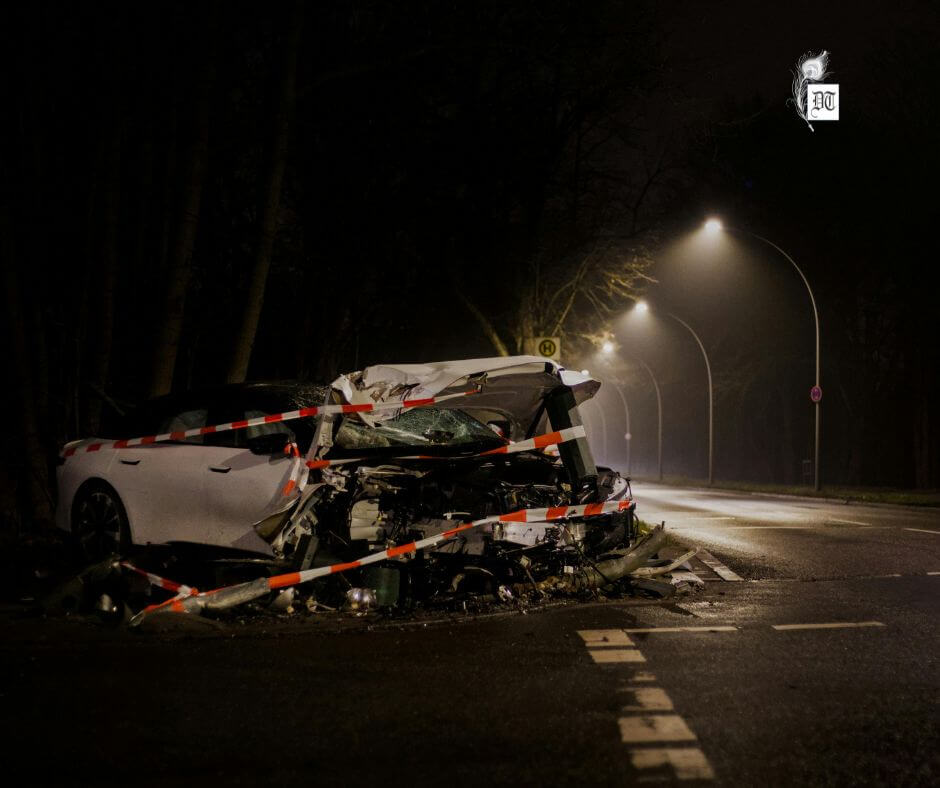
India’s roads claim 1.77 lakh lives yearly—every three minutes a death, warns Ratan Mani on DifferentTruths.com. Future fallacy fuels unsafe habits.
AI Summary
- Over 485 daily road deaths in India stem from speeding, no helmets/seatbelts, drunken driving, and poor infrastructure.
- Minister Nitin Gadkari laments the “lack of fear of law” and behavioural defiance despite Motor Vehicle Act hikes.
- Chaotic traffic, agency chaos, and cultural disregard doom soft campaigns—stricter enforcement is essential.
Every day, at least 485 individuals in different places in India leave their homes or workplaces and do not return alive. They lose their lives to accidents on roads involving anything from a pedestrian, an animal, a vehicle, a tree, a broken road or simply their own lapses.
None among the millions who are out on the road every day imagine that today it would be their turn to die. Yet, those who manage to come home at the end of the day invariably think it will not happen to them.
Call this the “future fallacy” or whatever, but unsafe behaviour on roads and, at the same time, hoping that death will not come to them has come to characterise the use of roads by millions of people in India.
It is borne out by the fact that India’s roads are among the world’s deadliest. Road crash deaths rose to over 1.77 lakh in 2024, or a death occurring every three minutes. It is not for nothing that surviving daily traffic in urban India is increasingly described as a “daily miracle”.
But wait! Are we worried? Not really, as the bystanders and passers-by at a fatal road accident site glance at the mess and blood, muttering that “surely the deceased was at fault!” And they move on regardless – wearing no helmet, precariously balancing three riders on a motorbike, avoiding the “uncomfortable” seatbelt, taking dangerous turns, making risky manoeuvres and ignoring traffic lights.
Does Anyone Care?
Are the authorities worried?
Wait again! Which authority? Is any single authority even responsible? Choose one: municipal body, development authority, public works department, highway authority, water and drainage authority, electricity department, road transport authority, railways… or it could be the trees and garden department.
The causes of road accidents are also many: over-speeding or driving in excess of prescribed speed limits (typically the single biggest cause); not wearing helmets or not using seat belts; drunken driving or driving under the influence of drugs; overloading in passenger vehicles; three or more riding a two-wheeler; driving without a valid licence; driving on the wrong side; complete and uncivilised disregard for basic road rules; unfit vehicles; and, of course, bad roads, encroachments and brazen aggression by fellow road users.
The Union Road Transport and Highways Minister Nitin Gadkari is credited with many innovations, an infrastructure thrust and a futuristic vision. But he has repeatedly expressed his frustration at not being able to reduce road accidents. Speaking at different places, be it in the Rajya Sabha on December 20, 2023, the World Safety Conference 2024 in New Delhi or the Infrastructure Summit in August 2025, he has frankly acknowledged that despite years of safety initiatives, road accidents continue claiming lives because changing human behaviour remains the most formidable challenge.
Like most of us, the minister has expressed frustration with other persistent violations, including poor lane discipline and casual disregard for basic traffic rules. He has even observed that “people are athletic – they jump over two-foot barriers”, reflecting the observations of most people. These observations underscore that enforcing safety measures is almost impossible when citizens actively circumvent protective infrastructure. When Gadkari cites a “lack of fear of the law” as a major contributor to the problem, it says a lot about our overall universe of governance. Rightly so, as Gadkari himself said that the high rate of road accident fatalities in India can be deemed to be a governmental failure.
Soft options
Will campaigns, awareness drives, traffic safety “week”, “Run”, “Quiz”, and similar soft initiatives lead to a change in the mindset of the people regarding violations of traffic rules?
Eternal optimists might respond with a resounding “YES”, but as a close observer of human behaviour on roads since the 1970s, my response is a resounding “No.”
My reasons:
The chaotic traffic mix: it comprises cars, buses, motorcycles, e-rickshaws, bicycles, cycle rickshaws, handcarts, animal-drawn carts, pedestrians and stray animals, hawkers, encroachments on roads and footpaths.
Zero coordination among agencies: One department builds and paves a road in the night – the next morning, another agency digs it up to lay a pipe or cable. The electricity department leaves a pole in the middle of the road after shifting the light. The water authority leaves a pit or manhole open after digging it for repairs. Clearly, for all such agencies, the value of safety or a lost human life or injury is a big zero (italics for emphasis).
Culture of convenience: A large number of individuals get a permanent driving licence at home without the hassle of standing in the queue, taking driving tests, getting a medical fitness certificate and getting a photo clicked – after paying a “convenience fee”. For them, knowing how to drive safely, knowing the signs, physical fitness, etc., does not matter.
Disregard of law: Those who are rich, politically or otherwise well-connected, need not follow the rules. It is for the lesser mortals to do so. Showing off one’s prowess on the roads is the most visible and effective way to assert dominance.
All this is happening every day across India despite amendments in the Motor Vehicle Act in 2019 to hike prescribed fines for traffic violations. This was expected to bring down traffic violations by financially hurting the violators, but no significant dent has been made in the volume of infringements. Instead, road fatalities have kept increasing year after year.
The government may apparently be convinced that merely increasing penalties is only marginally consequential in addressing the issue, but taking stricter punitive measures is still not an option. Instead, the minister talks about bringing about “behavioural changes” by pressing the services of social and educational organisations. In the next 24 hours after you read this article, perhaps more than 450 persons would have died in road crashes. To most people, the deceased could be a stranger. But for at least one family, he or she is a loved one, a sole wage-earner, or the only member in the family.
Yet, measures such as life-long driving bans, punishment for obstructing roads, greater enforcement with technology or more traffic cops and large-scale DL cancellations are not considered, perhaps for being too “undemocratic.” The death of 1.77 lakh people every year is the price we will continue to pay.
Picture design by Anumita Roy

Ratan Mani Lal is a journalist with more than 40 years’ experience in major English and Hindi newspapers such as The Times of India, Hindustan Times and The Bhaskar Group. He headed the Jaipuria Institute Mass Communication for several years. He writes for Firstpost, One India.com, Zeenews.com and other publications in English and Hindi. A celebrated commentator for several television channels, he writes on current affairs with a focus on political scenario, development issues, and environment.
He is our Editorial Advisor and National Editor: Politics, Development Issues and Environment


 By
By
 By
By
 By
By
 By
By