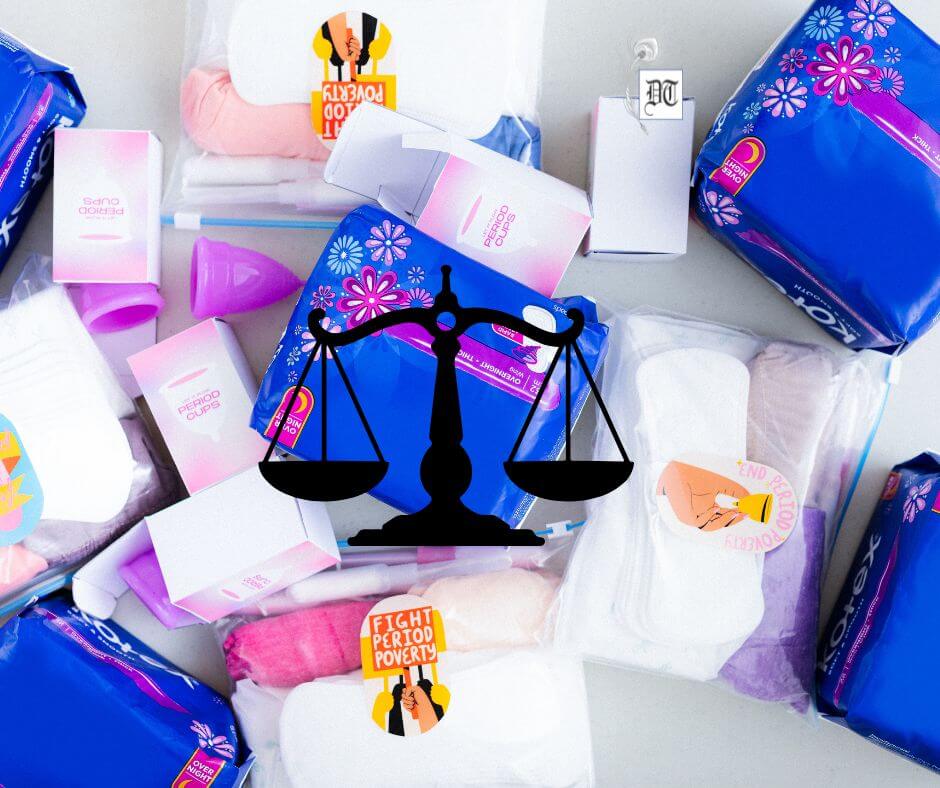
For DifferentTruths.com, Chitra reports the Supreme Court now links menstrual health to the Right to Life, mandating free pads and school facilities for 119 million Indian girls.
AI Summary
- The Supreme Court ruled menstrual health as a fundamental right under the Right to Life, ordering free sanitary pads and MHM corners in all schools.
- Mandates stocked facilities with spares and proper toilets; trains teachers on stigma-free education for 119.3M schoolgirls.
- Three-month implementation deadline with a follow-up hearing to ensure gender equality in education.
—
- The Supreme Court of India, in a directive on January 30, 2026, has declared the Right of Menstrual Health a part of the Right to Life.
- It has ordered free sanitary pads for girls in urban and rural schools.
- Menstrual Hygiene Management (MHM) corners in schools stocked with spare innerwear, uniforms, disposable bags, and other necessary menstrual accessories for the girls have been declared a must.
- The Right to Menstrual Health is intended to enable the Right to Education, which is part of the broader framework, one that enables the Right to Life and Human Dignity and the Right to a Healthy Reproductive Life.
Schoolgirls, whether in cities or villages, will now feel more comfortable if their periods begin unexpectedly during class. They can openly inform their teachers about this and ask for free sanitary pads at their schools. The Supreme Court of India, in a January 30, 2026, directive that has declared the Right to Menstrual Health as part of the Right to Life, has made this possible.
Girls who previously absented themselves from school during their periods can now participate in classes with greater confidence, thanks to this ruling that ensures not only the provision of free sanitary pads but also the availability of safe, girl-friendly toilets.
Approximately 119.3 million girls in school stand to benefit from this ruling.
The Division Bench, comprising Justices JB Pardiwala and R Mahadevan, has stated that the Right to Education is a ‘multiplier right’ that includes the Rights to Life, Human Dignity, and Healthy Reproductive Life. The justices emphasised that inadequate menstrual health leads to gender-specific disadvantages in education for girls. They argued that the Right to Menstrual Health aims to address and rectify this issue.
As menstrual health has been a missing element in school infrastructure, the Supreme Court, in a significant breakthrough, has mandated that schools establish Menstrual Hygiene Management (MHM) corners. These areas, the order says, should be stocked with spare innerwear, uniforms, disposable bags, and other necessary menstrual accessories for the girls. Additionally, according to the ruling, toilets must provide running water, sanitary pads, covered disposal bins, soap, and functional hand-washing facilities. It may come as a surprise to many that not all schools, even in urban areas and among top premium institutions, have these essential facilities, the absence of which leads girls to face indignity, humiliation, discrimination, and inequality.
The Apex Court’s focus on raising awareness and providing training about menstrual health and puberty is commendable. It has directed the National Council of Educational Research and Training (NCERT) and the State Council of Educational Research and Training (SCERT) to address the taboos, stigma, and silence surrounding menstruation in their curricula. The Court’s move is particularly important, as this is an often-ignored issue, filled with misinformation and misrepresentations of facts that restrict girls’ mobility and social interaction.
A complex mix of daily gendered experiences, biology, and medical conditions influences menstruation. Consequently, teachers are specifically instructed to allow girls to leave for the restroom upon request, without objection or question.
The Court has taken another significant step by emphasising the importance of male teachers incorporating accurate and stigma-free information about menstruation into their lessons. This initiative aims to break the silence and discomfort surrounding the topic, encouraging both genders to engage in open discussions. It also seeks to help male students develop empathy for their female peers. The Court believes that this measure will promote the understanding of menstruation as a natural biological process, rather than something to be ashamed of or discussed in hushed tones.
Notably, the recent menstrual justice framework holds that this right should not be treated as a discretionary welfare measure but as an essential, non-negotiable component of educational infrastructure. To show seriousness of intent, the Court has fixed a three-month timeline for implementation and has stated that it will follow up with a hearing on progress, or lack of it, at the end of the timeline.
Picture design by Anumita Roy

Chitra Gopalakrishnan, based in New Delhi, is a versatile writer whose passion for language bridges nonfiction and fiction, narratology and psychoanalysis, marginalia and manuscript, as well as tree-ism and capitalism. A journalist and social development communicator, she focuses on environment, gender, and child rights. She has also worked as a consultant for Oxfam GB, Plan International, Care India, and the United Nations, bringing insight, sensitivity, and depth to her interdisciplinary practice. She is our Associate Editor: Advocacy, Environment and Social Development.


 By
By
 By
By