
Sanjukta Dasgupta translates Rabindranath Tagore’s poignant Bengali poem ‘Narir Kartavya’ for DifferentTruths.com.
Rabindranath Tagore’s Bengali poem, Narir Kartavya, was first published in 1939, two years before his demise. A translation in English.
For Men, all mantras and tantras are a pack of lies
Manu-Parashar groups will fail to pull him down
His mania is to follow the path of intelligence;
Regarding meals and what’s touchable
He will argue about it all, creating such chaos

Women will save the country,
When the country hastens ahead
Yawning, calling out to Durga,
They remain awake
In the last hours of the night.

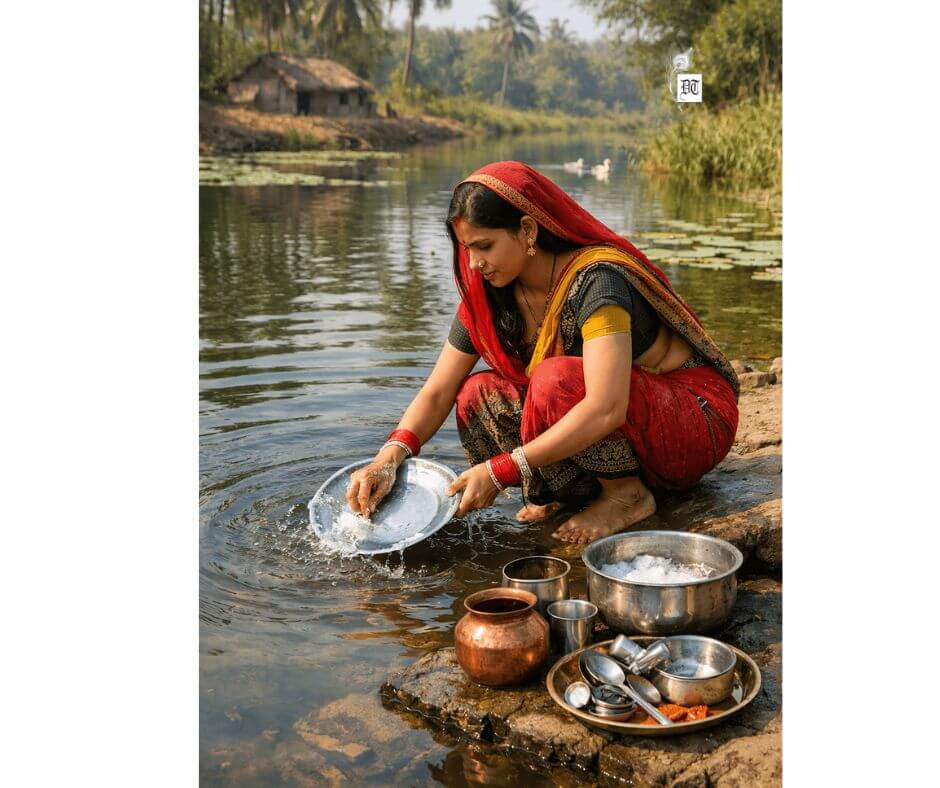
In the stagnant backyard pond
She carries all the soiled dishes
After scrubbing and cleaning them all
She returns to the kitchen
She cuts the restless live fish into pieces
Holding its head and tail tightly, with her skilled wrists
She spreads ashes from the oven, wields the fish knife
After she has tightly secured her Anchal, her sari-end.

She shreds Ichor, the raw and tough jackfruit
She cuts in large round slices, Thor, the raw Bamboo shoot
She tugs out and spins the Thor threads around her fingers
She also shreds mocha, the banana blossoms with aplomb
She assesses the Chalta’s1 toughness
Potol2, Brinjal3 and Alu4
She slices it into countless pieces

Thereafter, over to the spatula, wok and ladle
Cooking in three or four rounds
As proposed by the family –
Some for the office or school, or for those with a weak stomach
Boiled rice, refined rice, husked rice, some thick too
The time she gets some recess – that time would be two-thirty.
Giving the cat some fish bones
Stuffing some betel leaf and dokta5 in her mouth
She would try to get some sleep
If the child cries, she smacks him on his back
And says, “He’s such a naughty boy,”
Thereafter, at night, she will serve roti and leftover vegetables.

Janardan Thakur’s hyacinth-covered pond
It's bank-lined with water spinach
In between bathing in the pond
Carrying the pitcher on the hip,
The wet sari wrapped around
The hand is swaying frequently
Walking through the crackling
Leaf-strewn bamboo forest
Chanting the name of Ram in her mind
She returns home as fast as possible

In the haunting twilight, in the shadow of darkness.
In the evening, the widowed sister-in-law sits on the terrace
Twiddling the holy beads in a string.
The bride of the family runs a comb through her matted hair
As she maligns the neighbours in whispers –
Hearing about this from an unknown source
Bose Ginni comes rushing from the neighbourhood;
She warns sharply that for such defiance
Husbands and sons will be visited by misfortune.

Holding the cloth-wrapped holy book in his arm
Smearing a tilak on his nose
Arrives the priest –
The mistress’s second son is under the spell of Saturn
So, his marriage is facing a setback
To settle this debacle
The list of required items
The holy rituals are massive
All was arranged
Without informing the master of the house

In this way, the eternal Sanatan6 days pass by
As stipulated by Chatterjee Mahasay –

Through quarrels and chanting of holy names,
 In search of a future bridegroom
By arranging feasts for drug-addict Brahmins.

If in case girls do read books at all
Their hearts should never be moved
Why is a new book necessary?
Just buy a new panjika7
Hold it over the head and perform
Worshipful pranams8 on an auspicious day
Then there are the rhymes in the Panchali9
These will wrap the intellect tightly
With the norms of the national culture

Disaster can be perceived;
The Bengali woman now wears a chemise
By passing the BA and MA, they scatter seeds
Of rational thinking that spreads carnivorous practices
Religious practices have gone berserk
They neglect the Goddess Mother Sitala10
They get themselves vaccinated for pox
“During the eclipse, bathing in
The river Ganga cleanses all sins”
When they hear this advice, they laugh like fools!

Yet this pristine land can be saved,
Countless girls have been born in the garb of men
They paint the mandirs with the blood of sacrificed animals
They smear the foreheads of their children with that blood
But when there is a medical crisis
Then cars of doctors arrive at their gates.
Goddess Saraswati11 accepts their floral offerings
But during examinations, there’s no alternative to notebooks.
Women are entering colleges with such a male-centric education
Hence, this is the result.

When the intellect of women cools the men
It is then that the land is saved.

It is difficult to understand, chased by fear
They consult the holy almanack
Before stepping out of the house.
Yet in that very land, the Gods
Advocate strange evil practices
The one who breaks all practices
Is the emissary of Death, Yamadoot12

They speak of a host of auspicious hours
They drum this message in localities
Yet more than all other lands
It is in these lands
The number of the dead rises.
On a Thursday afternoon, I have written this poem.
Who knows whether I will be able to bear the fallout?
Notes:
- Chalta – elephant apple. Very sour to taste. Popular as a fruit in South Asia.
- Potol – pointed gourd
- Brinjal – eggplant
- Alu-potato
- Dokta- tobacco leaf
- Sanatan – timeless tradition. Sanskrit word
- Panjika – a traditional Hindu astronomical almanack used particularly in Bengal, Odisha, Assam, Nepal and others
- Pranam- respectful bow or feet touching. A traditional gesture of showing respect.
- Panchali- oral narrative form of simple songs and stories
- Ma Sitala – a Goddess who protects and heals people from epidemics such as smallpox. This poem was first published in 1939, when Rabindranath Tagore was 78 years old. He died two years later in 1941.
- Saraswati – Hindu Goddess of learning
- Yamadoot – messenger of death. Yama is the deity governing death and the netherworld.
Picture design by Anumita Roy

Dr Sanjukta Dasgupta is a poet, short story writer, critic, and translator. She was a General Council of Sahitya Akademi, New Delhi, member and the Convenor English Advisory Board Sahitya Akademi, New Delhi. She is the President of the Intercultural Poetry and Performance Library, Kolkata and has twenty-six published books. Her poems have been translated into German, Serbian, Bengali, Hindi, Punjabi, Kashmiri, and Tamil.



 By
By
 By
By
 By
By
 By
By