

Ruchira reviews Triveni Kala Sangam’s street play on Kabir’s life for Different Truths, highlighting its immersive, timely message of communal harmony and timeless spiritual wisdom.
As 2025 quietly drew to a close, New Delhi’s Triveni Kala Sangam, a renowned cultural institution, presented a diverse range of cultural events and programmes. This was intended as a curtain raiser for the 75th anniversary celebrations, which are planned to continue throughout the year.
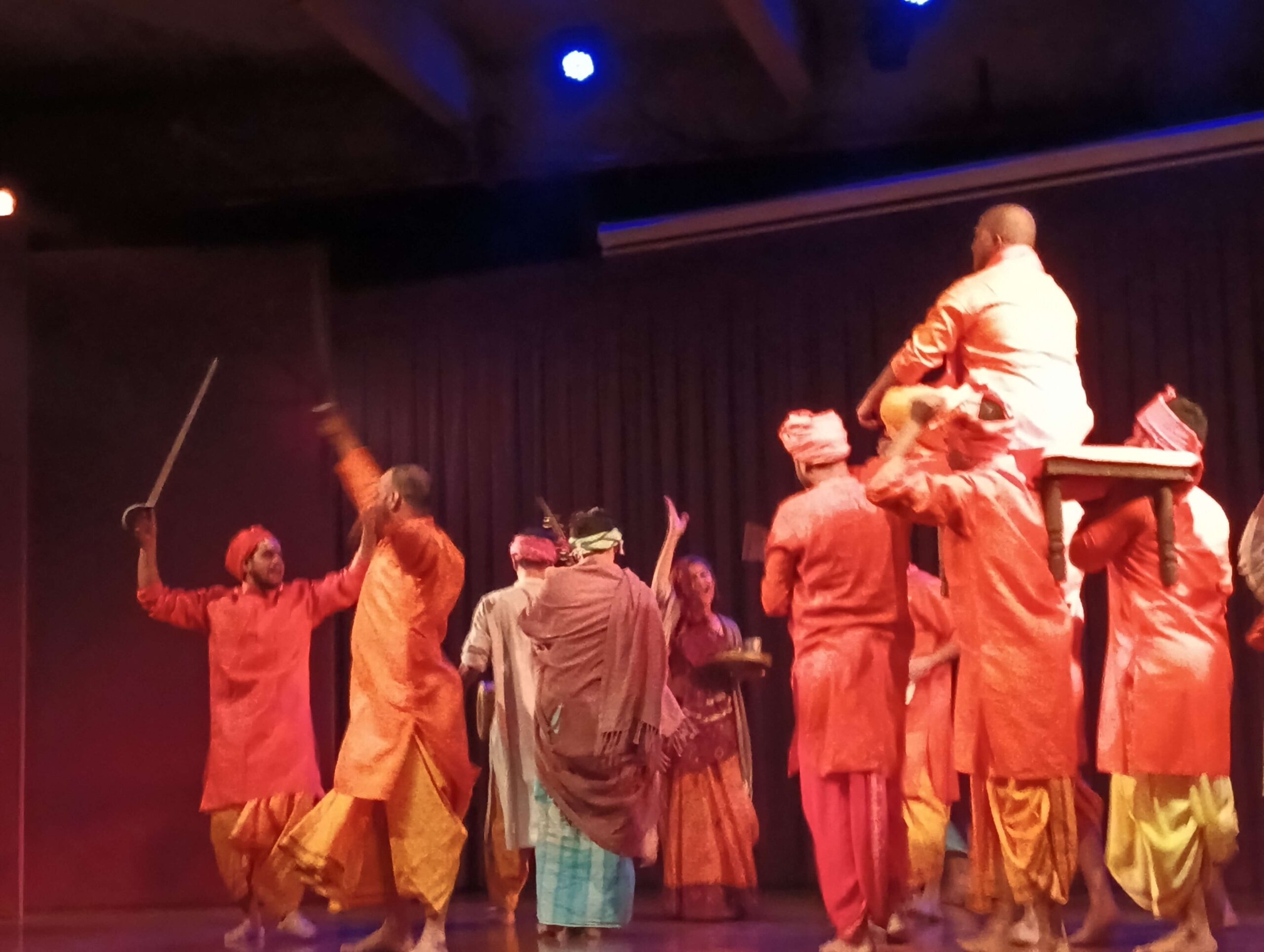
On one weekend, an immensely popular Hindi play, “Kabira Khada Bazaar Mein” originallypenned by the famous litterateur Bhisham Sahni (this particular version directed by Arvind Gaud, who heads the group Asmita) was staged at the premises.
For me, it was a one-of-a-kind experience since this was the first time that I got an opportunity to witness a street play. And trust me, it was so refreshing. There were no mikes, no stage backdrop, decoration and such like. Lights, which are a sine qua non for any theatrical piece, were there, for sure.
Although many of us Indians are quite familiar with the works of Kabir Das, often referred to as Sant Kabir (or simply Kabira, as he liked to call himself), there is less knowledge about his personal life. His poetry, known as “Dohas” (couplets or two-liners), is widely appreciated, but details about his worldly existence remain largely unknown. This play effectively bridges the gap. It presented vignettes from Kabir’s life suitably blended with imagination, music and dance.
The scene of the play is the sacred city of Banaras (aka Varanasi and Kashi). We learn about the antecedents of his birth, which is shrouded in mystery, his adoptive parents who were weavers by profession, his indulgent mother and an irate father who considered him nothing more than a wastrel, his circle of friends and fans. The viewers are bound to be amused by the depiction of frivolity between Kabir and his wife, Loi.
In addition, Kabir’s day-to-day interaction with the masses, people from other communities, individuals in positions of power and authority, is well portrayed. We watch with amazement as the unschooled, unlettered man, who appears to be a simpleton, elaborates on the eternal Truths of life in a simple, rustic lexicon that is understood by all and sundry, i.e., people from diverse social strata. Such people might have been blinded by power, wealth and success. Yet they could not help being impressed by the pearls of wisdom spoken out loud by Kabir.
Everything about the play was as realistic as possible. For a few moments, any viewer would feel he was transported to the narrow winding lanes and alleys of Varanasi, where life continues at its own pace, and not much has changed since Kabir walked the streets down to the present times. Even the actors’ garments and their (simulated) home ambience were larger than life -sweaty turbans, faces and chins with stubbles, crumpled dhotis or pyjamas, sweat-stained, soiled upper garments, folks sitting on their haunches, their homes dotted with wooden charpoys and clay ovens…
To enhance the realistic touch of the play, several actors moved from the stage into the audience and back at certain points. A blind beggar singing verses of Kabir, a mother mourning her son who had succumbed to the rulers’ atrocities, and a headless corpse being carried on a bier. The audience found these scenes deeply moving.
Given the present turbulent times when the social fabric of our country is being torn asunder by feuds and faction, and the dragon of communalism is raising its ugly head, Kabir’s words instil in us the spirit of fraternity, communal harmony and Brotherhood of Man.
Photo sourced by the author

Ruchira Adhikari Ghosh brings a liberal, wide-ranging outlook shaped by extensive travel across India and abroad. Educated at Holy Child School, New Delhi, Sacred Heart Convent, Ludhiana, and Panjab University, Chandigarh, she holds a Master’s in English Literature and a postgraduate diploma in Journalism and Mass Communication. With three decades in media, she writes on travel, books, music, performing arts, women’s issues, and especially food, drawing inspiration from rich life experiences. She is our Features Editor.


 By
By
 By
By

 By
By
Thank you for bringing Delhi’s street theatre to the notice of your readers, for relating it to contemporary events and reminding them of Kabir.