
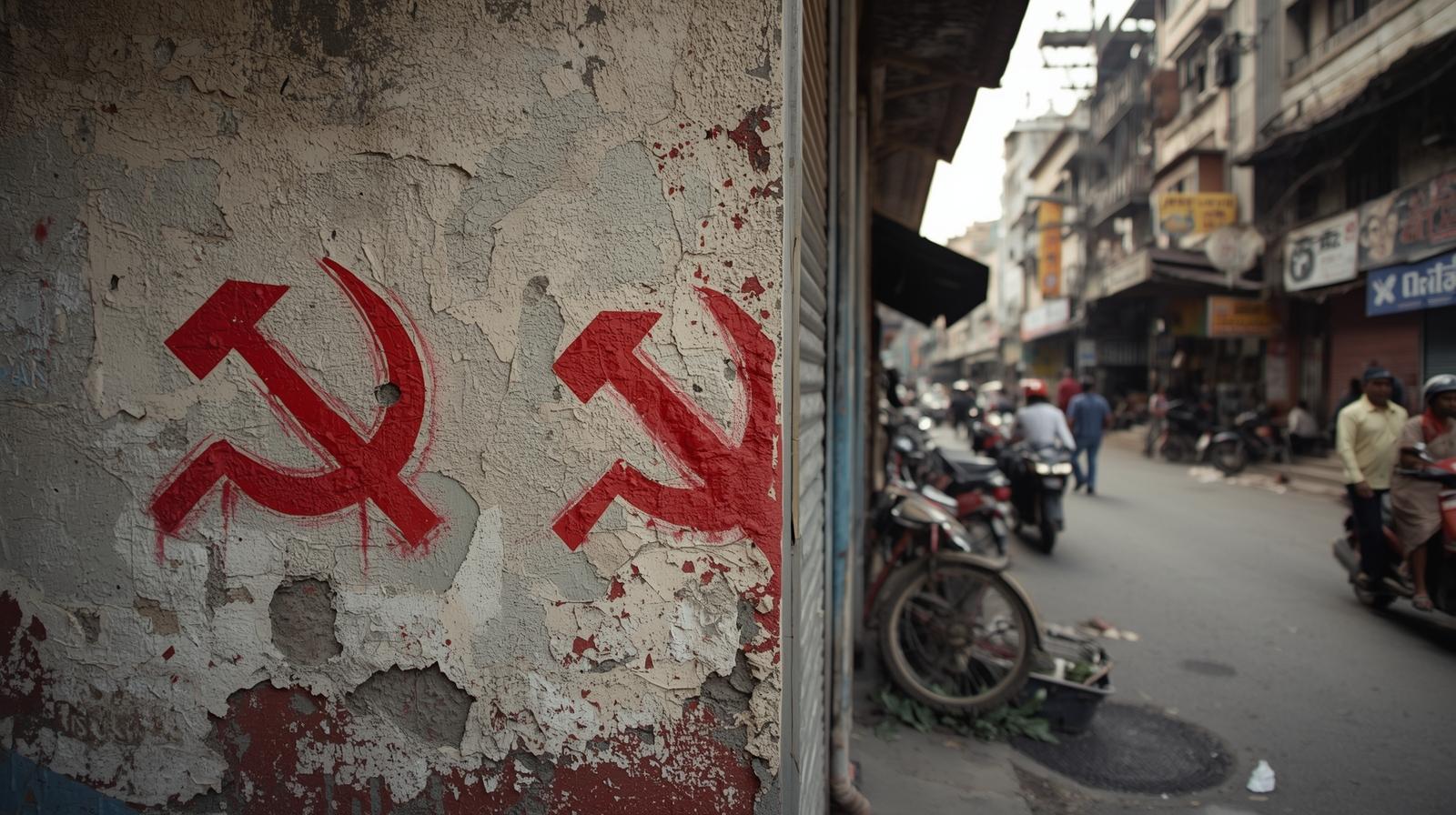
Akash opines that Communism in India needs evolution, blending cultural roots, selective capitalism, and religious ethics to address inequality and unite the masses, exclusively for Different Truths.

Communism has long been debated in India, both as a political possibility and as a lived socio-economic reality. The Communist Party of India (CPI), the Communist Party of India (Marxist), and several regional leftist forces have influenced the nation’s history, from the peasant struggles of Telangana and Tebhaga to the long-standing Left Front rule in West Bengal and Kerala’s globally admired model of social development. Yet, while communism has remained deeply relevant, it has also faced a decline in electoral strength and ideological influence in recent decades. The question that arises is not whether communism is redundant in India, but whether communism needs an ideological evolution to address India’s unique realities—an evolution that considers religion, cultural propaganda, and selective cooperation with capitalist forces.
This article argues that India still needs communism, but not in its rigid, classical form. Rather, India requires a refined communism that integrates selective capitalist partnership for economic growth, acknowledges the centrality of religion in Indian life, and incorporates religiously rooted ethical propagandas to unify people. Such an evolved communism could ensure not only economic justice and equality, but also a stronger sense of cultural belonging, making it deeply rooted in the soil of India.
Communism in the Indian Context
India’s tryst with communism has been distinct from that of Europe. Marx and Engels wrote in the context of industrial Europe, where religion was largely Christian, industrial capitalism was highly advanced, and class consciousness was relatively more homogeneous. India, by contrast, is a land of multiple religions, semi-feudal agrarian relations, and uneven capitalist growth.
In independent India, the communists championed workers’ rights, fought for land reforms, and defended secularism. States like Kerala and West Bengal, under communist leadership, demonstrated that leftist governance could achieve high literacy, low poverty, and significant human development even in conditions of economic backwardness. Yet, by the late 20th and early 21st centuries, Indian communism appeared stagnant. Dogmatic adherence to theory, suspicion of private investment, and lack of cultural propaganda alienated the masses.
The irony lies in the fact that India desperately needs the core promises of communism: land to the tiller, eradication of class exploitation, and social equality, yet the theory has not evolved adequately to meet the cultural and economic complexity of the country.
The Case for a Modified Communism
1. Selective Capitalist Partnership: Communism traditionally views capitalism as the primary enemy. In Marxist theory, capitalism is a system of exploitation that must be overthrown to establish socialism. While this holds in principle, Indian reality demands a nuanced approach.
Buddhadeb Bhattacharya, the former Chief Minister of West Bengal, embodied this nuance. While deeply rooted in Marxist values, he recognised that without industrial investment, jobs could not be created, nor could the state sustain its developmental commitments. His invitation to Tata Motors in Singur was not an abandonment of communism, but an attempt to modernise it, by accepting limited capitalist participation for the greater good of the working class.
This form of communism does not surrender to capitalism; rather, it co-opts capitalist ventures for public welfare. Industries can be invited with strict state oversight, ensuring that workers’ rights, environmental sustainability, and equitable distribution of wealth are prioritised. In this way, capitalism becomes a temporary instrument in the larger communist project.
2. Integration of Religion into Communism: One of the greatest weaknesses of communism in India has been its neglect of religion. Marx’s famous dictum that religion is the “opium of the masses” has often been used simplistically to dismiss religious life altogether. Yet in India, religion is not merely an instrument of class oppression; it is also a source of identity, morality, and cultural continuity.
Indian communism, if it wishes to resonate with the masses, must integrate religious sensibilities into its framework. This does not mean surrendering to religious orthodoxy or communalism. Rather, it means recognising the ethical and cultural value of religion. Hinduism, Islam, Christianity, Sikhism, Buddhism, and other traditions offer rich traditions of social justice, compassion, and community. A people’s communism in India must reinterpret these traditions to highlight their egalitarian aspects.
For instance, the Hindu Upanishadic vision of unity, the Buddhist emphasis on compassion and anti-materialism, the Islamic insistence on zakat (wealth redistribution), and the Christian call for love and charity can all be integrated into a religious propaganda of communism. Instead of alienating believers, communists can show them that their faith traditions already call for justice, equality, and solidarity.
3. Religious Propaganda as a Tool of Mobilisation: If capitalism succeeds partly because of its cultural propaganda: advertisements, films, narratives of consumer success, then communism too must develop cultural and religious propaganda. In India, where temples, mosques, churches, and gurdwaras command immense influence, communists cannot afford to remain outside these spaces.
A communist propaganda rooted in religious idioms could mobilise millions. Imagine a campaign where Ram’s fight against Ravana is interpreted as the people’s fight against exploitative landlords, or where the Prophet Muhammad’s emphasis on justice is framed as a call against capitalist exploitation. By re-reading religion through a communist lens, the ideology can be deeply rooted in India’s cultural imagination.
This would prevent communism from being perceived as “foreign” or “atheistic” and instead make it an indigenous, spiritualized socialism that resonates with common people.
Why India Needs Communism Today
India in the 21st century faces unprecedented inequalities. According to Oxfam reports, the wealth of the top 1% is greater than that of the bottom 70%. Farmers continue to commit suicide due to debt and exploitation, while urban workers suffer insecure employment and inflation. The capitalist growth model celebrated since liberalisation in 1991 has indeed created wealth, but it has also concentrated it in the hands of a few conglomerates.
At the same time, communalism and religious polarisation threaten the secular fabric of the country. Democracy, while vibrant, is increasingly manipulated by money and media. In such conditions, communism becomes not merely desirable but necessary, for it provides an ideology that unites economic justice with social harmony.
Yet, to succeed, communism must evolve. A rigidly atheistic, anti-capitalist communism alienates too many Indians. What India needs is a communism that combines three principles:
1. Economic justice through class struggle and redistribution.
2. Pragmatic capitalist partnerships to create employment and infrastructure.
3.Religious-cultural propaganda to mobilise the masses ethically and emotionally.
This trinity can ensure that communism speaks to the lived realities of the Indian people.
Towards a New Indian Communism
An Indian communism that evolves in this way would look very different from its European counterpart. It would not be a dry, materialist project, but a living, cultural, and spiritual revolution. Its characteristics might be described as follows:
Culturally Rooted: Drawing from Indian traditions, festivals, and religious texts to propagate equality and justice. For instance, celebrating Holi as not just a festival of colours but also as a reminder of the triumph of the marginalised (Prahlad) over tyranny (Hiranyakashipu).
Economically Pragmatic: Encouraging industries, foreign investments, and technological growth, but ensuring they remain subordinate to social goals. Corporations must invest in education, healthcare, and local communities under strict state oversight.
Spiritually Inspiring: Instead of negating religion, communism must reinterpret it. Spiritual values can be harnessed to promote solidarity, discipline, and hope. Religious leaders, when convinced, can become powerful allies in spreading messages of justice.
Politically Inclusive: Moving beyond electoral struggles, communism must establish strong grassroots networks, cooperatives, and community organisations that embody its values in everyday life.
Conclusion
India’s need for communism today is greater than ever. Rising inequalities, communal tensions, and exploitative capitalism demand an ideology of resistance. Yet, communism in its rigid European form cannot survive in India. It must evolve by adopting selective capitalist partnerships for development, by recognising the centrality of religion in Indian society, and by using religious-cultural propaganda to mobilise the masses.
This evolved communism would not be a betrayal of Marxist principles, but their creative application in the Indian context. Just as Marx adapted Hegel to his own needs, and Lenin adapted Marx to Russia, Indian communists must adapt Marxism to the plural, spiritual, and semi-capitalist realities of India.
The dream of a classless, just society is still alive in India. But to realise it, communism must wear the garb of Indian culture, speak the idiom of Indian faith, and act with the pragmatism of Indian politics. Only then can communism once again become a mass movement, guiding India towards true equality and liberation.
Picture design by Anumita Roy

Akash Paul, a renowned criminologist, theologian, historian, and demonologist, and the author of four globally acclaimed textbooks, pioneered post-crime analysis in criminology and comparative religious studies in theology. His expertise spans criminal profiling, sexual offences, Christianity, religious history, and Indian history, with research interests in Ancient Indian History and the Indian Freedom Struggle. An insightful critic of contemporary society, he also writes poetry, short stories, and novels, blending creativity with profound societal analysis.


 By
By
 By
By
Excellent article son… India indeed needs for this specific genre of Communism.
A unique article this is❤️❤️❤️❤️✨✨