
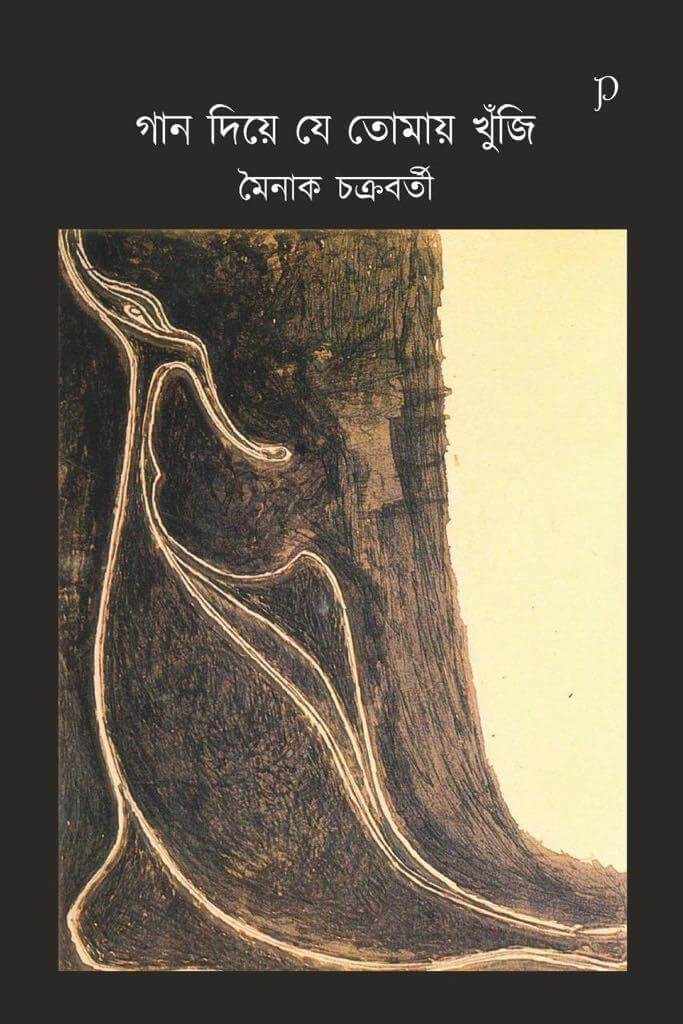
Amita reviews Mainak Chakrabarty’s Gan Diye Je Tomay Khunji that dwells on how Rabindranath Tagore’s songs captivate, transcending time and revealing eternal truths, exclusively for Different Truths.
The ineffable charm of the songs written by the Nobel Laureate Rabindranath Tagore captivates the heart of all music lovers; its influence is ubiquitous. The songs are a subtle blending of lyrical poetry and harmonious melody that encompasses a vast spectrum ranging from the material to the metaphysical. The lyrics and melody of his songs complement each other, evolving a signature style which marks them with a classy distinctiveness and trait.
The cognoscenti of Tagore’s works have delved into the eclectic range of his literary activity in an endeavour to project, posit and premise. Mainak Chakrabarty, the author of the book Gan Diye Je Tomay Khunji, is a young, impassioned devotee of Tagore. He explores the multifaceted significances of the lyrics of Tagore, transcending what evinces the ephemeral and temporal. The title of the book adequately suggests a quest for the eternal truth embedded within the folds of words and cadence of Tagore’s songs, symbolising a journey taken inwards. The avant-garde observer takes an innovative approach, weaving a soul-searching narrative under twenty-two evocative subheadings between the covers of the book, like:
Param sesher onneyshone (In Quest of the Absolute End)
Ekla pather chola (On a Sole Journey)
Matir buker majhe (Within the Bosom of Earth)
Dak porechhe oi   (Yonder the Call comes)
Chakrabarty seeks answers to his probing questions in the treasure trove of Tagore’s lyrics, thus trying to figure out the essence of the divine being himself. They emerge from his intense association and contemplation of the bard’s songs, coupled with his finer sensibilities attuned to them. His infallible observations do not take the beaten path of the established critics. He carves a niche of his own through his refreshing responses to the poet’s lyrics with effortless grace. The following is an example of how deftly he drives home his point:
Tomay sajabo jotone kusum ratane
keure konkone kumkume chandane.
kuntale beshtibo swarnajalika, kanthe dolaibo mukto malika
simonte sindur arun bindur—charon ronjibo alokto-ankone.
Translation:
Will adorn you with care in flowers and jewels
armlets, bangles, vermilion and sandalwood paste
will style your coiffure girdled in golden net, a pearl necklace will deck your neck
In the parting of your hair, vermilion will glow—your feet tinged with liquid dye.
On reading the above four lines of the lyric, Tagorian Mainak Chakrabarty, as a discerning reader, is nonplussed; he expects much more from the literary stalwart. Immediately next comes the following epiphanic revelation, which magically transforms the platitudinous verse to sublime elegance as befits the doyen—
Sakhire sajabo sakhar preme
alokhyo praner amulyo heme
Translation:
Will adorn my sakhi with love of sakha
effulgent in the golden aura of imperceptible soul.
Life, as it seems to us, is a journey through binaries—beginning and end, light and darkness, joy and sorrow, birth and death. But is it so? Chakrabarty, in his book, with consummate skill, explicates the inherent coherence of the concepts tapping the bard’s creative output. What one recognises as the ‘End’ is a seamless slipping into the infinite; its luminous joy. Tagore’s songs convey his most profound thoughts emanating from his concept of ‘Jivan devata’. It refers to an amorphous entity, a divine presence within each of us which binds all things in the universe. The author in this book interrogates, speculates and unravels the philosophical substratum in his free-flowing flowing inimitable style.
In concord with Tagore’s thoughts, the author reflects that the divine is the ultimate source of enlightenment; darkness surrenders to its exuberance. And when we are at one with Him ‘Mongolalok’, the blissful and rapturous light inundates our soul.
 Ar rekho na andhare, amay dekhte dao.
Tomar sathe amar apnare dekhte dao.
Translation:
Do not keep me in the dark anymore; give me the vision.
In your midst, let me find my being.
The text is subtly studded with words and quotes sans the quotation mark, just as they appear in the songs of Tagore, to frame a free-flowing narrative. This infusion lends an impeccably innovative trait to the voice of the young writer. The author admits that this is deliberately done on his part, as Tagore’s words have become integral to the essence of our very existence.
The book has an adjunct, which enhances the appeal of the book. It is provided with QR codes, which, when scanned, will lead the reader to happy listening of some Rabindra sangeet. Moreover, the book is also embellished with some fine paintings and sketches done by Ankita Sanyal.
This book, authored by Mainak Chakrabarty, brings a spurt of new thoughts on Tagore’s songs. It can claim to be a coveted addition to one’s collection.
Cover photo sourced by the reviewer

Amita Ray, a former associate professor in English is based in Kolkata. An academic of varied interests she is a translator, short story writer and poet. She has four volumes of noted Bengali authors to her credit. She has authored a collection of short stories which has received rave reviews. Her latest publication is a book of poems. Her translation of Abanindranath Tagore’s ‘Khirer Putul’, has been inducted into the post -graduate syllabus in English of Burdwan University.


 By
By
 By
By
 By
By
 By
By