

Harry Owen, a Liverpool-born poet, embraced South Africa in 2007, crafting eight collections that weave nature and humanity, inspiring global poetry. An exclusive interview with Dr Amitabh Mitra for Different Truths.
Harry Owen, born amidst the lively hum of Liverpool, is a man who crossed the seas to plant his roots in South Africa in 2007. Long before, in 2003, the good folk of Cheshire crowned him their first-ever poet laureate, a title that fit him like a well-worn cloak.
Harry’s heart beats for the wild places, his voice a clarion call for nature’s beauty, his pen a tireless champion of poetry’s power. Eight collections bear his name, each a tapestry of verse. The latest? Small Stones for Bromley from Belfast’s Lapwing Publications in 2014, The Cull: New and Resurrected Poems from East London’s Poets Printery in 2017, and All Weathers from Grahamstown’s (theInkSword) in 2019.
But Harry’s not one to hoard his gifts. He’s gathered voices from near and far, editing three anthologies that sing with purpose. First came I Write Who I Am in 2011, a chorus of 19 young poets from local township schools, their words bold and unpolished. Then, in 2013, For Rhino in a Shrinking World, an international cry to save the majestic rhino from the jaws of extinction. And in 2019, Coming Home: Poems of the Grahamstown Diaspora, a gathering of voices tethered to a shared heart.
In Grahamstown, which Harry calls home, he lights up the night with Reddits Poetry, a monthly open floor where poets, young and old, share their verses under the stars. Here’s Harry Owen’s candid interview with Dr Mitra.
Amitabh Mitra: Please describe your experience as a South African poet and South African poetry in comparison to the global poetry movement in the contemporary era.
Harry Owen: When I first came to South Africa from the UK in 2007, I had no idea what to expect. I had never been here before, and almost all I had heard about the country from British news outlets had been bad. During the horrendous years of apartheid, no one that I knew associated South Africa with poetry.
But, arriving in Grahamstown (now Makhanda) in the Eastern Cape, my views changed almost immediately. The town itself was beautiful and included both a major university (Rhodes University) and its cathedral, so despite its small size, it could proudly call itself a city. The City of Saints was its official nickname, owing to a proliferation of churches, but I soon realised that it might also be considered the City of Poets.
During the fraught days of the apartheid regime, poetry had been one of the most powerful ways for oppressed and disenfranchised people to oppose it. Protest poetry was everywhere, and Grahamstown was a hotbed. From Black townships to the ‘ivory tower’ of the university, poetry flourished; its words ultimately proved to be ‘more powerful than the sword’.
Yet this proud poetic heritage is one that I, a complete outsider, did not know how to join – or even if I would be allowed to do so. I had come from a place where poetry was often seen as a minor and even inconsequential thing, a hobby or pastime at best, and not the hugely important, defining aspect of human life that I passionately believe it to be.
So, South Africa was a revelation. Poetry showed itself here to be a vibrant and welcoming reality.
During the next few years, I met many wonderful poets from every sphere of life imaginable—Don Maclennan, Chris Zithulele Mann, Dan Wylie, Phillippa Yaa De Villiers, Kobus Moolman, JahRose Nthabiseng Jafta, Silke Heiss, Dudu Saki, Jeannie McKeown, and so many others—who supported a vibrant ‘open floor’ event I founded called Reddits Poetry. For thirteen years (until Covid brought it to a premature end), Reddits proved an immensely popular and thoroughly inclusive monthly phenomenon that sang of how exciting, how pulsating and alive the South African poetry scene is. How fortunate I was to be part of it!
I had published three collections of poetry before moving to South Africa but knew nothing of the publishing possibilities here. Being approached by your small press, The Poets Printery, however, opened the doors, and my first SA collection, Non-Dog, was published by them in 2010, followed also over the years by three successful anthologies. Since that time, other collections have been released by a variety of publishing houses.
The effects of poetry seem to me to be expanding across the globe and are especially important in a time of fear, political uncertainty and environmental collapse. Poetic voices always need to be heard. I still follow poets and poetry in other countries, particularly the UK and the USA, but do not feel in any way sidelined or out of touch in South Africa. Indeed, the perspective from the global South is a salutary and healthy one that I find inspirational in my work. I consider myself now to be very much a South African poet.
AM: What provokes you to write poems in South Africa?
HO: South Africa is like nowhere I have lived before, a place of real and unavoidable contrasts. Vast areas of Earth’s most glorious natural wonders are found here, as are some of the ugliest urban wastelands. Ostentatious wealth stands, almost literally, next to appalling poverty. Its history, like its soil, is soaked in centuries of blood.
Yet it is as rich in culture, customs, narrative, environmental biodiversity and sheer humanity as anywhere I have ever been. Its people are phenomenal. Here is a poem written shortly after I arrived, when I was still trying to come to terms with my new home:
Questions to ask in South Africa
A monkey tail waves from the rear wiper of Dumza’s taxi, and I ask myself:
When do things become too much? When do you start to begrudge it, feel you’re being taken
for a ride, the word ‘borrow’, meaning ‘give’, and resent the assumptions made about you, your character, your wealth? Why do you sense your heart solidifying, congealing
like a crust into what you’d rather not be: the cost of a breakfast, a chicken, a conscience or a soul?
                         Named, we are owned; spoken, we are real; lived, we become known.

Only a toy, then, but that monkey clings to the back of the taxi, its brave tail
asking, ‘What happens now? What happens now?’
Harry Owen
(from Non-Dog, The Poets Printery, 2010)
I still marvel at such variety and richness and expect I always shall. The sheer generosity of experience that South Africa offers is something that I cannot help but value.
AM: In the 21st century, where poetry, books of poems and web-based instant poetry co-exist, and the mind is increasingly overtaken by computer-based programmes, do you believe in the future of poetry?
HO: Do I believe in the future of poetry? Of course I do! Since poetry is, in my view, the deepest expression of human consciousness (and always has been), it will continue to blossom as long as there are people to feel it, to know it. Whether written or, as it originally was, spoken as spell, prayer, song and incantation; whether physically in scrolls, scripts and books, or virtually as computerised publications; whether in performance or memory, poetry will flourish as long as there are feeling human beings to compose it.
Poetry is the language of feeling – “language in orbit”, as Seamus Heaney called it – so, as long as feelings persist, good or bad, we will find the words to express them. We can’t help ourselves; it is who we are.
Since Africa is the cradle of humanity, the earth from which our species sprang in all its variety, it is no surprise that this wonderful continent has been steeped in poetry from the very beginning. And it continues to be.
AM: Imbibing an African experience, can poetry and peace together offer an example to war-torn countries and cultures?
HO: Humans have shown themselves over the centuries to be thoroughly warlike, often cruel, spiteful and self-centred, and this is plainly in evidence now. There ought to be very little poetry in such ferocity. Yet even in this tumultuous time, there it is – not as an empty aggrandisement of barbarity but as the heartfelt longing for the brutality and ruthlessness to end. While it acknowledges the reality of horror, poetry is typically a yearning, a cry of hope, a memory of peace and an empathetic celebration of all that is best in human potential.
To this extent, poetry and peace – whether in Africa or anywhere else in the world – are the same thing. Long may it continue.
Photo sourced by the interviewer
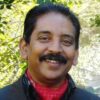
Amitabh Mitra is a poet, artist, and medical doctor based in East London, South Africa. He is the Head of the Trauma and Emergency Medicine Department of a tertiary hospital complex in the black township of Mdantsane. It is the second-biggest Black township after Soweto. Recently, the Department of Arts and Culture, in association with Oxfam, honoured him for his contribution and long-standing devotion to the people of Mdantsane.
 By
By
 By
By
 By
By
 By
By