
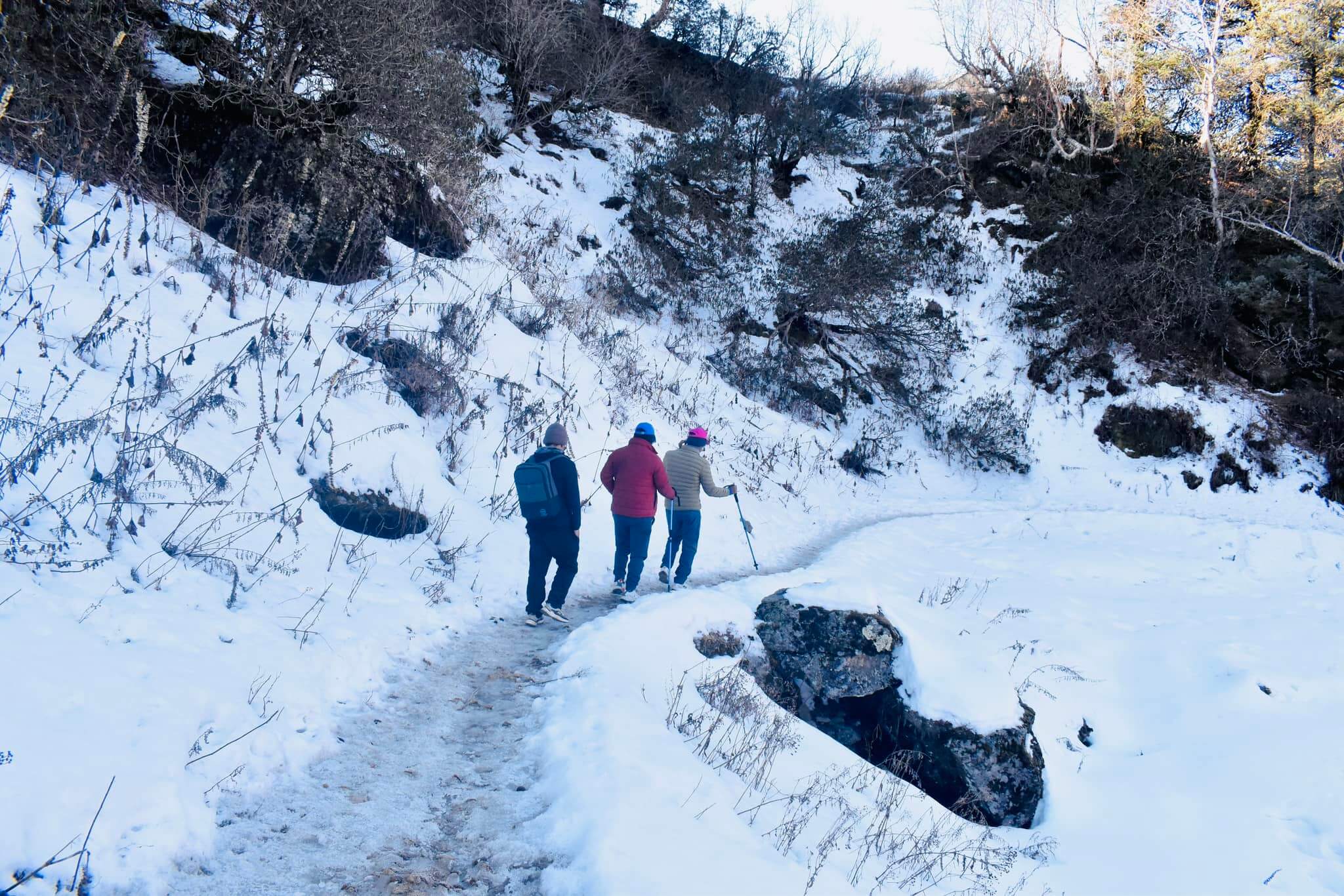
Sushil embarks on a thrilling Nepal trek to explore Khaptad’s mystical allure, blending adventure, spirituality, and resilience in the Far West’s untamed trails, exclusively for Different Truths.
For nearly seven years, I had been walking the winding trails of Nepal’s Far West-Doti, Achham, and the remote hills that stretch beyond. In that time, I’d visited dozens of villages, crossed endless ridges, and become familiar with the unique rhythm of life in the region. But deep inside, there was always one lingering dream: “One day, I must reach Khaptad.” And just as often, I’d hear people say, “You haven’t seen the Far West until you’ve been to Ramaroshan.”
Khaptad had become a mythical place in my imagination-its name always surrounded by a sense of mystery, lush greenery, and quiet spirituality. It felt like a place not just to visit, but to feel. And yet, year after year, the timing never worked out.
I kept wondering, “When will life give me the chance?”
And then, out of nowhere, the call came from Bajhang. The Progressive Youth Society reached out one day, asking if I could facilitate a series of trainings for them. I smiled quietly to myself as I heard the invitation. This could be it. This might just be my moment.
The assignment involved four training sessions, spread over several days. I quickly crafted a plan: run the first two trainings back-to-back, take a short two-day break to finally head to Khaptad, and then return to complete the remaining sessions. With careful coordination, the organisers agreed to the revised schedule.
My long-held dream was finally beginning to take shape.
Everything fell into place. Not just the training schedule, but also the quiet wish tucked deep in one corner of my heart. The dream of Khaptad, which had lived with me for years, was finally stepping out of the world of “maybe someday” into reality. The door had opened.
But for me, Khaptad wasn’t just a destination. It was something bigger-something personal. It was a dream woven into the fabric of my journey, one that had waited patiently to come true.
Of course, every journey has its own story-full of twists, people, and memories that stay with you long after the road ends.
Initially, two of my colleagues, Ganesh Paudel from Dang and Deepa Thapa from Kailali, had travelled with me to Bajhang to help facilitate the training. But due to their other commitments, they couldn’t join me on the Khaptad leg of the trip. That’s when I reached out to Ram Prasad Dahal from Hetauda, whom we affectionately call R.P. He was scheduled to co-facilitate the remaining two training sessions with me. I called him and said, “Can you come a bit early and join me for the Khaptad trek?” Without hesitation, he accepted my invitation with warmth and excitement.
On 5th February 2025, RP made the long journey and arrived in Chainpur, Bajhang by 10 a.m. His arrival didn’t just bring company-it brought energy. My plans felt more solid, and my enthusiasm shot up another level.
The next day, on 6th February, we wrapped up the second training. As soon as it ended, we were ready. The long-awaited Khaptad trek was finally happening.
Our friend Binod had already prepped his motorcycle for the ride. RP and I hopped on behind him, and the three of us rode off through Tamail, excitement buzzing in our hearts and the wind brushing against our faces.
The road ahead was unknown, but the feeling was familiar-pure adventure.
The person who played the most important role in turning our plan into reality was Menuka. From day one, she had been involved in planning, but more than that, she remained a constant source of support throughout the journey. Whether it was managing logistics, leading the way, coordinating with locals, or simply lifting our spirits-she did it all, effortlessly.
The three of us-Menuka, RP, and I set out toward the Khaptad region on two motorbikes, excitement humming in the cold mountain air.
After about two hours of winding, often bumpy, bike riding, we reached a small village called Daru Gaun. From there, the road simply disappeared. No vehicles could go any further-it was now just us and the trail ahead. We arrived around 8 p.m. under a sky glittering with stars, the night crisp and silent, pierced only by our footsteps and occasional laughter.
Despite the biting cold, our hearts were full. We were close. Khaptad was near.
Thanks to Menuka’s foresight, our overnight stay in Daru Gaun had already been arranged. Her ability to lead and manage things made us feel safe and cared for. A local mother and her son welcomed us with the warmest hospitality, cooking up a simple meal with leafy greens and vegetables from their backyard. After hours of travel, that meal tasted better than any luxury feast.
We huddled around a fire, sipping hot tea, sharing stories with the family, and teasing each other as we drank warm water-laughing as we kept calling it “Daru Gaun maa Pani (Water).” That night, wrapped in thick blankets, we slipped into sleep-not just resting our bodies, but quietly stepping into the beginning of a long-awaited dream.
That night was more than just a place to rest. It was the emotional starting point of the journey we had waited years to take.
The next morning, the sweetness of sleep lingered, but so did the bite of the cold. The warmth of the blankets made it hard to get up, and outside, thick fog and a layer of frost were waiting to greet us. In that moment, nothing seemed more tempting than staying curled up for just a little longer.
But something stronger pulled us-Khaptad. A dream that had waited for years wasn’t going to be kept waiting any longer.
And so we rose-leaving behind the cozy warmth of bed, wrapping ourselves in wool and willpower. With hopeful hearts and eager steps, we began the uphill hike, entering the trail that would soon lead us into the mystical highlands of Khaptad.
We had estimated about five hours of walking. That’s what the locals and fellow trekkers had told us. “Even at a relaxed pace-stopping for breaks and enjoying the views-you’ll be there in five hours,” they had assured us.
RP and I weren’t new to treks. Every year, we took on a new trail somewhere in the hills or mountains. We were used to uphill climbs, steep descents, harsh terrain, and high altitude. Fatigue wasn’t something we feared.
But this trek was different for a beautiful reason.
***
Menuka had never done a long-distance trek before, yet her courage and determination were nothing short of inspiring. What she lacked in experience, she made up for with her heart. She kept moving-slow but steady-and her spirit never wavered. Respecting her pace, RP and I walked with her, step by step.
And that’s why our so-called five-hour trek stretched into nearly double that.
If we had walked at our usual pace, we might have reached our destination within the estimated time-perhaps even stopped to admire the views without worry. But here’s the thing: we never felt delayed. Not even for a moment.
The extra time became a gift.
It gave us a chance to slow down and truly connect with the landscape, with the silence, with every leaf and flower that lined our path. We listened to the rustling trees, watched clouds drift just above our heads, paused to greet curious birds, and felt the mountain breeze whisper stories we might have missed had we been rushing.
That unhurried pace brought us closer to nature and to each other.
At times along the trail, Menuka’s tired voice would quietly protest, “You two go ahead. I’ll wait here. You can come back for me, can’t you? ”
Those words carried a weight that tugged at us. They weren’t just about physical fatigue; they echoed deeper emotions-doubt, maybe even fear. Every time she said it, something in us sank.
But we’d respond without missing a beat: “You are part of this journey. We started together, and we’ll finish together.”
Sometimes, I wondered-were her words a subtle test of our patience and loyalty? Or perhaps they were her internal challenge to push through, to keep going even when her body resisted.
Truth is, Menuka was one of the bravest, most determined people I’ve walked with. Her spirit never gave up, even when her legs begged for rest. I think she wasn’t just testing us-she was testing herself, quietly proving her own strength.
Our journey, by now, was no longer measured by time or distance. It had become something much deeper. Each step wasn’t just about getting to Khaptad-it was a dialogue with nature, with resilience, with each other. It was about learning how to be present, how to hold space for one another, how to walk together without rushing.
In the background, the majestic Saipal Himal appeared like a silent guardian. Its snow-clad peaks gave our tired feet new strength, as if nature itself was cheering us on.
By the time we reached Lokhada, it was nearly 1 p.m. Our legs were heavy from the morning’s long walk, and our stomachs had started protesting too. But we weren’t worried. Once again, Menuka had taken care of everything.
She had already called ahead and arranged for lunch to be prepared. As soon as we arrived, we were welcomed by the warm aroma of freshly cooked food. It wasn’t just a meal-it was comfort, care, and nourishment served on a plate.
We had carried snacks with us, of course-energy bars, dried fruits, a few nuts. We’d nibbled as we walked. But nothing compares to the warmth of a real meal on a cold day in the hills. The moment we saw those steaming plates, our hunger doubled. We washed up with freezing mountain water, found a sunny patch, and sat down to eat.
And oh, that food! The taste defeated even the deepest fatigue. For a while, we didn’t talk-we just ate, grateful for each bite.
Afterwards, we sat around, stretched our legs, exchanged stories, and simply breathed. The body needed that rest. We spent nearly an hour there in Lokhada, letting the stillness sink in before we stood up again-ready for whatever lay ahead.
After resting in Lokhada, we continued our journey. Now, we had officially entered the Khaptad National Park. Lokhada marked the beginning of the protected area.
We could feel the change around us. For the first time, we saw real signs of the wild-fields dug up by wild boars, stories from locals about animals, and a deep, peaceful silence that only nature can offer.
We paid a small entrance fee of Rs. 100 each and moved into the forest. The trail was a mix of everything-some parts were uphill, others flat; some areas had thin trees, others were covered in thick, dark forest. There were snow-covered meadows in some places, and in others, dry leaves and soft grass blanketed the ground.
This was more than just a walk. It was something we felt with our eyes, our hands, and our hearts. We stopped often to take photos-some bent low to catch the flowers, some climbed rocks, and some just stood still, soaking in the view.
Finally, we reached our destination.
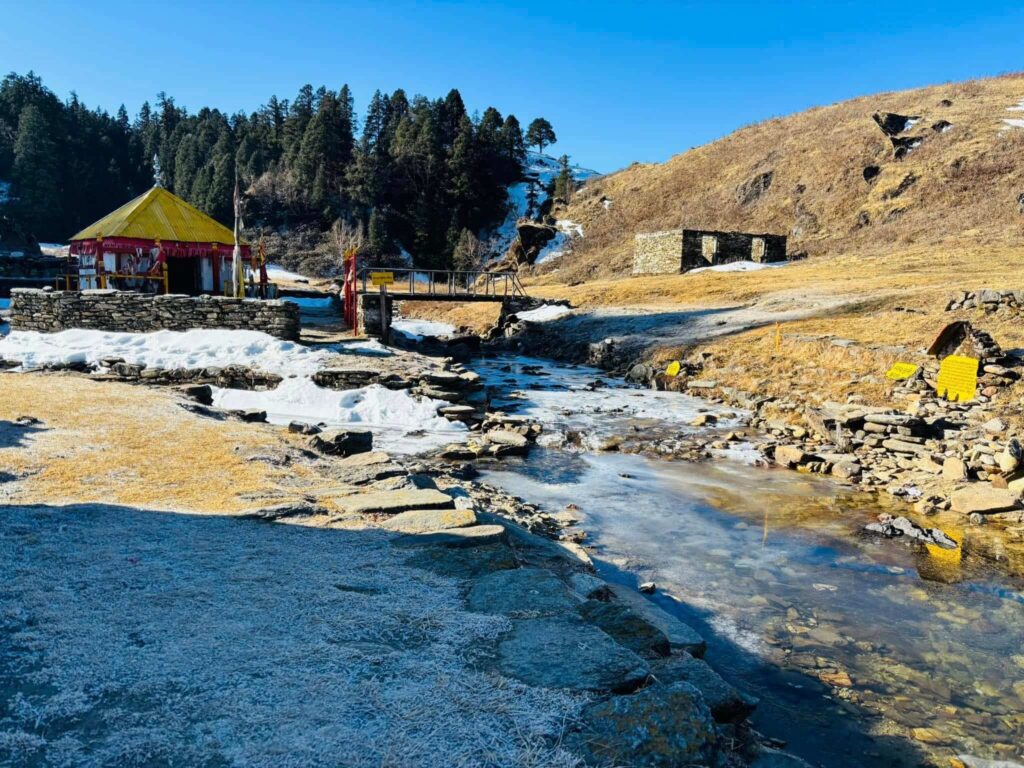
It was late in the evening, but still not completely dark. The sky had turned orange and grey. There was only one place to eat and sleep-Khaptad Baba Hotel and Shanti Lodge.
We weren’t the only ones staying there. Four other travellers had already arrived. Two of them we had met earlier along the trail-strangers then, but now it felt like we were friends.
We got a room at the hotel so we could rest our tired bodies. The cold was sharp, biting at our skin. We warmed ourselves with hot black tea, took in the views around us, and snapped a few photos. Just like that, the exhaustion of the day seemed to fade.
As soon as we had our rooms, everyone quietly disappeared into their own space. But even though our bodies needed rest, our minds were still wide awake. I stepped outside and so did a few of the others. We were all hoping to catch a phone signal. Some searched for corners, others raised their phones in the air, waving them slowly, hoping for a single bar of network. As night grew darker, both signal and light faded away completely.
Later, we all gathered around the kitchen hearth. Dinner was served. It was delicious-maybe because we were starving, or maybe because the setting made it feel special. After the meal, Menuka went off to rest. The rest of us-six in total sat around the fire, sharing stories.
There were laughs, personal reflections, even talks about dreams. Time passed quickly. It must have been around 10 p.m. when we finally decided to head back to our rooms.
But sleep? That was a whole different story.
I’ve never been one to fall asleep easily-especially not in vehicles or strange places. RP had the same problem. The rooms had no lights, so we relied on our flashlights to find our way around. At first glance, the bedding looked okay, but the smell told a different story. The cold was intense. Still, we were grateful the hotel owner hadn’t locked up and left, as some do in such remote, freezing places.
I spent the night turning from side to side-dozing off, waking up, and drifting again. I’m not sure if it was midnight or one o’clock, but I remember staring into the dark, just waiting for sleep to win. It came in pieces-light, scattered, but enough.
I woke up at 5 a.m. sharp.
Stepping outside in that cold would have been foolish-it was still pitch dark, and the chill had only grown deeper overnight. But something inside me didn’t want to stay in bed. So I got up, wrapped myself warmly, and quietly stepped out.
And what a morning it was.
The mountain air was crisp, the wind damp with dew, and far in the distance, snow-capped peaks shimmered in the faint early light. That soft glow, the silence of dawn, and the stillness around me-it was hard to say how much my camera captured and how much my heart held onto. Some moments can’t be explained. They’re just felt.
After a while, I returned to my room and lay back down not to sleep, but to revisit every feeling from the past few days. My body rested, but my mind was replaying every step. We had one more part of the journey left.
It was the third day since we had left Chainpur-7th February, and our final day in Khaptad. We had to return by night, no matter what. There was no choice. Our break already felt too short.
We were determined to make the most of the time we had.
At the hotel, one of the staff had already started preparing breakfast-chickpeas and boiled eggs, with hot black tea. After finishing our simple but energising meal, we made our decision.
It was time to start the day’s journey.
This time, Menuka stayed behind. It was her second visit to Khaptad, so she felt no pressure to join. She smiled and said, “You two go explore. I’ll stay here.” So, RP and I packed up and set off again, ready for the final leg of this incredible adventure.
Two more travellers joined us that morning-Apurva Singh, an IT expert from Bhaktapur who had been invited by the municipality to help with the training, and Mahesh Khatri, an IT officer working in Khaptad Chhanna Rural Municipality. Mahesh was a local, which made our journey even easier. He knew the area well and could guide us confidently.
So now, we were a group of four-walking, talking, laughing, and sharing stories as we moved ahead.
We planned to visit:
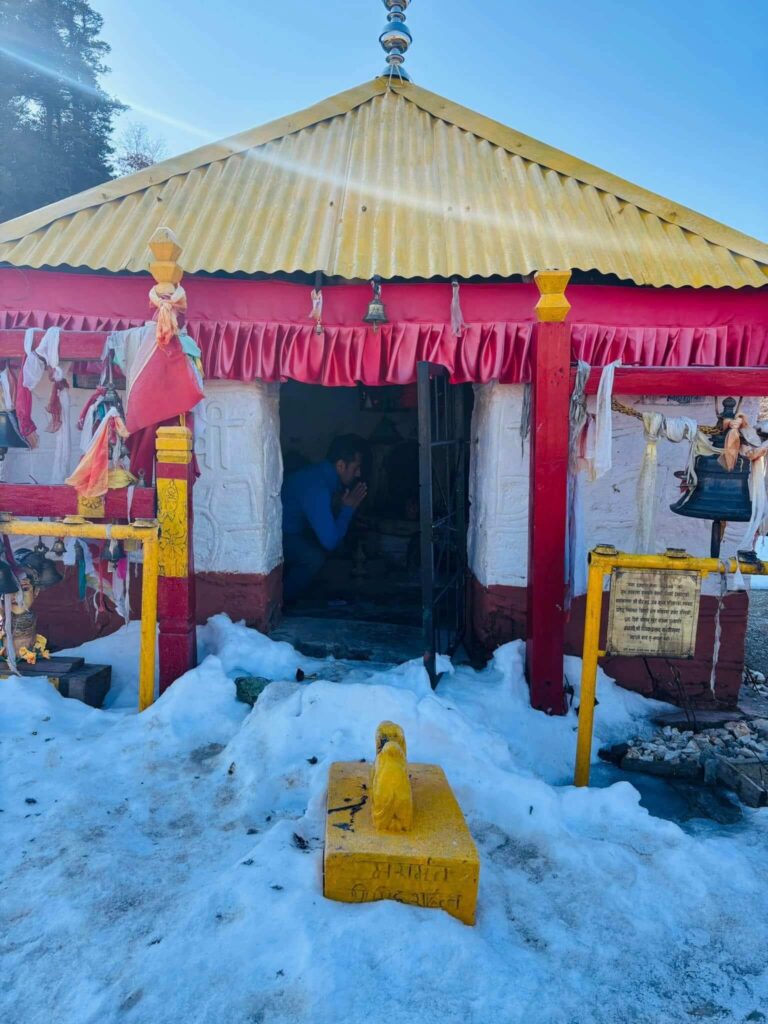
- Khaptad Baba Ashram
- Khaptad Triveni Temple
- Kedar Dhunga
- Sita Paila
- and many of the beautiful meadows spread across the region.
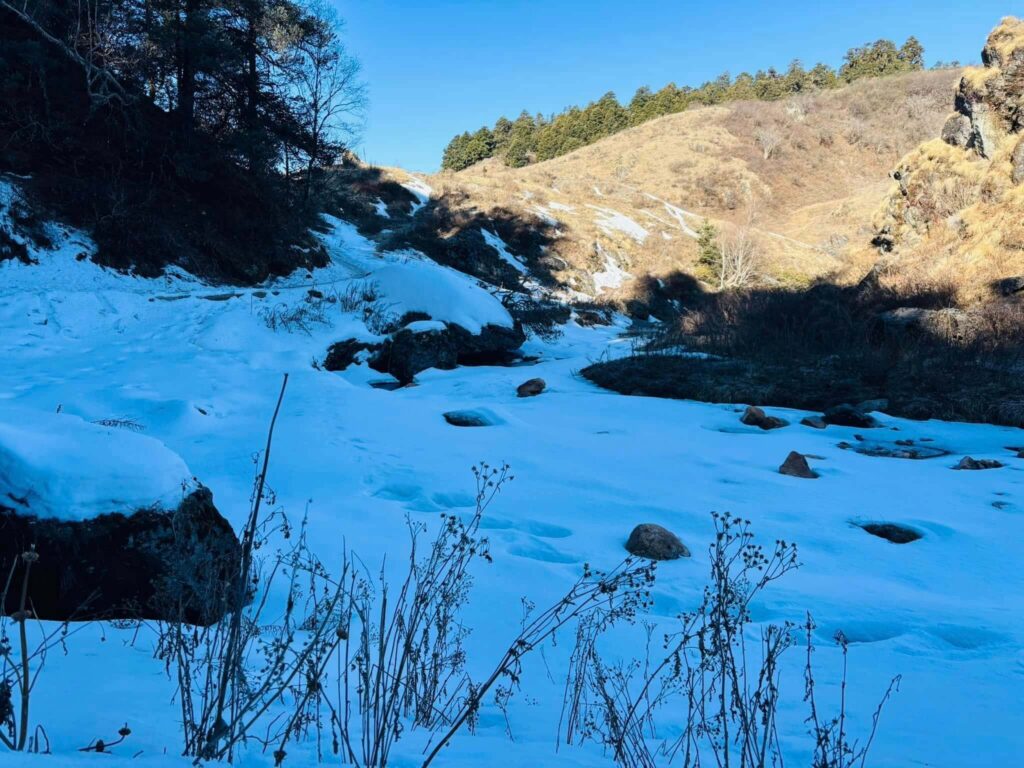
The morning was breathtaking. In some places, thick snow covered the path; in others, it was just a soft white layer. The snow sparkled in the sunlight, making everything look magical. Each step brought us something new-a view, a moment, a memory.
We were fully immersed in the experience. Every sight was worth stopping for. Every turn brought another photo opportunity. We didn’t rush. We just enjoyed.
By the time we returned to the hotel, it was already noon. We decided to eat lunch and then head back without delay. But something unexpected had added to our joy during the hike-we had, without even realising it, stepped through Doti, Achham, and Bajura districts, all in one morning! Our footprints had crossed three districts in a single walk.
Still, one thing kept bugging us-Khapar Daha.
It was a place we all wanted to visit. But time wasn’t on our side. We would need at least three extra hours just to get there and back, which we simply didn’t have. It was disappointing. The desire to see it was strong, but the reality was-we had to let it go.
Menuka, especially, seemed disheartened. She had missed Khapar Daha on her first trip, too. Now, for the second time, it looked like she’d have to leave without seeing it. And that clearly made her a little sad.
After lunch, we slowly began getting ready to leave. Just then, a group of army personnel arrived. As we exchanged greetings and chatted casually, the conversation turned to the trail. That’s when they shared something important-it was possible to return via Matwa village by passing through Khapar Daha, and it would be a shorter route.
That one sentence changed everything.
All five of us had Khapar Daha in our hearts. It was the place we had all wanted to see but thought we’d have to skip. So, without wasting time, we decided we’d take the Khapar Daha route back. The five of us-RP, Menuka, Apurva, Mahesh, and I formed one group, while the other two companions chose to return through Achham.
Mahesh, being a local, knew the path to Khapar Daha very well. He took the lead, and we followed him into the wild.
The trail was stunning. Giant open meadows, heaps of snow, and breathtaking views greeted us at every turn. We laughed, played with the snow, stopped for photos, and soaked in the cool breeze while sharing stories. With every step, the beauty around us became more magical.
We didn’t look at our watches. Time was slipping away, but none of us cared. We were fully present, living the moment. It wasn’t about reaching a destination-it was about being there, in that exact time and place, surrounded by untouched nature.
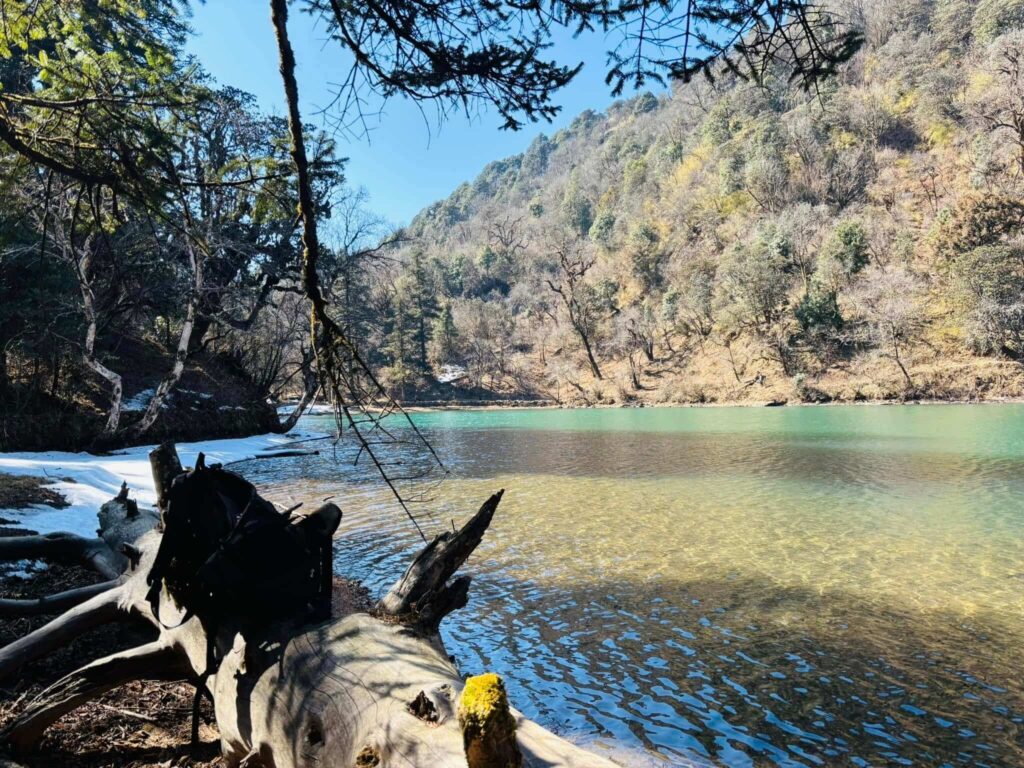
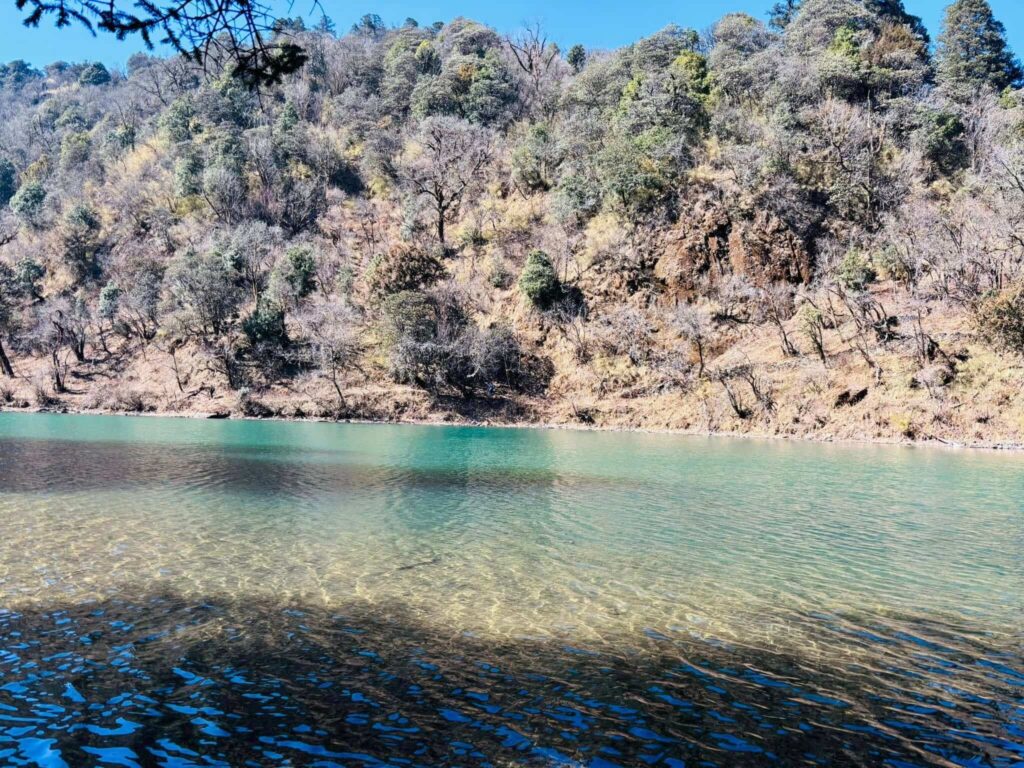
When we finally reached Khapar Daha, it felt like a dream. The lake was still, its water reflecting the sky like glass. The silence around us was powerful, almost sacred. Snow-covered meadows wrapped around the water like a soft white blanket. We stood there, completely absorbed in the view.
It was hard to leave.
The peace, the reflection in the water, the gentle silence of the highlands-Khapar Daha had captured us. But as much as we wanted to stay longer, we knew we had to move. Darkness was approaching, and we still had a long way to go to reach our next stop safely.
With heavy hearts, we turned back taking one last look, silently promising ourselves that we’d return someday.
With our hearts full of memories, we said goodbye to the lake and moved on. But now, the path ahead was completely unfamiliar to all of us. There were no trail signs, no direction boards-just forest after forest. A quiet sense of uncertainty began to creep in. Not long ago, we were filled with joy and excitement. But now, a slight chill-not just in the air, but in our hearts-started to settle.
Thankfully, Apurva and Mahesh-both IT professionals-were calm and confident. They relied on different mobile apps to guide our way. I can’t recall the names of the apps, but they weren’t the usual GPS tools we used. Their apps seemed more technical and accurate, and they gave us some much-needed peace of mind.
We followed them, trusting their navigation skills. Their confidence was reassuring, and we quietly admired their cool headedness.
The five of us continued walking as one group, moving in sync. Apurva and Mahesh were fast walkers. RP and I kept pace, but we were also careful to stay close to Menuka, who was walking more slowly now. Sometimes, RP would stay back to walk with her while the rest of us waited up ahead. Other times, I would fall back, and RP would move forward. We kept rotating, making sure she was never alone.
As we went deeper into the forest, our bodies began to feel the strain. Still, we had no idea how close-or how far-we were from our destination. Around us, there was nothing but quiet woods, the soft sound of distant waterfalls, and the occasional cry of birds.
The sky was getting darker, and the forest shadows deeper. Apurva and Mahesh had their plans. Their destination was different, and so was their timing. Slowly, our group split into two: the three of us-RP, Menuka, and me-and the two of them moving ahead at their own pace.
We knew we were still heading in the right direction… but how far was the end?
None of us knew for sure.
Now we started feeling a little lost.
RP’s phone was down to just 2% battery. Since he often called home to check in, it wasn’t surprising that his battery had drained so quickly. My own phone was also dropping fast-only about 20% left, mostly because I had been using it to take photos throughout the day. Menuka’s phone wasn’t in much better shape.
Still, we kept walking.
Apurva and Mahesh were no longer in sight. They had moved far ahead. But thankfully, we were still in contact over the phone. Knowing we might lose our way, they had cleverly left signs along the trail-an arrow drawn on a rock, a scrap of paper tucked by a tree, small clues to keep us going in the right direction.
We followed those signs carefully, though our pace had slowed. Even with those helpful markers, a quiet fear had started to grow inside us-a fear of the unknown, of the forest, and of the fast-approaching night.
By now, our only sources of hope were the light from our flashlights, the trust we had in each other, and the strength within ourselves.
The sun had already dipped below the hills. The sky was now blending into the misty darkness, casting a shadow of unease around us. The forest was growing silent, heavy, almost as if it was holding its breath.
We had run out of food. Our flashlights were dimming. And we had no idea how far the village was-or even which path would take us there.
There was only one option: keep walking and try to reach the village below.
But at that moment, it felt like we were walking into the unknown-with no map, no clear direction, and only our will to guide us.
Menuka was now struggling to walk. Her steps were slow, dragging along the uneven forest path. She looked exhausted-completely worn out. And to be honest, we all felt the same. A quiet mix of fear, fatigue, and frustration had started to settle deep into our bones.
We had only two flashlights, and their dim light barely lit the trail ahead. The glow flickered over leaves and branches, sometimes casting shadows that looked like jackals or wild animals. But even more frightening than what we could see was what we felt inside-the darkness creeping into our minds.
It wasn’t just the forest that had gone dark-the fear was now inside us too.
Then came the worst moment of all.
We realized we might be lost.
Yes, that sinking feeling hit us hard-we had probably taken the wrong turn.
Our friends kept saying over the phone,
“You’re all on the same trail. There was no need to leave extra signs.”
But their calm words didn’t match the storm brewing in our hearts. Doubt kept growing like a rising river. We started thinking-what if we had unknowingly taken a different path?
Every step was now full of uncertainty. That uncertainty quickly turned into fear.
Back in Chainpur, our friend Binod was calling repeatedly. His voice on the phone was worried,
“Don’t panic. If needed, postpone the training.”
But we weren’t just hikers-we were professionals. We had a responsibility. The training was scheduled, the invitations had gone out, and people were waiting.
For us, postponing was not an option.
No matter how late, how dark, or how tired we were-we had made up our minds.
We had to make it. We would reach, no matter what.
We had already informed the hotel earlier, saying,
“We might be late.”
But now, every passing second felt like a challenge. Phone batteries were dying, the trail had vanished, and all we had left was a bit of light from our flashlights, our shared courage, and the trust we had in each other.
At this point, there was only one choice-to keep moving forward. Even if the path was uncertain, we had to figure it out ourselves. That night forest, the darkness, and the decision to go on were shaping into one of the most unforgettable chapters of our lives.
As the darkness deepened, calls from Apurva and Mahesh stopped coming. The connection with them slowly faded. We felt like a tattered map in a storm-torn, drifting, and directionless. Each fork in the trail became a question. Left, or right? Who knew?
Then suddenly, a call came in from an unknown number.
We were surprised-puzzled-but the voice on the other end carried hope.
It was Birendra, a local resident from the village below and an old friend of Mahesh. He spoke calmly,
“Don’t worry, I’m tracking your location, and I’ll guide you.”
Apparently, during their earlier conversation, Mahesh and Apurva had already told him about the three of us-who we were, where we were headed, and how we might be struggling.
What made it even more special was that Birendra personally knew Menuka. When he sensed we were in real trouble, he first tried calling her. When she didn’t pick up, he found one of our numbers and reached out directly.
In that moment, his voice felt like light breaking through the forest. Like someone sent just in time. Like a guardian.
Someone who would help us find our way home.
“Namaste, this is Birendra speaking,” the voice said.
There was something about his tone-calm, steady, that made us feel he wasn’t just showing us the way, he was becoming a light in our darkness. He started describing the path ahead in detail-mentioning landmarks, springs, waterfalls, and turns as if painting a map with his words.
But as we moved forward, our surroundings didn’t quite match his descriptions. We were walking over slippery rocks, parting a thick curtain of fog, and stepping cautiously through a forest that felt more like a maze. Still, Birendra’s voice on the phone gave us courage-a lifeline we held onto.
All around us was fog, shadows, and the faint, distant glow of lights from houses somewhere below. But those lights felt like something from a fairy tale-close enough to give us hope, but always just out of reach. “They’re like stories from the Ramayana,” I thought-you see them, you chase them, but never quite arrive.
A part of us had already started to believe:
“Maybe we’ll be walking the whole night.”
Menuka’s condition was worsening. She could hardly speak now. We were all physically and mentally drained. But every now and then, we’d laugh-joking about our situation, teasing each other gently. Maybe it was just our way of keeping fear in check.
Then it happened-a moment of real hope.
We heard a waterfall.
It was the very one Birendra had mentioned earlier. As we approached it, something shifted in us. Our steps became a little quicker. Our faces lit up with quiet relief.
“We’re on the right path!”
That sound-the rushing water, the cool mist in the air-it felt like life itself had whispered to us,
“Keep going. You’re almost there.”
It was at that moment that we finally understood something-we weren’t just behind on the trail; we had also fallen far behind Apurva, Mahesh, and Birendra’s guidance. No wonder we were feeling so unsure.
But Birendra never gave up on us.
He called again and said gently,
“Just reach the lower clearing base of the hill. I’ll be there waiting to pick you up.”
That one sentence… it wiped away everything-our hunger, our fear, our exhaustion. We started walking again, not with fear anymore, but with faith. In that long night, Birendra became our beacon-our true hero.
It was exactly 9 p.m. when we finally, slowly, reached the base of the forest. Our legs felt like they could barely hold us up, but our hearts whispered,
“We made it. We’re safe now.”
And just like magic, Birendra appeared with a motorbike. Right on time. It didn’t feel like a coincidence. It felt like destiny.
We took a long breath-the kind of people take when they’ve escaped something that could’ve ended very differently. It was a breath of survival, of deep gratitude.
Birendra had brought a friend along too. Seeing how tired Menuka was, we placed her gently on the bike so she could ride ahead. RP and I followed the second guide on foot. We agreed to meet at Birendra’s home in Matwa village-our destination for the day, the place we had been aiming for all along.
The walk to Matwa took about 40 minutes.
Our legs were sore and heavy, but that exhaustion slowly turned into relief and joy. We were almost there. This time, RP and I kept up easily with our local guide, not because we had more energy, but because hope had returned to our steps.
And finally, we arrived at the house.
We were safe. We had made it.
The moment we stepped into Birendra’s home, it felt like walking into a warm blanket. Their hospitality wasn’t just kind-it was soul-soothing.
“Please have some water, tea is on the way,” someone said with a smile, and it touched our hearts more than we could explain.
Birendra’s father was already in the kitchen, preparing something. The night was cold, but our stomachs were burning with pure hunger. We were starving, and honestly, refusing food felt almost impossible.
But we had another journey ahead-we still had to reach Daru Gaun to collect our motorbike. That stretch would take another hour and a half to two hours on foot. And only after that could we ride back to Chainpur-where our training was scheduled for the next morning.
So, despite the tempting smells and kindness, we had to politely decline their offer for a full meal. Still, everyone in the house insisted we stay the night-Birendra, his father, their friends.
“It’s better to leave early in the morning. Walking through the forest again at night isn’t a good idea,” they said, with love in their voices.
Menuka had already made up her mind. She was staying. Honestly, she couldn’t walk another step. She was done and rightly so.
But RP and I were still holding on to our original plan. We were determined to continue.
That’s when Birendra’s father softly asked,
“We have some fresh millet bread, honey, and radish pickle. Would you like some?”
It felt like a message from the universe-simple, warm, and deeply comforting.
Our faces lit up.
We were suddenly alive again.
And that night…
That millet bread, chilled local honey, and the spicy radish pickle-that humble meal became one of the most unforgettable plates of food in our entire lives. Maybe it was the hunger, maybe the moment, or maybe the love with which it was offered but everything about it felt like pure comfort, like something sacred.
But our night wasn’t over yet.
The next challenge was getting back to Daru Gaun to collect our motorbike. Walking there at night meant navigating forest trails in the dark-cold, risky, and with our bodies already at their limit.
And once again, Birendra rose like a hero.
“Let me see if I can arrange a vehicle,” he said, already dialing numbers on his phone. We stood nearby, silently hoping. This time, we were standing on the edge of hope.
And then-luck smiled again.
A Bolero jeep was found. Just like that. As if the universe had decided we had faced enough.
That moment-just hearing the vehicle was on its way-we all let out a deep breath, the kind that carries days of exhaustion.
The darkness, the hunger, the fear… they all became stories we’d survived.
In no time, we saw headlights cutting through the night.
That Bolero, driving up through the silent emptiness, felt like a beacon of light, a moving promise that we were finally going home.
We couldn’t thank Birendra, his family, and his friends enough. Their kindness, their care, their generosity-they had carried us through.
We hugged them with our hearts full of gratitude. Promising to meet again, and telling Menuka we’d see her in Chainpur the next day, we said goodbye-carrying not just our bags, but the weight of their kindness with us.
As the night grew deeper, we sat quietly in the Bolero-wrapped in a silence made of exhaustion, peace, and quiet satisfaction. The road to Chainpur rolled ahead, and we didn’t speak much. We didn’t need to.
It was around midnight when we finally arrived at the gates of Hotel K.P. Plaza.
That hotel, that moment, that weight of tiredness-it all seemed to wrap around us like a blanket. We had made it.
Waiting there, just as warmly as always, was “Aunty”-the hotel owner, whom everyone fondly called that. She had a way of making the hotel feel like home. Turns out, she had already asked the kitchen to prepare a hot meal with local chicken curry, just in case we arrived late.
What truly moved us was that the kitchen staff were still awake, waiting for us. That wasn’t just hospitality-it was care. It was love. It was respect for the tired souls walking through that door.
We sat down and ate like it was a royal feast-each bite filled with the taste of the road, the struggle, the cold, the laughter, and the quiet victories.
We thanked everyone sincerely, apologized for keeping them up so late, and finally made our way to our rooms.
But it wasn’t over yet-not completely.
The next morning, we had a training to lead. It was on a topic we knew well, but we still wanted to present it with fresh energy and new ideas. So, after showering and refreshing ourselves, we started preparing quietly, but with purpose.
Still, one small worry remained in the back of our minds-the bike we had left behind in Daru Gaun.
“How will we get it back tomorrow?” That question stayed with us even as we tried to rest.
But that night, no tension could overpower the one big feeling:
We had made it back safely.
It was past 2 a.m. now. Our bodies were tired, but our minds were still flipping through the memories like a slideshow-the broken trail, the dark forest, the warmth of millet bread, Birendra’s laughter, Menuka’s quiet strength, the roar of the Bolero in the night.
And in that stillness, I came to a quiet realisation:
“This wasn’t just a journey to a destination.
It was a journey inward to something deeper within the soul.”
That thought gently cradled me into sleep. And I don’t remember when I drifted off…
Photos by the author

Sushil Raj Giri, hailing from Hetauda, Makawanpur, Nepal, serves as a dedicated consultant. With a focus on governmental realms spanning the local, provincial, and federal sectors, he meticulously crafts strategies and policies. Sushil is renowned for his adeptness in facilitating diverse training, with a special inclination towards initiatives benefiting children and youth. His commitment to empowering future generations shines through his work, embodying a passion for positive societal change.


 By
By
 By
By
 By
By
 By
By