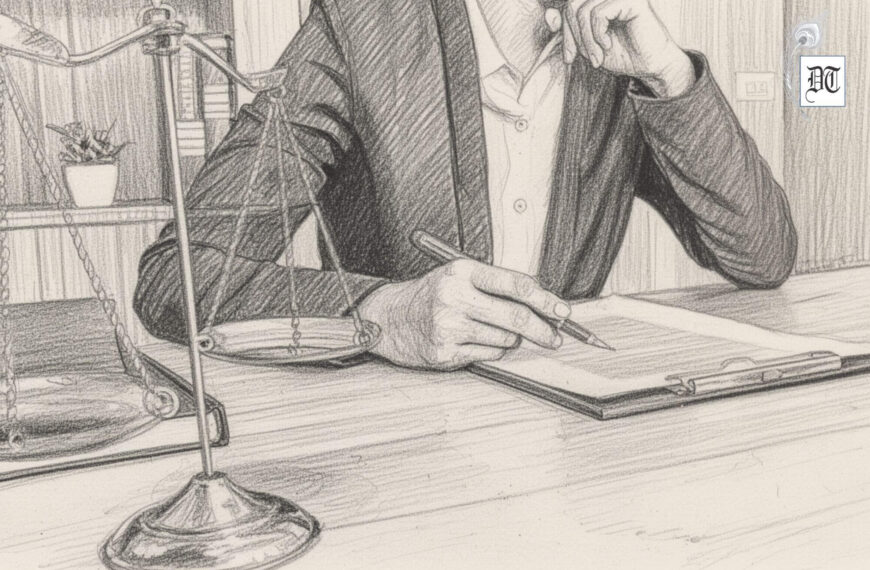
When the state mimics a crime syndicate, justice suffocates—people must reclaim dignity through truth, courage, and civil awakening, opines Prof Bhaskar, exclusively for Different Truths.

The question is serious: if the powers-that-be boldly work as a crime syndicate, what will be the public response? The juxtaposition is, if the individual becomes a criminal in the eyes of the state, the individual is punished, like being arrested and imprisoned. How to imprison a core state?
In the epic Mahabharata, Draupadi was dragged by pulling her hair by Duhshashan (meaning ‘duh-shashan’ or bad administration) and disrobed, which remained unaddressed by the throne (Dhritarashtra). All the wise people, like Bhishma and Drona, loyal to the throne, failed to understand the gravity of the situation—the dignity of a lady in a public place. This was ultimately answered by Krishna through a war of justice.
The problem is the political complexity and state arrangement—now we have parliamentary democracy and judiciary—the latter unattainable to the common people and the former determined by power. Addressing injustice becomes a herculean task then.
Crime and Law
I am pointing at the murder and rape of a young lady doctor on duty on August 9, 2024, at RG Kar Hospital in central Kolkata—the ‘cultural capital’ of India that has probably been in ‘duhshashan’ for the past decade. Both people and the core state are suffocating—obviously for different reasons. People are suffocating due to their failure to restore justice. The core state is suffocating because people are in no mood to deviate from demanding justice.
The court of law is not suffocating but is waiting to get strong evidence from the CBI, pending which it cannot pronounce any judgment. Of course, a civic volunteer had been arrested and imprisoned, which may do more wrong than right, for the heinous crime was committed not by only one person—it was murder at midnight and alleged rape post-murder. It was an organised institutional crime—unless proved otherwise by the Apex Court.
Planned Misguidance
The core state, however, has taken some strong action—it has allegedly punished three chosen doctors in May 2025 through government order who were at the forefront of the public protest of the murder-rape—they understood it as institutionally organised murder-rape. The esteemed Court of Justice is yet to decide.
Meanwhile, some stalwarts in the ruling party started spreading venom. In their view, all can be purchased with money; so, they are asking the face-covered parents of the victim to take money and leave the war of justice. This reminds me once again of the Communist Manifesto, where Marx says, ‘Capitalism converts family relations into money relations’. However, the murder-rape case does not reflect capitalism, and it is not intra-family relations; it is a case of a crime syndicate which reaps benefits from spreading fear through murder-rape.
Let there be no doubt that some will follow Dhritarashtra (along with Duhshashan) and some will follow Krishna. The problem is, there are silent-secret supporters of Duhshashan in Kaalyug (21st century), where the core state is the benefit-giver and the secret supporters are benefit-receivers. These benefits are outside the Lakshmi’s Bhander, arranged by the Government of West Bengal, which surely help the income-poor households. This Bhander follows the Panchali, ‘Lakshir Bhander Sthaapi sab ghare ghare, rakhibe tandul tahe ek mushti kore…’ (Keep Lakshir Bhander in each house, put one handful of rice in that…) that women recite at Thakur Ghar, particularly on Tuesday and Thursday. Now that Bhander is filled with money provided by the government of West Bengal, it benefits both households and the ruling polity.
Social Contradictions
The question naturally arises: where do these stalwarts get so much courage to offer money? One, because they have unaccounted money accumulated through loot-theft-plunder apart from ‘cut money’. Second, they have an umbrella (power) on their head. Third, their next generations are assured of a safe future. Fourth, they may change political sides if need be and get support from the other wrong side. Point one—money breeds money. Point two—power-money is in collusion or symbiotic relations. Point three: institutional safeguards work in their favour. Point four—politics of possibilities works.
Common people suffocate because, one, they live or die in fear; two, they are employees of state government (‘tiki bandha’ as they term it); third, past offences can be blackmailed; and fourth, they have a girl child, which is an offence now in West Bengal, as it may be elsewhere, notwithstanding the pledge of the government of India, ‘beti bachaon, beti parao’ (Save girl child, educate girl child).
Ignorance
What common people probably do not know is that the core state is at best the custodian of resources and hence, that money spent by the state is collected from the people through taxes and other means and methods. Common people did not get enough training to understand the differences between the country and the state, between the state and the government, between the government and the people. In Hindi Heartland, I heard from down-to-earth people, ‘sarkar mera mai-baap’ (the government is my parents). In West Bengal, it seems not much different – the reasons may be different. In the Heartland, I heard educated professors saying, ‘satta ke saath rahana chahiye’ (one has to be on the side of power). In West Bengal, I heard similar statements that I abstain from quoting here. What seems hilarious is that, given this mindset, the pious people say, “Change yourself; the world will change.” What came to me over the past many decades visiting pan-India is that the self is very weak to stick to ideology or to change.
Emancipation
Most of the Bengali thinkers of late are penning poems expressing their fear-anger-sorrow that leads to nowhere, for they are not Nazrul-Sukanta or at least Gurudev. Bengali is abegpravan (sensitive), which leads to a rising number of poems and poets. The need of the hour is to organise people – make them understand the ground reality in which they are part and probable victims. Let there be no expectation that the mindset of mass society is going to change radically because it requires continuing education over generations. Renaissance in undivided Bengal is a past glory, probably forgotten in the pressure of technology and finance. Still then, living with dignity requires a second renaissance that is people-centric. The first task is to get rid of atanka (deep fear) and kapurushata (cowardice); this is to be done through mobilisation of the right people. The second task is not to do a post-mortem of what happened but to take preventive measures – to stop wrong actions from happening.
Of course, West Bengal is not India. Still, I believe a part may be stronger than the whole by the law of averages. West Bengal still can show the way. The immediate task is to get rid of the ‘M’ Raj (read money-muscle-mockery-manipulation or any proper noun if you like). Eliminating one wrong, of course, does not automatically ensure another right – it may be a relocation from the frying pan to the fire. If that is the apprehension of people, they need to search for an alternative outside the political society – that is, social transformation through education, where civil society needs to come forward.
Picture design by Anumita Roy

Prof Bhaskar Majumder superannuated as an Economics professor from GB Pant Social Science Institute, Allahabad. He served as a visiting professor at Central University of Bihar (Patna), Sri Sri University (Cuttack), Banaras Hindu University (BHU), Science College (Calcutta University), and others. He published extensively in 26 reputed journals, authored 11 books, co-edited two, and contributed 38 chapters. He completed 26 research projects funded by the Planning Commission, GoI ministries, ICSSR, the World Bank, NTPC, and Tata Chemicals. An international academic, journal reviewer, and PhD supervisor, he holds degrees from the University of Calcutta. He is our National Editor: Economics and Social Science.



 By
By