
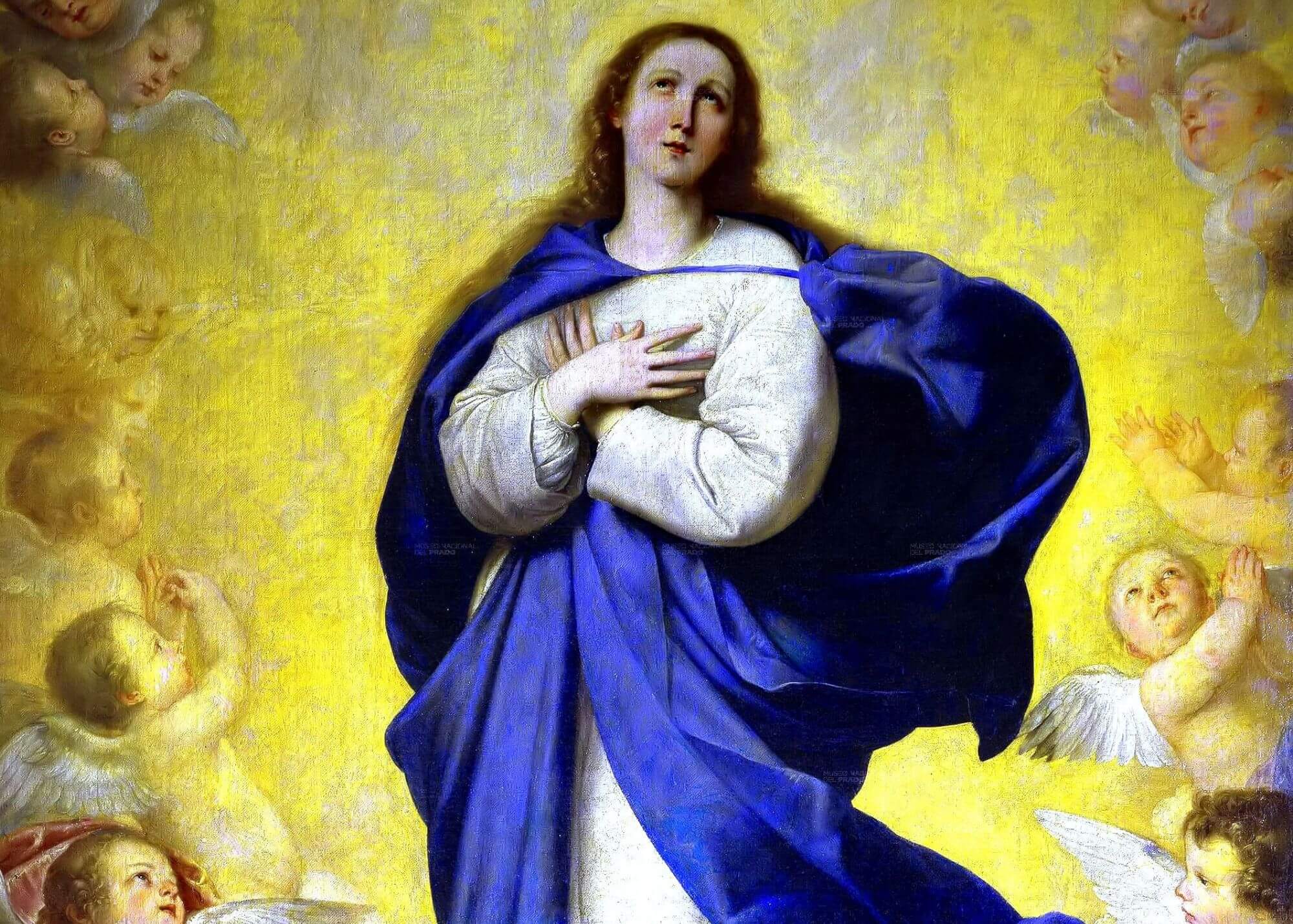
Akash elucidates that the Immaculate Conception reveals Mary’s preservation from sin, a radiant sign of God’s grace, mercy, and redemptive power through Christ, exclusively for Different Truths.
In the quiet moments of Christian meditation, few mysteries call forth such contemplation as the mystery of the Immaculate Conception. It is not merely a doctrinal statement, not a line on a creed recited by rote, but a luminous truth infused with divine tenderness, maternal sanctity, and eternal purpose. The doctrine of the Immaculate Conception speaks of the Virgin Mary’s preservation from original sin from the very first instant of her existence. It is a singular privilege, a masterpiece of divine grace, that anticipates her role as Theotokos, the God-bearer.
A Clarification of Meaning
Many misunderstand the Immaculate Conception as referring to the conception of Jesus Christ in Mary’s womb. Yet the truth of this dogma reaches back further, to Mary’s beginning in the womb of her mother, Anne. This conception, though natural in form, was supernatural in grace. According to the bull Ineffabilis Deus (1854), Pope Pius IX declared that “the most Blessed Virgin Mary, in the first instant of her conception, was preserved immune from all stain of original sin by a singular grace and privilege of Almighty God, given the merits of Jesus Christ, the Saviour of the human race”.
This preservation was not Mary’s merit but the pre-emptive application of Christ’s redemptive work. It was a foretaste of redemption’s power, transcending time itself.
Scriptural Echoes and Patristic Seeds
The doctrine, while not explicitly stated in Sacred Scripture, finds rich resonance in Biblical typology and early patristic insight. Genesis 3:15, the protoevangelium, offers the first glimmer of hope to fallen humanity: “I will put enmity between you and the woman, between your seed and her seed.” That enmity—so total, so pure—would be impossible were the woman ever subject to sin’s tyranny. Likewise, the greeting of Gabriel in Luke 1:28, “Hail, full of grace”, is more than a pleasant salutation; it is a title. The Greek kecharitōmenē implies a plenitude of grace already completed, not one to come later. She is full of grace because she is empty of sin.
The early Church Fathers, too, began to perceive the singular dignity of Mary. Irenaeus, Justin Martyr, and Cyril of Jerusalem spoke of Mary as the New Eve. Just as Eve, created without sin, freely chose disobedience, so Mary, conceived without sin, freely chose obedience. Ephrem the Syrian would sing of her purity, and Ambrose, Bishop of Milan, wrote of her incorruptibility. These whispers grew louder with time, forming a chorus that eventually found doctrinal form.
Medieval Struggles and Scholastic Nuance
Yet this truth did not emerge without tension. The mediaeval Church, ever cautious with doctrine, struggled to reconcile Mary’s freedom from original sin with the universality of that sin. St Thomas Aquinas hesitated to affirm the Immaculate Conception, fearing it contradicted the need for universal redemption. For Aquinas, to be conceived without sin seemed to imply that Mary did not need Christ’s redemptive act.
It was the subtle insight of Blessed John Duns Scotus that brought resolution. He proposed a concept known as praevenientia gratia, or preservative redemption. To be saved from sin is one thing, but to be preserved from it altogether is a greater gift. Thus, Mary was redeemed by Christ, not by liberation, but by prevention—a more excellent way, he argued, befitting the mother of the Redeemer.
The Voice of the Faithful and Dogmatic Proclamation
What emerged from the academic debates was not a cold conclusion but a warm fire kindled in the hearts of the faithful. Across centuries, devotion to Mary as the Immaculata grew. In Spain, Immaculist fervour became so intense that it shaped public art, liturgy, and political sentiment. The vision of Catherine Labouré in 1830—of Mary on a globe, rays streaming from her fingers, bearing the words “O Mary conceived without sin, pray for us who have recourse to thee”—only deepened the belief.
Pope Pius IX, listening to the voices of bishops and the sensus fidelium, declared the dogma infallibly in Ineffabilis Deus in 1854. It was not simply a theological definition—it was an act of faith, a recognition that what had been long held in hearts was true in heaven.
The Marian Apparitions: Heavenly Affirmation
Heaven itself seemed to rejoice in the proclamation. Four years later, in 1858, a young girl named Bernadette Soubirous reported a vision of a lady in white at Lourdes. When Bernadette asked the woman’s name, she replied, “I am the Immaculate Conception.” The unlettered child could hardly have invented such a term—this was seen as divine affirmation of the Church’s dogma.
In other apparitions too—Our Lady of Gietrzwald, for instance—Mary has been invoked under this title. These mystical encounters do not add to revelation but confirm it, showing us that what the Church binds on earth is honoured in heaven.
Eastern and Oriental Witnesses
While the Immaculate Conception is a doctrine formally defined by the Catholic Church, it is not without echoes in other traditions. The Ethiopian Orthodox Tewahedo Church affirms that Mary was born free of original sin, “clean from any sins of the flesh and soul”, and “the choicest from among the chosen”. Though the Eastern Orthodox Church does not formally define the dogma—largely because it rejects Augustine’s definition of original sin—it holds deeply to the purity and holiness of Mary. Bishop Kallistos Ware would write, “The Latin dogma seems not so much erroneous as superfluous,” acknowledging the reverence but not the necessity of the term.
Liturgical Reverence and Sacred Art
The Feast of the Immaculate Conception, celebrated on December 8, has become a beloved moment in the liturgical calendar. The hymn Tota pulchra es, Maria—“Youare all beautiful, Mary, and the original stain is not in you”—echoes through sacred spaces. Gregorian chant and polyphonic settings by Bruckner and Duruflé transform doctrine into doxology and theology into prayer.
Art, too, has tried to catch a glimpse of this mystery. The iconography shaped by Francisco Pacheco and perpetuated by Murillo and Velázquez shows a radiant young Mary clothed with the sun, crowned with stars, the moon under her feet. It is the image of Revelation 12, reimagined as the Immaculate One, triumphant not by might, but by grace.
Theological Implications
What does it mean that Mary was conceived without sin? It means that from her very beginning, she belonged totally to God. She is the first fruit of Christ’s redemptive victory. Her Immaculate Conception points forward to our purification, not as a unique grace to remain isolated, but as the beginning of what God desires for all humanity: holiness, freedom, and union with Him.
Mary is not a remote figure on a pedestal but the tender Mother who shows us what we are meant to be. She is, as St John Henry Newman called her, the “First of the Redeemed”. In her, the Church sees its destiny: immaculate in glory.
Contemporary Relevance
Today, in a world where sin often seems to have the final word, the Immaculate Conception is a gentle but powerful contradiction. It reminds us that sin is not necessary, that grace can prevail, and that beauty untouched by corruption is not fantasy but real. In Mary, the Church finds its most ancient icon and its most hopeful prophecy.
Her sinlessness does not alienate her from us—it brings her closer. She knows our frailty not from within but from without, and in her compassion, she intercedes for us. Her prayer is that we, too, might be purified by the grace of her Son and become, in our way, “full of grace”.
Conclusion
The Immaculate Conception is not just a Marian doctrine—it is a Christological proclamation. It says that the Saviour is so powerful, His grace so overflowing, that it reached backwards in time to preserve even His mother from sin. It is a celebration of God’s foreknowledge, love, and mercy. It tells us that redemption is not merely an act of healing but of preserving, sanctifying, and exalting.
To contemplate the Immaculate Conception is to gaze into the eternal heart of God, who prepares a mother for His Son and, in doing so, prepares humanity for salvation. Let us then honour Mary, not as an unattainable ideal, but as our mother in grace—Immaculata, intercede for us.
Works Cited
1. Ineffabilis Deus, Pope Pius IX (1854)
2. “Immaculate Conception.” Wikipedia.
3. Frederick Holweck, Catholic Encyclopedia, 1910
4. Miravalle, Mark. Meet Mary: Getting to Know the Mother of God. Sophia Institute Press, 2007.
5. Coyle, Kathleen. Mary in the Christian Tradition. Gracewing Publishing, 1996.
6. Kappes, Christiaan. Immaculate Conception: A Theological Exposition, 2014.
7. The Roman Missal and Tota Pulchra Es liturgical tradition
8. Lourdes Apparitions and testimonies of St Bernadette Soubirous
9. Ethiopian Orthodox Tewahedo Church Synodal Declarations
Picture design by Anumita Roy

Akash Paul, a renowned criminologist, theologian, historian, and demonologist, and the author of four globally acclaimed textbooks, pioneered post-crime analysis in criminology and comparative religious studies in theology. His expertise spans criminal profiling, sexual offences, Christianity, religious history, and Indian history, with research interests in Ancient Indian History and the Indian Freedom Struggle. An insightful critic of contemporary society, he also writes poetry, short stories, and novels, blending creativity with profound societal analysis.



 By
By
 By
By
 By
By
 By
By
Excellent article son. May mother Mary bless all of us..
Outstanding 😌🥹✝️
Wonderful 🥹😌✝️
Passion, belief and clarity.
The untold glory of mother Mary is enlightened… tranquil article 💗💗💗💗💗