
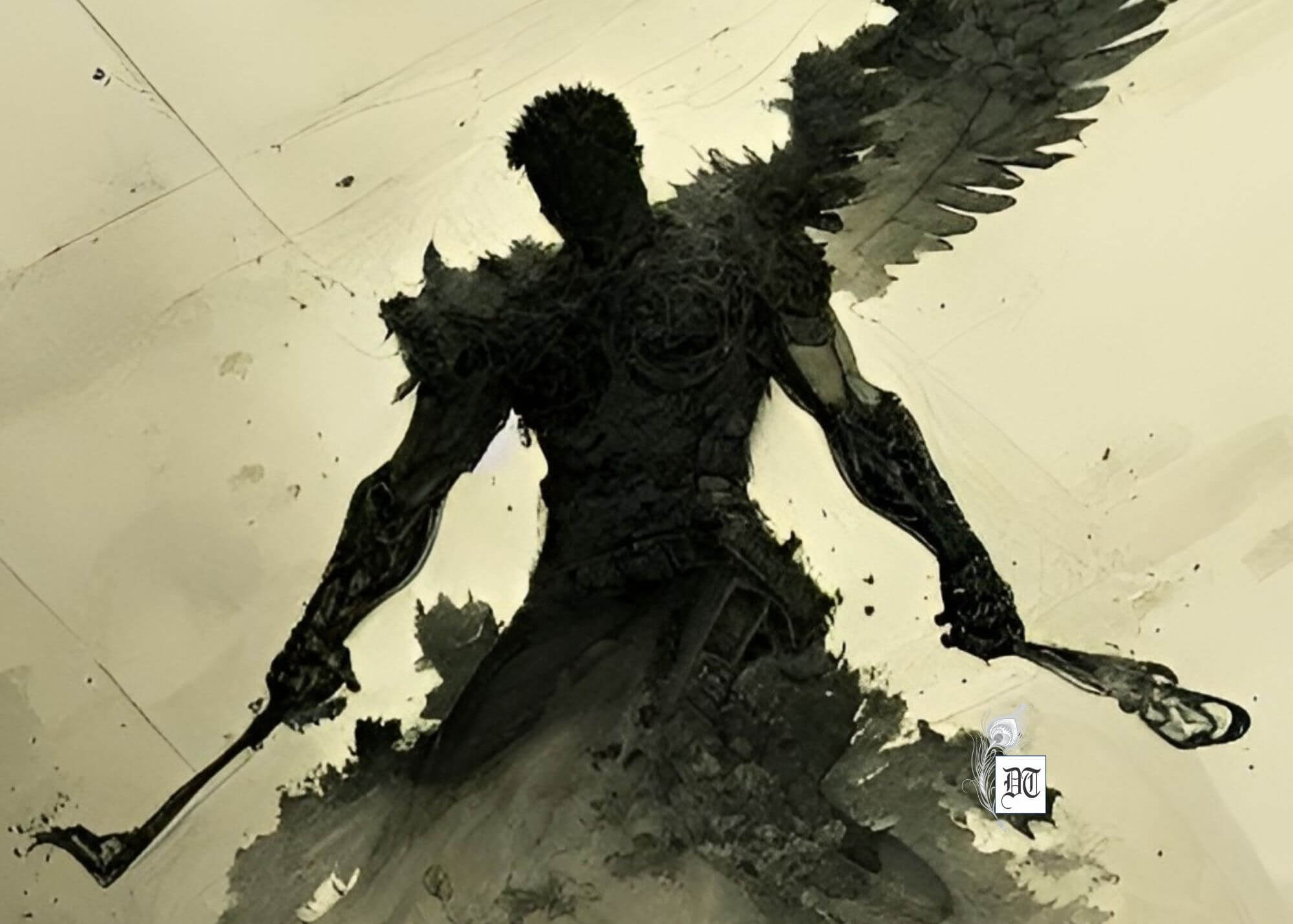
Dr Ketaki delves into the conflict between divine will and human ambition, tracing Satan’s vengeful journey from Paradise Lost to Doctor Faustus’s tragic pursuit of forbidden knowledge for Different Truths.
 Yet, ah! Why should they know their fate,
 Since sorrow never comes too late,
 And happiness too swiftly flies?
 Thought would destroy their paradise!
 No more; – where ignorance is bliss,
‘Tis folly to be wise.
                  [Ode on a Distant Prospect of Eton College, by Thomas Gray]
Satan, while falling from Heaven for nine nights and days, strove hard to inspire his fallen angels with his fiery speeches. He took a vow that doing ‘good’ would not be his motto, but on the contrary, causing evil would be. Satan was determined to wage war against God, and that had already been elaborately mentioned by Milton in his Paradise Lost. In Book I of Paradise Lost, Satan [Lucifer] said in clear terms that,
“Fall’n Cherube, to be weak is miserable
Doing or Suffering: but of this be sure,
To do aught good will never be our task,
But ever to do ill our sole delight,
As being contrary to his high will
Whom we resist.”
                  [lines 157-162]
And Satan entered the earth to take vengeance on God by ruining His creation, by enticing Eve with the ‘forbidden fruit’ and subsequently being the latent cause of the First Man and Woman’s ousting from Paradise. And since then, Satan went on holding on to his pledge indefatigably, tirelessly. And thus, perhaps, his iron-willed determination to play havoc with God’s creations found an ultimate consummation in Doctor Faustus.
In Christopher Marlowe’s Doctor Faustus, though Faustus was a philosopher-cum-sorcerer, his necrophilia turned him into a believer of Lucifer or Satan or the contending forces continually in war against God. Knowledge can manifest itself in two ways: either it can manifest in the best way God would prefer it to be, or the worst or the evil way in which God abhors it to exist. When Man, especially the ‘Renaissance Man’[ who is prone to suffer from a sense of defeatism, as he tends to defy the forces considered to be allied to God just to prove his own greatness, though his plans get awry as the good only wins] takes a detour to prove his own greatness, by challenging the invincible power of the Almighty and pathetically has to accept defeat in the long run, for which he never was prepared initially. Being a Renaissance Man, Faustus aimed at ‘freedom of his own will’, and emphasised the ‘element of necessity’, ensuring human existence. Both the aspiration for deterministic schemes as well as the love of liberty had been found in the Renaissance Man, as propounded by Pico della Mirandola. In fact, near the conclusion, Faustus began to blame the stars to drive home the message that all ensued due to an ‘impersonal necessity’. Marlowe strove hard to show that his protagonist was a sort of ‘over-reacher’, who surpassed the ‘devil’. To quote the lines which came from Mephistopheles would be a perfect reference in this regard, “… [Faustus’] labouring brain/begets a world of idle fantasies/to overreach the devil.”[Act V, lines 13-15]
Thus, the problem of ‘freedom’ and ‘necessity’ did not remain confined to just the Calvinists but was pursued by the whole line of Renaissance thinkers. And in this regard, John Calvin could hardly be lost sight of. The French reformer gave a new shape to the ideas of the theologians during the age of Reformation. While dealing with the issue of God’s foreknowledge and man’s free will, he stressed the existential quality of Biblical thinking. As a Master of Theology, Doctor Faustus was not unaware of Calvinistic doctrine of Perdition, according to which a handful of people would reach the Heavens while the most of the others would be damned as they would follow the footsteps of Lucifer, thus assimilating evil. May be, Doctor Faustus had cocked a snook at such a doctrine, which stood in the way of his enjoying existence on the earth to the hilt.
No matter what, Doctor Faustus had sold his soul to Lucifer for twenty-four years on a promise of being privy to almost all the pageantry of pleasures the world could have offered. He did not think twice that his soul was being confiscated by the devil, which might have annulled all the good he might have had in him. But ‘necessity’ for pleasure and ‘freedom’ of will goad him to take such a weird decision, and he succumbed to it, pathetically. As Doctor Faustus had been a magician apart from an academic and philosopher, he thought of experimenting with the power of evil, as in medieval thoughts on magic, there was a tension between human power and that of the devil. Perhaps, through Doctor Faustus, Marlowe had presented dramatically, who had been in power— the magician or the devil?
Satan was on the lookout for a wise soul to be claimed, which would be his victory over God, whom he tried to wreak vengeance on. And Doctor Faustus had a dream of having at his command, “All things that move between the quiet poles”. [Act I, Sc. i, line 55]. As inordinate desire drives a man to achieve that by any means, Faustus was no exception either. In fact, according to him, “a sound magician is a demi-god” [Act I, Sc. i, line 61]. Faustus’s desire for ‘power’, ‘honour’, ‘omnipotence’ made him an easy prey to Lucifer, who, through Bad Angel, enthused Doctor Faustus to practice his art, which would make him the lord on the earth, as Jove is in the sky.’ Faustus invoked Mephistopheles and asked him to wait upon him all through his life. But, being the servant to Lucifer, he would not be able to comply with his command unless he made a pact with his master, Lucifer. Faustus readily agreed and pledged:
“So Faustus hath already done, and holds this principle:
There is no chief but only Belzebub,
To whom Faustus doth dedicate himself…”
     [ Act I, Sc. iii, Lines 57-59]
He further went on to say that the word ‘Damnation’ did not intimidate him as ‘he confounds hell in Elysium’ [ibid: line 61] And the conversation with Mephistopheles continued, in which, just as in Paradise Lost Satan pined for his loss of Paradise along with the bliss associated therewith, Mephistopheles too expressed his sadness for being ‘deprived of the joys of heaven’[ Act I, Sc. iv, line 86] to which Doctor Faustus derisively reacted. Faustus willingly sold his soul to Lucifer and with the assurance that Helen, whose beauty was known to the world as nonpareil, would walk before his eyes, and the riches of the world would be revealed to him. And truly, all his desires stood fulfilled and left him with a feeling of satiety.
As Doctor Faustus was embarking on a journey through the paths of evil, he would have loved to have a crystal-clear idea about Hell, to which Mephistopheles replied that Hell was limitless, and had no particular locus, wherever they all were, was Hell. As the world dissolved on the purification of the souls, Hell would remain circumscribed to that place, which was not Heaven. Doctor Faustus conjectured Hell to be a ‘fable’ and he had no dithers to be ‘damned’. He began putting forth all sorts of strange demands, which were being paid heed to, ‘in the name of the devil’. Even while talking to the young scholars, Doctor Faustus was keen on concentrating on conjuring. To Valdes, he uninhibitedly said that he would keep conjuring all through the night, before he slept off. He was thus halfway through the magic that would conjure all evil on earth and make him see his desires being fulfilled.
Thus, evil ate away into the heart of Doctor Faustus. He was the perfect soul Lucifer could have fain claimed. And Faustus, like Shakespeare’s Macbeth, loved slipping into the slimy path of degeneration by befriending Lucifer, by selling his soul to him. The difference lay in their aims; Macbeth had an inordinate ambition, while Faustus had a desire to rule over the universe by tasting the joys of the exquisite fare on the earth. Magic was his forte, and through magic only, he could make the impossible possible and make his dreams come true. But a contrariness that meets our eye, perhaps eludes his. For his utmost happiness, he was trying to take Lucifer into confidence, but Mephistopheles confirmed that, “Unhappy spirits that fell with Lucifer/ Conspir’d against our God with Lucifer.”[ Act I, Sc. iv, lines 72-74] And in a temptation to be ‘the greatest emperor of the world’, he would give all his soul to Mephistopheles, he promised. But quite often, Doctor Faustus felt like repenting, and his heart was filled with despair. Immediately, Mephistopheles remonstrated with him, abusing him as a ‘traitor’. Helen of Troy was brought in; pageantry of happiness and pomp was presented. But lastly, when Faustus’s soul was about to be claimed perpetually by Lucifer, Faustus cried out,
“For the vain pleasure of four-and-twenty years hath Faustus lost eternal joy and felicity. I writ them a bill with mine own blood; the date is expired; this is the time, and he will fetch me.”
[ Act V, Sc. ii, lines: 66-69]
Mephistopheles came and confessed that he tried to win his soul through myriads of efforts, and he succeeded at last. And even if Doctor Faustus tried hard to ward off Lucifer’s influence on him, it would be too late to do so. Good Angel and Bad Angel kept vying with each other, Bad Angel concluded the arguments by saying, “He that loves pleasure must for pleasure fall.” [ Act V, Sc. ii, 132]
Just as the clock struck eleven and Faustus’s soul was to be claimed, his repentance became eloquent. He wanted to take refuge in God, but it was abnormally late for the comeback. Though the soliloquy of Faustus was full of irony, it had a message to the world that freedom of will must not be misused or wasted away. As Faustus was too confident of his sorcery, he was sure to emerge triumphant in whichever way he wished. But Lucifer proved to be stubborn, and Faustus had to yield to the demands of Satan, being caught unawares. Eternal damnation in Hell could not be averted by his magic, though he was sure to come out of the tangle, if need be. Otherwise, why would he express his misgiving in these words: “O might I see hell and return safe, how happy were I then!”[Act II Sc. iii, line 174] When, to his utter dismay, he found himself to be caught in the net laid by Lucifer inextricably, Doctor Faustus cried himself hoarse in a heart-rending repentance, begging Lucifer to allow him to repent in the name of God, for sparing him. But that would be next to impossible, though Doctor Faustus could not accept his magic to be an utter failure:
“…O lente, lente currite noctis equi!
The stars move still, time runs, the clock will strike.
The devil will come and Faustus must be damn’d.
O I’ll leap up to my God! Who pulls me down?
 See, see, where Christ’s blood streams in the firmament!
One drop would save my soul, half a drop.
                                       Ah my Christ!
Read not my heart for naming of my Christ!
Yet will I call on him. O spare me, Lucifer!”
                                                      [Act V, Sc. ii, Lines 144-151]
These lines may remind us of Marlowe’s translation of Ovid’s Amores, from which the Latin expression has been quoted, “Stay night, run not thus”, or translated by Marlowe a bit more poetically as, “Run softly, softly, horses of the night” [Ovid’s Elegies]. The situations in the two cases are opposites, yet Marlowe quoted by adding one extra ‘lente’ to the original line, to make us understand the graveness of the plight of Faustus, who prayed the night to be there for some more time, expecting some miracle to happen, hoping against hope that his prayers could be answered by God! In Ovid’s Amores, the goddess of dawn, Aurora, was chided by the poet for leaving her husband Tithonus’s bed so early, for driving a chariot thus concluding a night with her consort. Faustus’s plight, however, talked of jeopardy, frustration and ultimate realisation of the truth.
Hence, Lucifer and Mephistopheles’s appeal could not last for long, while God’s bliss remained an everlasting prayer for all. Between Good and Evil, the latter may be a temptation but not a permanent attachment, while Good has no parallel at all, though it appears bland, unappealing, and lacklustre. Faustus could have turned down the beacon of temptation on Lucifer’s first attempt and could have been saved and won over the futile lure of the cheap pleasures of life. Doctor Faustus is a lesson for all of us, and we should not give in to temptations which would ruin us forever, leaving no room for return.
Works Cited:
1. Marlowe, Christoher: Doctor Faustus, ed. Kitty Datta, OUP, Calcutta, 1986.
2. Milton, John: Paradise Lost, Books I&II, ed. B. Rajan, Asia Publishing House, Bombay, 1975.
Picture design by Anumita Roy

Dr Ketaki Datta (Ph.D.) is an Associate Professor with Goenka College (Govt), Kolkata. She is a novelist, columnist, poet, reviewer, translator, editor with several books to her credit. At present, she is a book reviewer with Muse India, Hyderabad and Compulsive Reader, Australia. She is a columnist with Different Truths, a noted weekly online journal of contemporary times.



 By
By
 By
By
 By
By
 By
By