
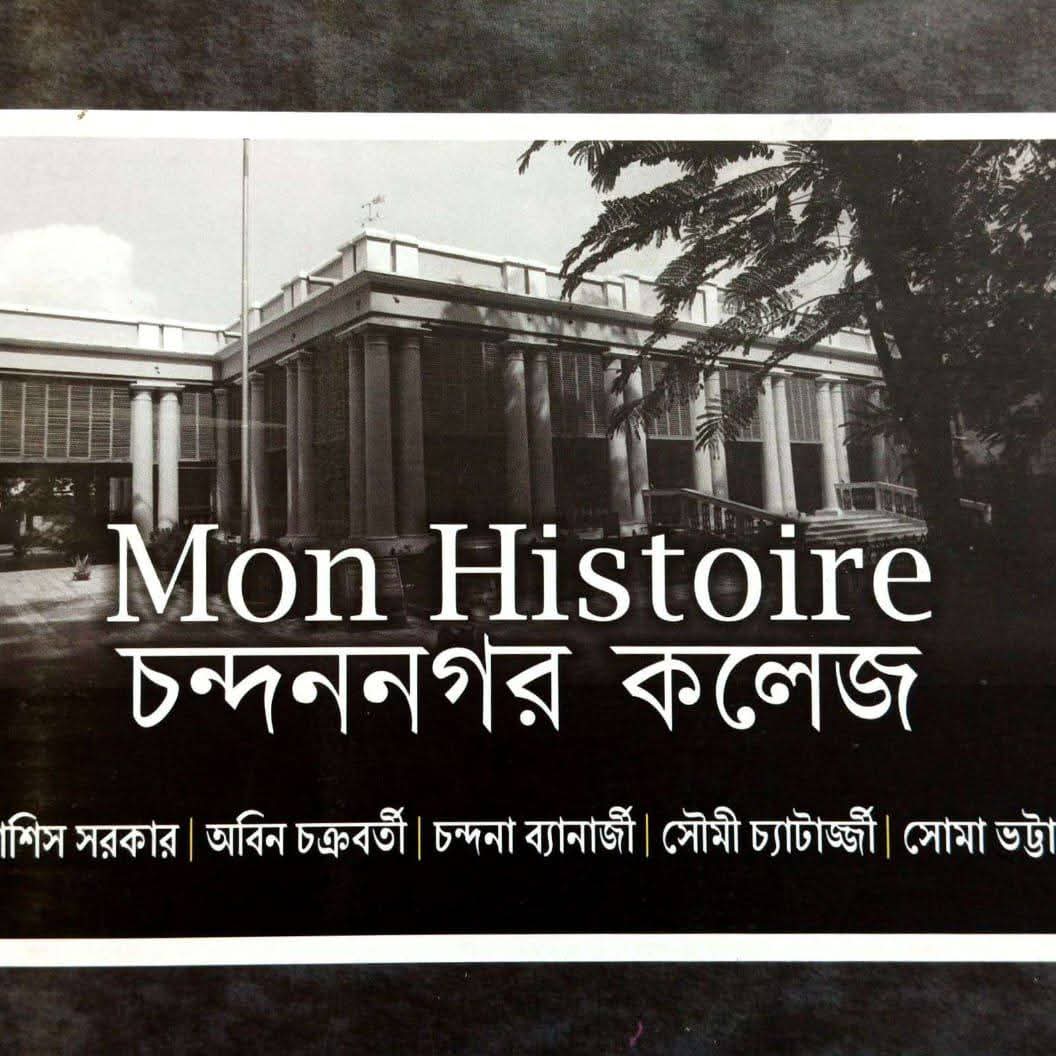
Rituparna reviews “Mon Histoire”, which narrates the history of Chandernagore College, tracing its French colonial roots to its current educational prominence in Bengal, exclusively for Different Truths.

Mon Histoire: Chandernagore College is a remarkable pictorial chronicle that meticulously documents the illustrious journey of Chandernagore College from its inception in 1862 to its present-day stature as a beacon of education and heritage. Concertedly complied and composed by a dedicated team—Debasish Sarkar (principal of the college) and other faculty members Abin Chakraborty, Chandana Banerjee, Soumi Chatterjee, and Soma Bhattacharya—this book is not merely a historical record but a vibrant tapestry of memories, anecdotes, and visual narratives that bring to life the evolution of one of Bengal’s most prestigious institutions.
A Journey Through Time: The Historical Tapestry
The book opens with a compelling introduction to Chandernagore (now Chandannagar), a former French colonial enclave that nurtured a unique cultural and intellectual milieu. The college, established in 1862 as Collège de Chandernagor, was a product of this cosmopolitan ethos, blending French and Bengali educational traditions. The authors meticulously trace its transformation from a modest institution to a premier degree college affiliated with the University of Calcutta and, much later, to the University of Burdwan.
One of the book’s most striking features is its seamless integration of historical documents, rare photographs, and personal reminiscences. The early chapters delve into the colonial era, showcasing vintage images of the campus, faculty, and students from the late 19th and early 20th centuries. The black-and-white photographs of the original building, the French-era classrooms, and the distinguished educators who shaped the institution evoke a sense of nostalgia and reverence.
The Golden Era: Academic Excellence and Cultural Flourishing
The mid-20th century marked a golden period for Chandernagore College, as it became a hub for intellectual discourse and nationalist fervour. The book highlights key figures, Charucahndra Roy and other luminaries who had close ties with the college, and other stalwarts who contributed to its academic prestige. The narrative is enriched with anecdotes from alumni and faculty, offering intimate glimpses into campus life.
One particularly poignant section recounts the role of the college during India’s freedom struggle. The students and teachers of Chandernagore College were actively involved in the anti-colonial movement, and the book captures this spirit through rare photographs of protests, student unions, and cultural events that celebrated nationalist ideals. The inclusion of personal letters and diary entries from former students adds an emotional depth to these historical accounts.
Architectural Grandeur and Campus Life
The visual splendour of Mon Histoire lies in its stunning depiction of the college’s architectural heritage. The book features high-quality images of the iconic Main Building, with its Indo-French architectural fusion, the sprawling Bot-tala (the banyan tree courtyard, a traditional gathering spot for students), and the historic library that houses centuries-old manuscripts. The contrast between the vintage structures and the modern additions, such as the new academic blocks and laboratories, illustrates the college’s adaptive growth while preserving its legacy.
The inclusion of alumni testimonials—ranging from distinguished academics to renowned artists—adds a personal touch, making the history relatable to readers.
The Modern Epoch: Expansion and Global Recognition
The latter part of the book focuses on the college’s contemporary achievements, including its expansion into new disciplines, research initiatives, and international collaborations. The authors highlight the introduction of modern facilities such as computer labs, digital libraries, and eco-friendly infrastructure.
The book also pays tribute to the contributions of past principals and administrators whose visionary leadership ensured the college’s sustained growth.
A Masterful Compilation: Strengths and Reflections
The collaborative effort behind Mon Histoire is evident in its meticulous research and evocative storytelling. Debasish Sarkar’s authoritative narrative, combined with Abin Chakraborty’s analytical insights and the editorial finesse of Chandana Banerjee, Soumi Chatterjee, and Soma Bhattacharya, results in a work that is both scholarly and deeply personal.
However, one minor critique is that the book could have included more oral histories from early 20th-century alumni, whose voices are gradually fading into history. Additionally, a comparative analysis with other colonial-era institutions in Bengal might have provided broader contextual relevance.
Conclusion: A Timeless Tribute to an Iconic Institution
Mon Histoire: Chandernagore College is more than just a commemorative volume—it is a living testament to the enduring spirit of education, resilience, and cultural synthesis. The book succeeds in preserving the past while inspiring future generations to uphold the college’s legacy. For alumni, it is a nostalgic journey; for historians, a valuable resource; and for current students, a reminder of the greatness they are part of.
This richly illustrated chronicle is a must-read for anyone interested in Bengal’s educational heritage, colonial history, or institutional biographies. It stands as a fitting tribute to Chandernagore College’s more than 160-year journey—a journey marked by intellectual rigour, cultural vibrancy, and an unwavering commitment to excellence.
Cover photo sourced by the reviewer

Rituparna Khan is an Assistant Professor in Geography at Bidhannagar College, Salt Lake, Kolkata. Her inclination to Literature, especially poetry is no less. A few of her works are published and well appreciated and awarded in print as well as social media. Her first book, a collection of short stories, was launched at Kolkata International Book Fair, this year.


 By
By
 By
By
 By
By
 By
By
Outstanding Ma’am🙏🏻💓