
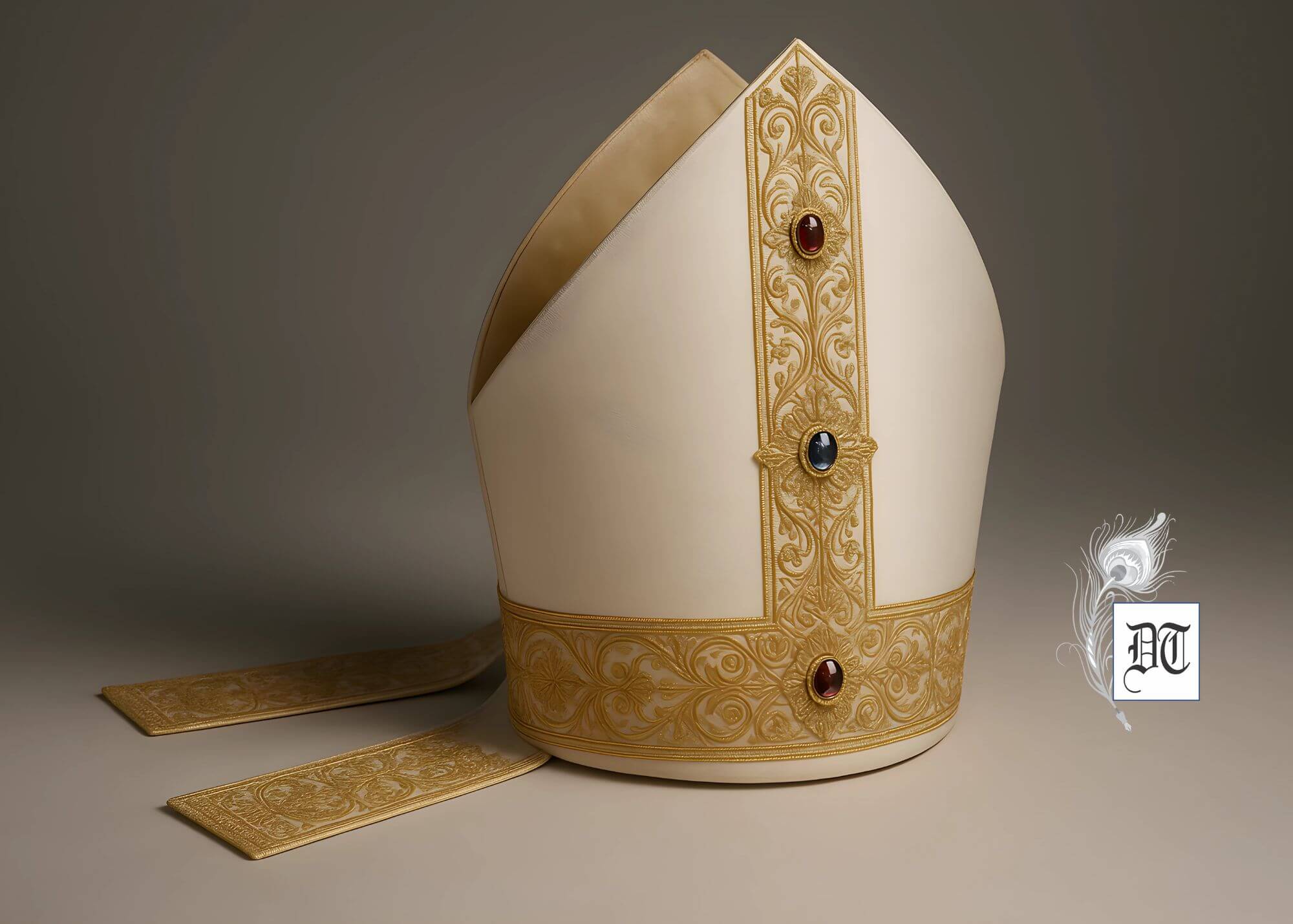
Akash profiles Karol Józef Wojtyła, Pope John Paul II, a profound figure from 20th-century Europe, who became a global conscience and a monumental pontiff, exclusively for Different Truths.
In the chronicles of papal history, few names shimmer with the radiance and resonance of Karol Józef Wojtyła—better known to the world as Pope John Paul II. A poet in soul, a philosopher in mind, and a warrior in spirit, he emerged from the crucible of 20th-century Europe to become not just the shepherd of the Roman Catholic Church but the conscience of an age tormented by war, ideology, and the search for meaning. His life was not merely a biography but a living epistle, a lyrical testament written across decades and continents, etched into the walls of time by his words, actions, and indomitable presence.
Born in the quiet Polish town of Wadowice on 18 May 1920, the young Karol’s early life was tormented by suffering. The death of his mother when he was just eight, the passing of his beloved elder brother Edmund, and the loss of his father during his youth left him an orphan by the age of twenty. “At twenty, I had already lost all the people I loved,” he would later reflect, his voice steeped in the still ache of memory. Yet these losses, far from crushing his spirit, forged within him a deep well of empathy and resilience.
Underground Theatre
In his youth, Karol showed a fondness for the stage, acting with passion and intensity in Kraków’s underground theatre during Nazi occupation. Words were his refuge and weapon—through literature, he resisted the spiritual decay imposed by the totalitarian state. Yet it was in this same crucible of war that his vocation crystallised. While others found solace in arms or ideology, Karol found God in the silence of suffering and the courage of compassion. He knocked on the door of the seminary amid the German tyranny, risking death to follow a higher calling.
Ordained in 1946, he rose steadily through the ecclesiastical ranks, not by ambition but by luminous merit. A scholar of Saint Thomas Aquinas, a lover of phenomenology, and a translator of Max Scheler, he married faith and reason with rare elegance. His books—Love and Responsibility, The Acting Person, and Theology of the Body—were not dry tomes but living documents that pulsed with philosophical and poetic vigour. His ideas danced between the sacred and the human, the eternal and the immediate.
Archbishop and Cardinal
By 1964, Wojtyła had become the Archbishop of Kraków, and by 1967, a cardinal. In the corridors of the Second Vatican Council, his voice rose with clarity and courage, defending religious freedom and human dignity with precision and grace. He did not merely attend the Council—he helped sculpt its spirit. In him, the Church found a man of tradition who walked boldly toward the future, faithful to doctrine yet attentive to the signs of the times.
Then, in October 1978, the unthinkable happened. The white smoke rose from the Sistine Chapel, and from a “faraway country,” the first non-Italian pope in 455 years stepped onto the balcony of Saint Peter’s Basilica. His voice trembled with awe as he spoke in Italian, “If I make a mistake, please correct me.” It was a humble beginning to what would become one of the most monumental pontificates in history.
John Paul II did not merely inherit the Chair of Peter—he invigorated it. From the start, he refused to be confined by the Vatican walls. A pilgrim-pope, he traversed the globe with apostolic fire, visiting 129 countries, embracing lepers in Africa, kneeling in synagogues and mosques, addressing youth in roaring stadiums, and whispering prayers at walls of ancient sorrow. In Manila, he gathered millions; in Auschwitz, he walked silently. His passport bore the ink of a mission, and his steps echoed with the Gospel.
His Papacy: A Moral Clarity
His papacy was an epic poem of moral clarity. Against the spectres of relativism and nihilism, he proclaimed the enduring truth of human dignity. Against abortion, euthanasia, and the culture of death, he raised a prophetic voice. “Be not afraid,” he declared—a phrase that became his signature, a battle cry for conscience. To youth, he offered World Youth Days, not as festivals of fleeting joy, but as deep calls to holiness, service, and identity.
But perhaps his most potent act of witness was his role in dismantling the Iron Curtain. With words sharper than swords and faith stronger than tanks, he emboldened the Polish Solidarity movement, awakened the slumbering hearts of Eastern Europe, and pierced the gloom of Soviet oppression. His 1979 visit to Poland was no mere homecoming—it was an exorcism of fear, a liturgy of liberation. “We want God!” the people chanted, and the Communists trembled. Historians may write of revolutions, but John Paul II catalysed one with prayer, courage, and truth.
His theology was not abstract but incarnate. Through the Catechism of the Catholic Church and the revised Code of Canon Law, he clarified doctrine for a complex age. In Veritatis Splendour and Fides et Ratio, he argued that truth and freedom were not enemies, but lovers. He reasserted the sacredness of life from conception to natural death. And amid scandal and institutional rot, he called for holiness with an urgency that pierced both hearts and headlines.
Spiritual Magnetism
Yet he was not without criticism. Some accused him of rigidity on sexual morality, of failing to address clerical abuse swiftly enough, or of consolidating too much authority in Rome. But even his critics could not deny his spiritual magnetism or moral authority. He was, above all, a man of prayer—rising before dawn to kneel before the Blessed Sacrament, entrusting his every breath to the Virgin Mary with the words Totus“ Tuus”—“Totally Yours”.
He was shot in St Peter’s Square on 13 May 1981, struck down by an assassin’s bullet. Yet he survived and forgave his attacker—a living sermon of mercy. He visited his would-be killer in prison, prayed with him, and called him “a brother”. It was Christianity, not as sentiment, but as radical love. That encounter became one of the most indelible images of his pontificate: the Vicar of Christ offering forgiveness, unshaken by hate, radiant with grace.
Undiminished Resolve
Even as age and illness bent his body, his spirit stood tall. Parkinson’s disease could not silence his voice, nor diminish his resolve. In his final years, the world watched in reverence and sorrow as the once-athletic pontiff transformed into a suffering servant. He became a mirror of Christ crucified—dignity in decline, holiness in frailty. “In suffering”, he said, “there is concealed a particular power that draws a person interiorly close to Christ.”
On 2 April 2005, as the world kept vigil, John Paul II whispered his final words: “Let me go to the house of the Father.” The bells tolled, the faithful wept, and heaven received its poet-priest. Four million mourners poured into Rome, a testament to the life that had touched theirs. The world did not merely lose a pope; it lost a father, a friend, a prophet.
His beatification in 2011 and canonisation in 2014 enshrined him as Saint John Paul II, but the people had already called him “John Paul the Great.” It was a title reserved for only the rarest of pontiffs—those who reshaped the Church, and in so doing, reshaped the world.
Legacy of John Paul II
What, then, is the legacy of John Paul II? It is not confined to statues or stained glass. It is written in the courage of solidarity, the faith of the young, the fall of tyrannies, and the renewal of the Church’s mission. It lives in the hearts of millions who heard his call to holiness and responded. It endures in the philosophy he taught, the truths he proclaimed, and the mercy he extended.
Pope John Paul II was more than a pontiff. He was a sign of contradiction, a lighthouse in a secular storm, a troubadour of truth. His life was a pilgrimage from Wadowice to Rome, from quarry to cathedral, from suffering to sanctity. He showed the world that greatness lies not in power, but in love; not in applause, but in sacrifice.
And so, the poet-pontiff rests in Saint Peter’s Basilica, yet his voice still echoes: Be not afraid. His life was a symphony of faith, and the world is quieter, yet wiser, for having heard its song.
Picture design by Anumita Roy

Akash Paul, a renowned criminologist, theologian, historian, and demonologist, and the author of four globally acclaimed textbooks, pioneered post-crime analysis in criminology and comparative religious studies in theology. His expertise spans criminal profiling, sexual offences, Christianity, religious history, and Indian history, with research interests in Ancient Indian History and the Indian Freedom Struggle. An insightful critic of contemporary society, he also writes poetry, short stories, and novels, blending creativity with profound societal analysis.

 By
By
 By
By
 By
By
 By
By
Your writing skill is excellent 💖☺️
Many many congratulations for your in future articles💗💗❤️❤️
What an inspiring life he had…. ❤️
Excellent ☺️☺️