
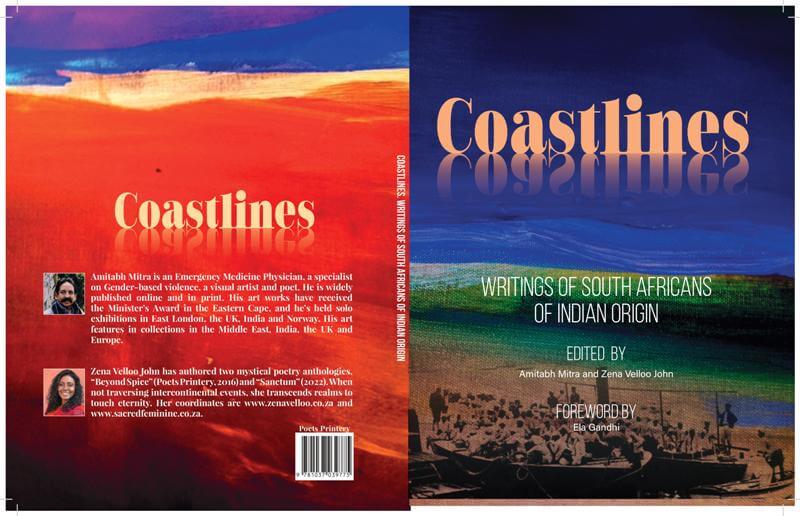
Dr Shweta’s book review, exclusively for Different Truths, explores the experiences of the Indian diaspora in South Africa, from indentured labourers to a vibrant community.

It is my privilege to write a review for this exquisite collection of writings from the pens of the Indian diaspora living in South Africa. The ethos and pathos associated with this group of people have been painted in a heart-touching manner. The evolution of this group has been traced from the humble ‘girmitiyas’, who landed on the shores of KwaZulu-Natal in 1860, to the elite class in the present South African society.
This group is epitomised by cultural front-runners like Dr Amitabh Mitra, who writes, ‘I brought from Gwalior a bundle of hopes and this great burden of Gandhi’. In one of his poems, ‘hasta siempre comandante’, the ‘never say die’ attitude of revolutionaries like Che Guevara is brought forth. Deep melancholy is etched in his lines – “between abyss/deeper than before/ Nothingness became so real/and you/and Che/and us/is all I have/now.”
“Wilting flowers” by Ahistha Gowthum Seebadri is a delicate, yet metrically perfect composition, poetically highlighting hope in the diasporic people. Danny Naicker writes about his yearning to belong: “O! Azania I long for you like a forsaken lover….” Deena Padayachee highlights the meaning of ’Ubuntu’, a Nguni word that means ‘I am, because we are’. Zena Velloo John talks about injustice: “as ghosts of colonisation and its putrid cousin ‘indenture’.” Her poem “Jaggery Shores” successfully highlights the struggles of the Indian diaspora and their capacity for staying rooted in their culture while at the same time flying into the skies of progress and prosperity.
I would consider this work to be a continuum of the legendary works of Sir Dr VS Naipaul (A House for Mr Biswas) and Amitav Ghosh (A Sea of Poppies). Dr Naipaul has highlighted the struggles of the indentured labour in Trinidad through his largely autobiographical work. The quest for a ‘house’ represents a quest for identity. The story of Mr Biswas is recounted with a lot of understanding and a touch of humour. The entire extended family of Mr Biswas remains rooted in their Indian culture, as is obvious from the nomenclature of their homes, which are named after Hindu gods. Their hopes and ambitions for a brighter, more prosperous future are representative of the entire displaced Indian community.
‘Sea of Poppies’ is an iconoclastic work by the prolific writer Amitav Ghosh. This novel has the distinction of being one of the few to hold up an honest mirror to European societies and highlight their deep-rooted racism. The protagonists Deeti and Kalua face torture within their society because of their gender and caste, respectively. In the quest for a better future, they manage to escape to Mauritius to work as indentured labour, only to find that their names and identities have been irrevocably altered. The ending of the novel leaves a question hanging in the minds of readers – whether escaping poverty and injustices from one society is better than losing one’s freedom and identity in another.
At this point, a special mention of the exquisite artwork on the cover pages would be appropriate. On the front cover, Dr Amitabh Mitra has successfully expressed the turbulent feelings of the Indian diaspora in his magnificent artwork – ‘Ferocious Seas’. The representation of the indentured labour by numerals is reminiscent of the inmates of Auschwitz’s concentration camps. The artwork has enhanced the emotions brought forth in this book.
‘Coastlines’ is a praiseworthy effort in the direction of giving voice to these millions of individuals living a fractured, though not necessarily unfulfilled, existence. The fact that making a mark in an unfamiliar country is far more difficult has been well iterated in this collection.
The entire book is a shining example of the strength of character possessed by Indians, with their capacity for hard work and their talent for assimilating themselves into an alien culture whilst nurturing their own.
Cover image sourced by the reviewer

Dr Shweta Sahai is a Professor of Medicine at a Government Medical College in Madhya Pradesh, India, with a professional experience of nearly thirty years. Reading, writing and art are her passions. She has done her Masters in English Literature from IGNOU, New Delhi. Her poetry has been published on various platforms, namely ‘Anthology of Women’s poetry-
India and South Africa’, Glomag, ILA magazine, Kavya Kumbh and the wise-owl poetry magazine. Her art has been showcased on the cover page of Glomag.

 By
By
 By
By
 By
By
Very nicely written review, Shweta, well done.