

Rituparna’s story dwells on a misty Sunderbans; a phone-dropping moment led to an unbelievable encounter with a wise monkey, revealing a profound message about humanity’s impact on nature, exclusively for Different Truths.
The Relationship Between Humans and Nature
The relationship between humans and nature has always been complex. Humans, in their pursuit of progress, have often taken more than what is necessary from the environment, unknowingly or sometimes knowingly destroying the delicate ecological balance. From deforestation to pollution, our actions disrupt the harmony of nature. However, amidst this destruction, nature still holds the power to heal and teach us lessons — if only we are willing to listen.
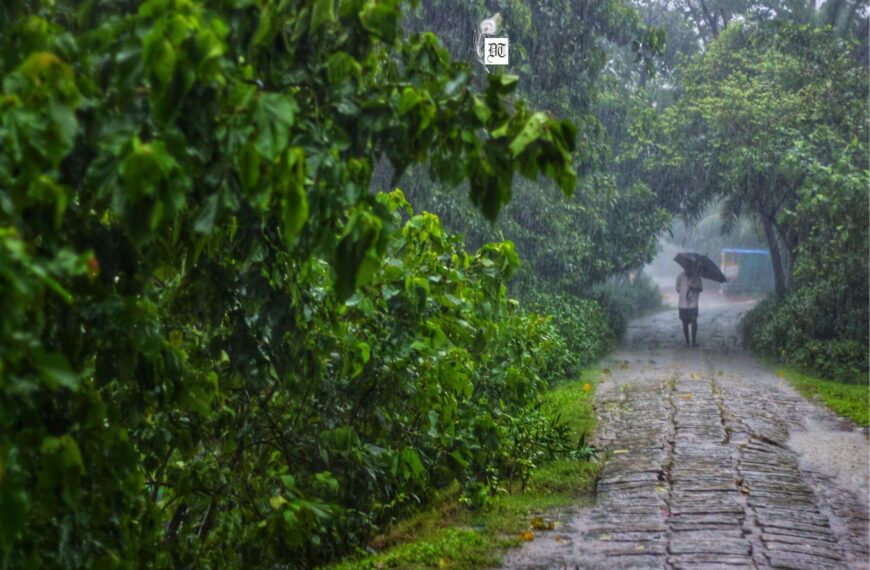
On a warm, misty morning, I found myself aboard a small boat, gently drifting along the river in the heart of the Sunderbans. The air was thick with the scent of wet earth, and the rhythm of the river’s flow was soothing. The vast, green mangroves on either side seemed to stretch forever, hiding countless secrets beneath their dense canopies. A place untouched by the fast-moving world of humans, a sanctuary of life.
As the boat glided through the water, my eyes caught sight of something playful. A monkey, perched at the embankment, was tossing leaves in the air. It was a simple, innocent joy, the kind of moment I rarely paused to notice in my hurried life. With a smile, I reached for my phone, eager to capture this rare scene — the monkey, the leaves, and the tranquil surroundings.
But as I raised my phone to snap the perfect picture, disaster struck. The boat shifted with the current, my hand jerked, and my phone slipped from my fingers. In slow motion, I watched it tumble through the air and splash into the river with a soft, sickening thud. My heart sank.
“No! No, no, no!” I cried, frantic. My phone — probably the most precious possession I had, the gateway to my world, to my connections, my memories, and my identity — was now sinking into the muddy depths of the river. In a state of distress, I could hardly think straight. I stood up, yelling, hoping someone would hear me, but the river’s expanse was silent, as though the whole world had forgotten me in that moment.
But then, to my surprise, I saw the monkey. He was watching me with curious eyes, and his gaze seemed almost wise. It was as if he understood my despair. After a few moments of silence, he suddenly scooped up a leaf from the ground. Without hesitation, he tossed it in the air toward my sinking phone.
The leaf landed just beside my phone, and strangely and inexplicably, the phone floated atop the leaf as though suspended by some invisible force. The monkey jumped with impressive agility from the
embankment into the water, carefully nudging the phone back toward the shore. With the phone now safe in his hands, the monkey did something that took me by surprise: he unlocked the device, turned the camera around, and took a selfie. A selfie! I couldn’t help but laugh at the absurdity of it all.
Then, as if the monkey had completed some sacred ritual, he made his way back to me, hopping from one rock to another through the shallow water. In one graceful leap, he returned the phone to me, dripping wet but intact.
But there was more to come. With a soft grunt, he spoke. I couldn’t believe my ears, but his words were clear and direct.
“You humans destroy, but we rescue,” he said, his eyes locking onto mine with a deep, almost sorrowful gaze. “You are humans and only humans. But if you could be an animal once in a while, maybe, just maybe, the world would be a better place to live in.”
The words echoed in my mind. I stood there, stunned, not knowing how to respond. The monkey, who had witnessed human destruction from the forests of the Sunderbans to the pollution of rivers, was trying to teach me something profound. He had rescued my phone, but in the process, he was giving me a message far more important than anything I could find on a screen.
Disrupting the Fragile Balance
In the world today, we are often consumed by our need for progress, technology, and convenience. We take from nature without understanding the consequences, disrupting the fragile balance that sustains us. We have become so focused on our achievements that we forget that we are part of the web of life. But the natural world, with its simple wisdom, can still teach us the true meaning of balance.
The monkey’s message was clear: “You humans destroy, but we rescue.” If we could learn to live more in harmony with nature, if we could embrace the wisdom of the earth and its creatures, the world would be a better place. Perhaps, if we acted less like humans and more like animals — in tune with the rhythms of nature — we could find our way back to a sustainable and harmonious existence.
Nature is not something to conquer or possess. It is something to respect, protect, and live alongside. Only then can we restore the balance that we have so recklessly disturbed.
Picture design by Anumita Roy

Rituparna Khan is an Assistant Professor in Geography at Bidhannagar College, Salt Lake, Kolkata. Her inclination to Literature, especially poetry is no less. A few of her works are published and well appreciated and awarded in print as well as social media. Her first book, a collection of short stories, was launched at Kolkata International Book Fair, this year.

 By
By
 By
By
 By
By
 By
By