
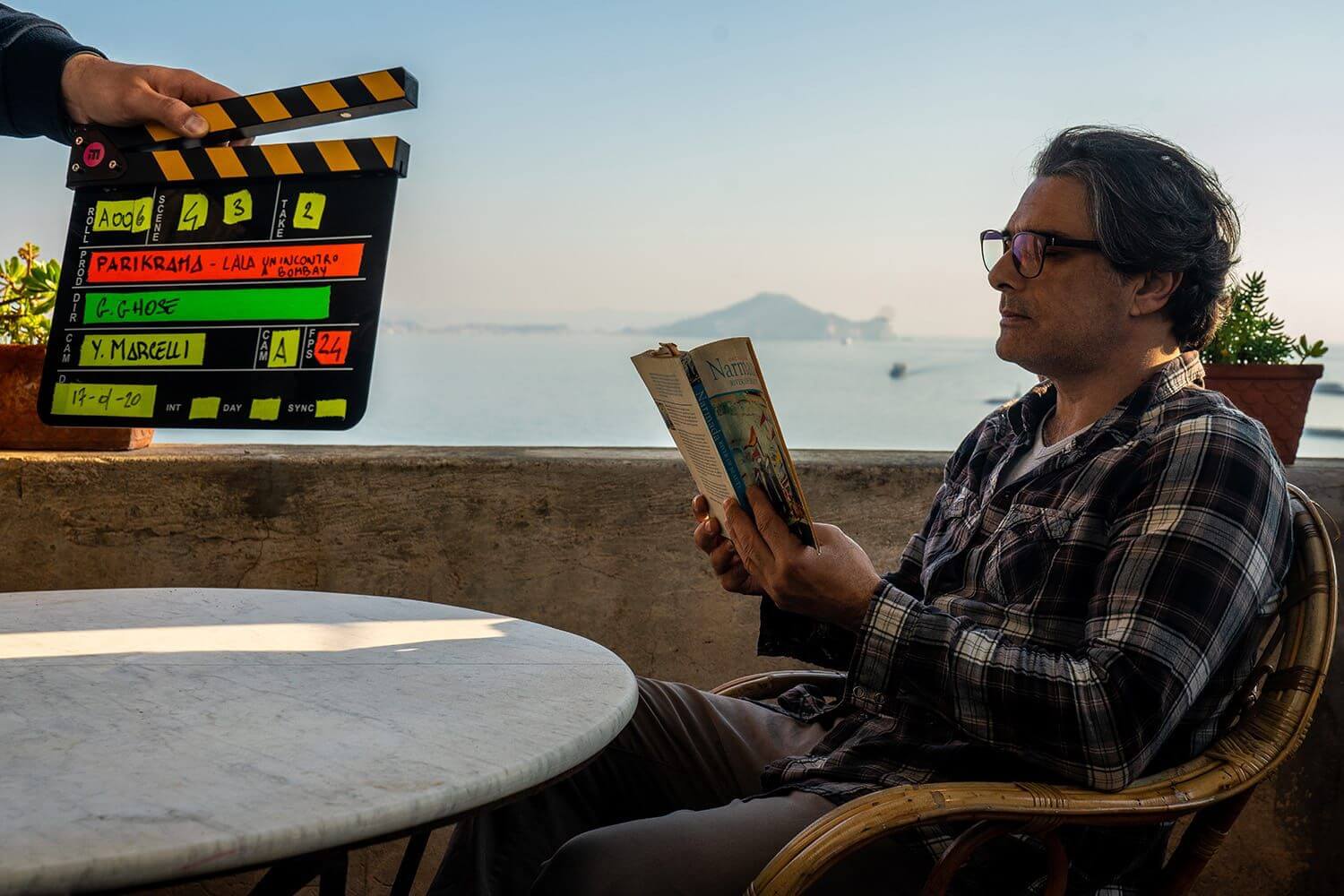

Goutam Ghosh’s Parikrama, which premiered at the Italian Film Festival, blends environmental issues and religious beliefs through an Italian filmmaker’s Narmada documentary, exclusively for Different Truths.
A few weeks ago, the celebrity director Goutam Ghosh’s latest film, Parikrama, premiered during the recently concluded Italian Film Festival at the prestigious India Habitat Centre in New Delhi. The film features various locations in Italy, primarily around Naples and its surroundings. It is impressive how Ghosh has skillfully blended environmental issues with religious beliefs and intense emotional experiences, creating an international masterpiece.
The pivot point of the film is the lifestyle, ideas and activities of an Italian filmmaker, Alessandro, who embarks on a unique project: a documentary focusing on the sacred Narmada River, where thousands of devout Hindus gather for their annual pilgrimage. This theme intersects with the story of how innumerable natives face untold misery due to the same river.
Moving on, Alessandro (played by Marco Leonardi) specialises in documenting environmental displacement. A single father in real life, he reluctantly leaves his teenage son, Francesco (Emmanuelle Esposito), behind with his grandmother to trace the journey of the mighty Narmada River into the Arabian Sea. Upon arriving in India, Alessandro is joined by Rupa (Chitrangada Singh), a social worker mainly involved in child welfare-related activities. While seeking to infuse some local flavour and realistic elements into the film, Alessandro bumps into Lala (Aryan Badkul), a ‘Smart Alec’ teenager who sells souvenirs – mainly targeting credulous foreign tourists – along the river’s banks.
In an uncanny resemblance to Rabindranath Tagore’s short story Kabuliwala, the Italian Dad finds a shadow of his son in Lala. As their bond deepens further, Lala narrates the tragic tale of how his village got submerged in the aftermath of the construction of a dam across the river. He got separated from his family and (till then) remained clueless regarding their whereabouts. Lala appears to be frequently mouthing the catchphrase “humara naseeb,” (my ill luck), which symbolizes how the marginalised surrender to their inexorable Fate.
The narrative unfolds through multiple journeys, including the eponymous circumambulation of the Narmada River. Alessandro’s documentary examines the impact of dams and development on the river, which ushers in its trail wanton destruction of the surrounding ecosystem, and how modernization or development takes a heavy toll of peoples’ lives, comfort, happiness and bliss.
Against this backdrop, it would perhaps not be inappropriate to ponder: Is a ‘River’ causing suffering to myriad nameless, faceless humans worthy of veneration at all?
The film also becomes a carrefour where currents and crosscurrents of Italian and Indian cultures meet, mingle, and fuse to ultimately take on a humanitarian connotation. The magnitude of such man-made tragedy and devastation may be colossal, and it could impact any country/ies no matter where they happen to be located.
Discerning viewers will laud Alesssandro’s sudden outburst when – upon noticing the gigantic structures jutting out from the river–he refers to ‘Atlantis’ (the mythical island described in Plato’s treatises) that was lost to the world owing to human vanity. His train of thought is further vindicated when the camera shifts to showing revelers having a gala time in the water parks built in the vicinity of the dams, utterly oblivious to the humongous cost of their entertainment.
The Ghose (father & son) duo deserve accolades for the exquisite photography–vividly capturing the quintessential scenic beauty of Italy and India.
Picture from IMDb

Ruchira Adhikari Ghosh brings a liberal, wide-ranging outlook shaped by extensive travel across India and abroad. Educated at Holy Child School, New Delhi, Sacred Heart Convent, Ludhiana, and Panjab University, Chandigarh, she holds a Master’s in English Literature and a postgraduate diploma in Journalism and Mass Communication. With three decades in media, she writes on travel, books, music, performing arts, women’s issues, and especially food, drawing inspiration from rich life experiences. She is our Features Editor.

 By
By
 By
By