
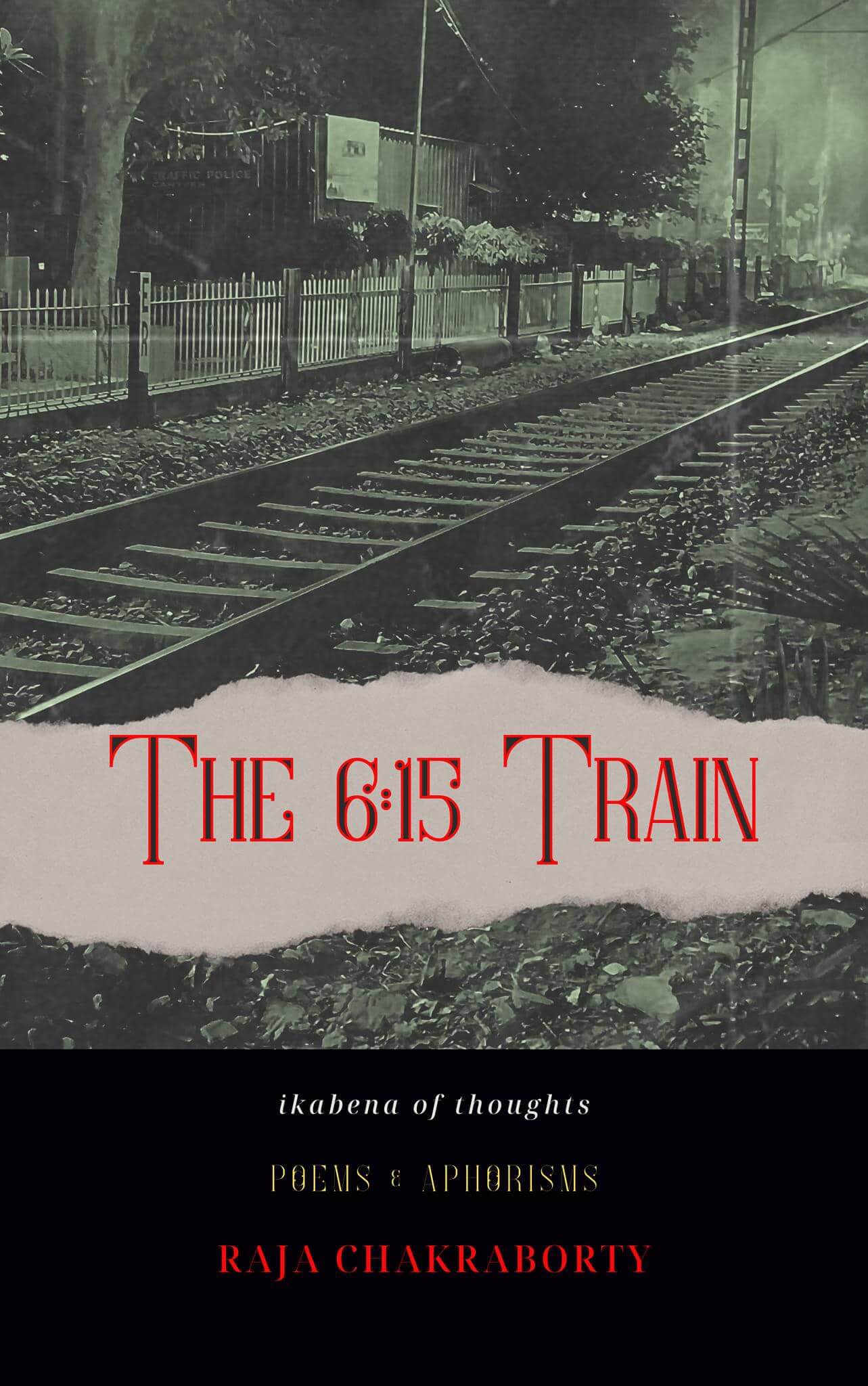
Dr Sharmila reviews Raja Chakraborty’s The 6.15 Train, a collection of poems that offers a unique perspective on perception, skill, and the human psyche for Different Truths.

Raja Chakraborty’s The 6.15 Train (Ikebana of Thoughts)/ Poems and Aphorisms is worth flipping through. The book is all about perception, the acquisition of skills and a psychological system. The poems are short and crisp and together with aphorisms create a filigree of thoughts, a continuous pattern. In other words, a structure, a form and the individual parts do not determine the motif, but the motif determines the parts. While going through the pages one feels bound to reassess the objective behind one’s existence. Written lucidly, the poet writes:
when nothing
comes to mind
I scribble
in thin air
invisible ripples...   (Nothing).
There is an opaque challenge to oneself in this collection. The intense difficulty about a blank space in mind and then a flash of inspiration, words fitting into one another creating an unending journey of life. The book is full of soft sounds and hard ones dampened by shadows, echoes, remnants of leftover passion.
rain is how I cry
when you close all your doors...

rain is all I have
to hold you back to stay… (Rain)
The words in most of the poems are woven like a mat, its strands entwined to form a lattice. The gaps in the lattice are blank spaces – open spaces for the readers to fill in their own ideas and thoughts. Therefore the poetry is not a passive set of words but an invitation to a dialogue.
Chakraborty’s meditation on reality is subtle, simple and sometimes abstract. Words are ripped from their usual context to reveal a new dimension.
white gold
truth is

but when you
cut it out

you are
red handed... (Ivory)
Another example:
haven’t seen
an island for years

haven’t touched
a shore for ages

still the embers burn…

smoke has
strange stories to tell…   (Smoke)
The poet’s aphorisms are a flowchart of evidence and ideas. A mind-map weaving through facts and concepts. There is absolute freedom to arrange and rearrange facts in ways Chakraborty sees fit. Sometimes the aphorisms are ironic which archives resonance and autonomy of thinking.
red
bleeding hibiscus
silent pain                 (38)

stones
lined relics
calligraphy           (37)
This collection is a combination of hope, reflection and assimilation. One needs to read and ponder and re-read again. The poems and aphorisms fit well in spite of their belonging to separate genres. In a nutshell it is a must read book that will certainly give the readers a roller coaster journey.
Thanks to Haoajan Publishers for publishing such a beautiful look-wise, read-wise book.
I cannot help ending this view of mine without the words of the famous painter Paul Klee-
he eye follows the paths
that have been laid down
for it in the work                (Pedagogisches Skizzenbuch)
Cover image sourced by the reviewer

Dr Sharmila Ray is an English poet and non-fiction essayist. She has eleven poetry books and edits Indian English poetry. She was an advisory member at Sahitya Academy and is an Associate Professor of History at City College, Kolkata. Ray has received numerous awards for her poetry, translated into various languages, and has been featured in various International Poetry Festivals. Her poems have been translated into Bengali, Spanish, Slovene and Tajik.


 By
By
 By
By
 By
By
 By
By
Beautiful review. Succinct, precise, and goes deep into the heart of the poems.
Thanks so much.