
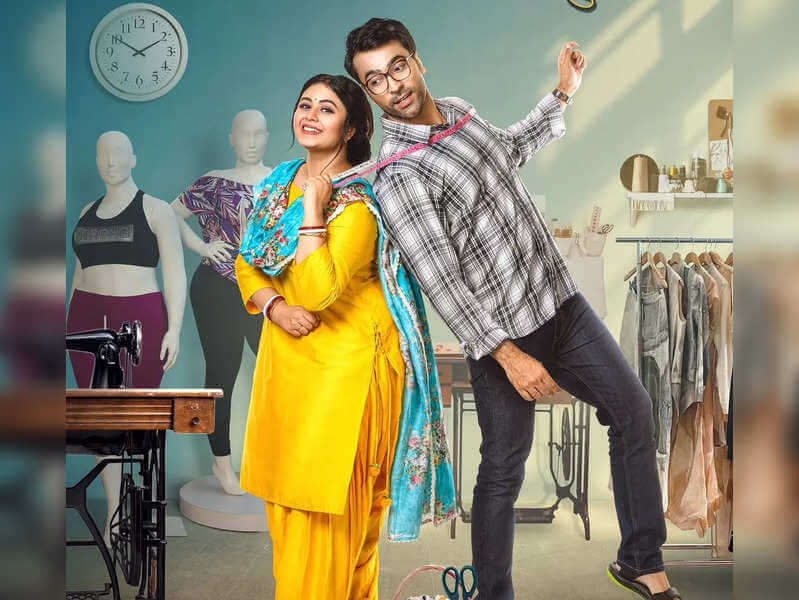

Ruchira reviews Fatafati, a film that follows Phullara, a plus-sized woman, as she navigates societal pressures as a fashion influencer, exclusively for Different Truths
I simply fell in love with this flick because it depicts my sentiments exactly. All my life, I have been a plus-sized woman. People would often brand me as “healthy” in sarcasm. That was till the second wave of the Pandemic had nearly “done me in. ‘In the aftermath of the cataclysm, my weight crashed from 92 kg to something like 40 kg. It was a blessing in disguise, as I am wont to believe.
So, you see, I can jolly well empathise with the so-called plump and heavy weights. The dismal situation, let me tell you, It is against this backdrop that director Aritra Sen’s oeuvre, “Fatafati” (lit. fabulous or fantastic), holds out a ray of hope and cheer for hundreds of such miserable and dispirited souls.
In a candid but discreet manner, the film seems to preach that women are much more beautiful than their physical features, body size, and shape. Phullara (Ritabhari Chakraborty), the protagonist, is a good-looking, albeit plus-sized, young lady who abandons a course in dress designing to get hitched and move to a small town. She continues to ply her trade, but for all practical purposes, she is nothing more than a qualified seamstress or tailor. Her spouse, Bachaspati Bhaduri (Abir Chatterji), works in a textile showroom. The couple lives with Bachaspati’s widowed mother and a school-going brother. Her only thorn in the flesh is the girl-next-door-cum-neighbour Biki Sen (Swastika Dutta), a fashion and wellness influencer who constantly mocks her for being obese.
…we discover that not all members of the ‘fat brigade’ can be blamed or held responsible for their humongous dimensions.
While the narrative races on, we discover that not all members of the ‘fat brigade’ can be blamed or held responsible for their humongous dimensions. A few are shown battling certain hormonal issues; in the case of some others, obesity runs in their families. So, they helplessly gain pounds without gorging or bingeing.
Otherwise, life goes on peacefully in a hunky-dory manner until Phullara’s husband loses his job. To augment the family income, Phullara, inspired by her brother-in-law, tries her hand at being a fashion influencer. And, hey presto!
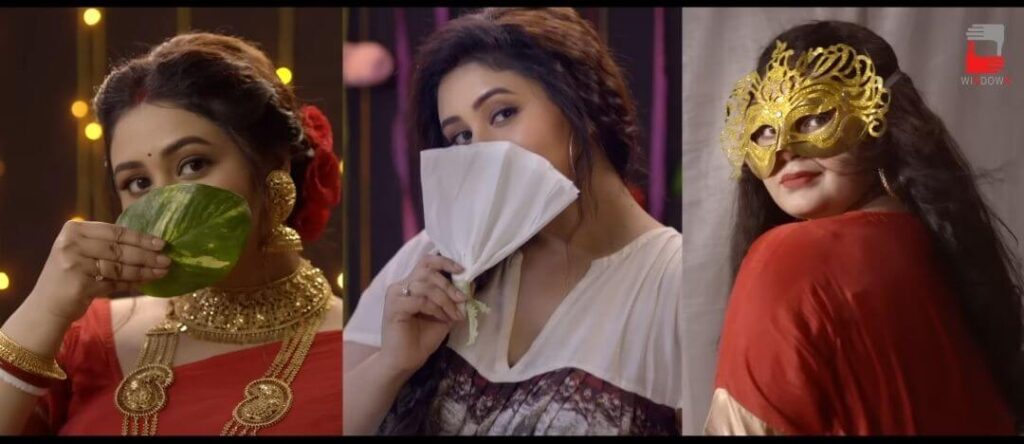
She comfortably manages to thrive as a plus-sized fashion influencer under the pseudonym of Ms Fatafati, whose body-loving posts help her rake in a few swanky brand deals and a staggering number of followers in the course of just a few months. The Dewar-Bhabi team is thrilled beyond measure!
Sounds a bit exaggerated? Maybe, but market surveys and experts’ opinions corroborate the fact that retail giants are searching high and low for reliable, high-potential regional influencers because the purchasing power of people living in class two and three Indian cities is skyrocketing.
Ms Fatafati, who was helped by her (rather ingenious) prolific use of masks, fans, and other props, creates a stir in fashion circles.
Ms Fatafati, who was helped by her (rather ingenious) prolific use of masks, fans, and other props—to hide her face and conceal her identity—creates a stir in fashion circles. The nail-biting climax of the film brings Ms Fatafati face-to-face with the snooty and overconfident Biki Sen during a sensational on-ramp competition. When the truth is revealed and Phullara unveils herself in public, the viewers are awestruck!
Photos sourced by the author from the internet

Ruchira Adhikari Ghosh brings a liberal, wide-ranging outlook shaped by extensive travel across India and abroad. Educated at Holy Child School, New Delhi, Sacred Heart Convent, Ludhiana, and Panjab University, Chandigarh, she holds a Master’s in English Literature and a postgraduate diploma in Journalism and Mass Communication. With three decades in media, she writes on travel, books, music, performing arts, women’s issues, and especially food, drawing inspiration from rich life experiences. She is our Features Editor.



 By
By
 By
By
 By
By
Pointed observations in a refreshingly original style make a delightful read!