
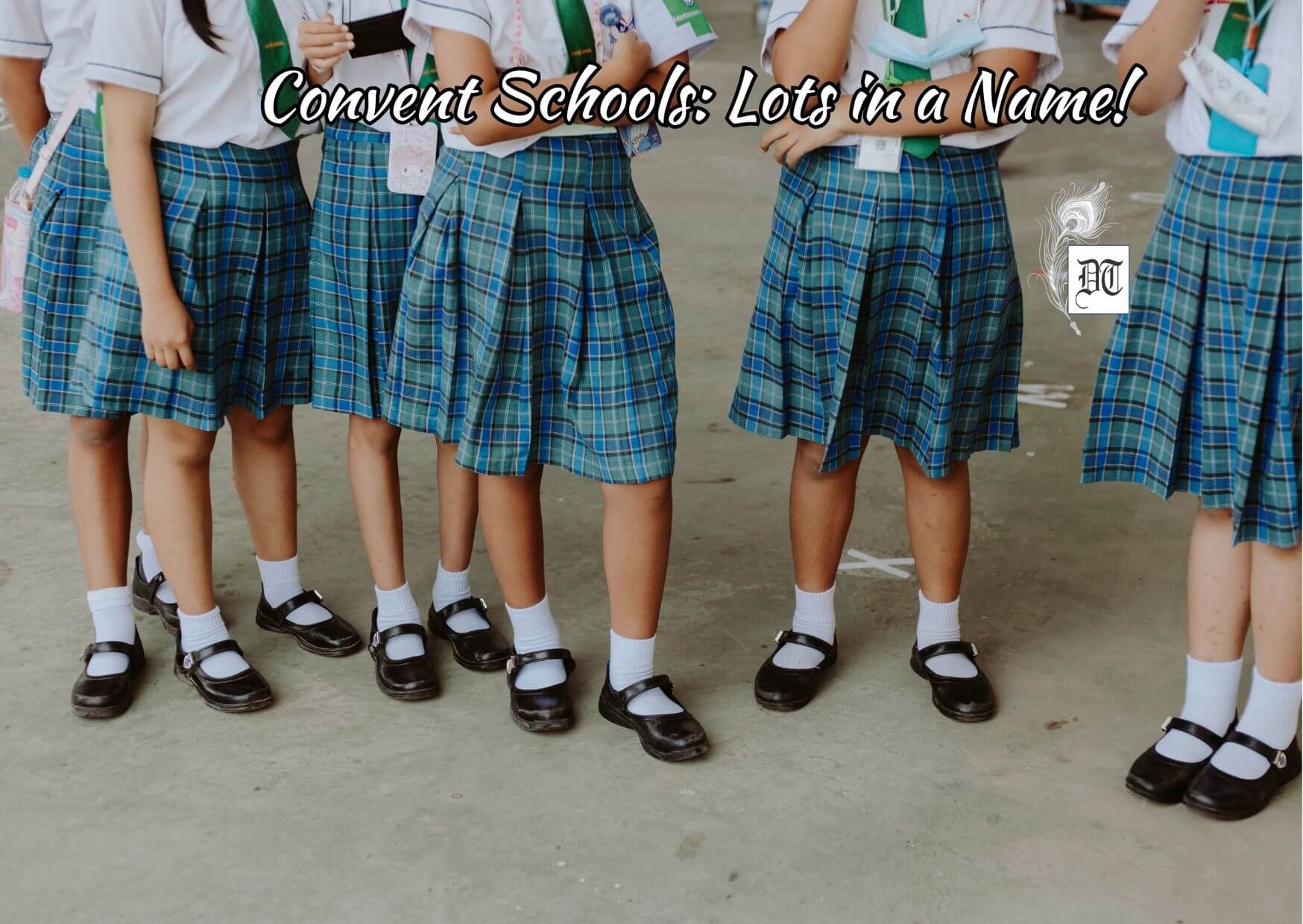

Urban India’s modern-day lifestyle is marked by contradictions, with a disdain for the English language and a demand for English-medium schools. Here’s a detailed account by Ruchira – exclusively for Different Truths.
Urban India’s modern-day lifestyle is a bundle of paradoxes. On the one hand, this heartfelt loathing, intense hostility, disdain, and scorn against the English language (Angrezi) is palpable at every step of our day-to-day lives. The language per se and nearly everything with the faintest traces of English about it is being furiously eliminated. And yet, if we look around, we will notice the serpentine queues in front of English’ medium’ ‘public’ schools only growing longer with every passing year.
Looking far and wide, in the United Kingdom, public schools charge tuition fees and maintain distinct criteria for admissions. In other words, such schools run on public funding instead of schools funded solely by the government.
Well, it may sound crazy, but utter chaos and confusion prevailing in the minds of aam janata (commoners) regarding their actual connotations.
English ‘medium’ schools are a unique, quintessentially Indian concept.
English ‘medium’ schools are a unique, quintessentially Indian concept. The Constitution of India has recognised 22 languages, including Hindi and English, as official languages. The bulk of school-goers countrywide study in the regional languages (read mother tongue). However, knowledge of English is a sine qua non for pursuing academics in premier, globally recognised institutions besides universities abroad. Hence the infinite craze for the English medium.
Now coming to the basic connotation of ‘Convent’ Schools, undoubtedly a vestige of British Colonial rule, trust the Urban Indian public to mess up and distort things. And they have done it so much that the result is hilarious. Close to where I reside, Preet Vihar, an upscale East Delhi colony, boasts of a Mother Teresa Convent Public School. A major crowd-puller: there is no convent element about it. The gracious saintly soul, who maintained a low profile, would have died of shame to see her name being flaunted in this manner. Wait, there is more. Imagine my bewilderment when I stumbled upon a prominent ad displaying detailed information about a certain Royal Khalsa Convent School, with branches at several places. Had the Dashme Badsha (10th Guru Gobind Singh Ji, who founded the Khalsa Panth) heard of it, he would have flown into a rage. Peaceful co-existence of diverse faiths is acceptable, but bungling of tenets of faith is not!
The mainstay of the teaching staff is nuns/ monks, though other teachers are also employed.
Coming to the brass tacks, iconic English dictionaries, e.g., Collins, Oxford et al., define a ‘convent school’ as one run by a community of Catholic nuns/monks who reside together in a nunnery/ monastery. The mainstay of the teaching staff is nuns/ monks, though other teachers are also employed.
Quoting from my personal experience, I venture to add here that convent schools have consistently been rated as expensive ones vis-à-vis other eminent public schools. Secondly, the ambience prevailing within their hallowed portals is a blend of eclectic and esoteric. Unsure of the present, things were that way when I left school more than thirty years ago. “Convented” (sic) pupils are considered snobbish (rightfully so).
My sole purport behind writing this is to implore educationists and educational societies doing roaring business in the field: convent schools are a class apart, so let them be. Establish any number of English medium public schools; the masses will thank you for this. But for Heaven’s sake, do not mislead or dupe the gullible using an inappropriate name.
Picture design by Anumita Roy

Ruchira Adhikari Ghosh brings a liberal, wide-ranging outlook shaped by extensive travel across India and abroad. Educated at Holy Child School, New Delhi, Sacred Heart Convent, Ludhiana, and Panjab University, Chandigarh, she holds a Master’s in English Literature and a postgraduate diploma in Journalism and Mass Communication. With three decades in media, she writes on travel, books, music, performing arts, women’s issues, and especially food, drawing inspiration from rich life experiences. She is our Features Editor.



 By
By
 By
By
 By
By
 By
By