
Ruchira demystifies the dark goddess, Maa Kali, worshipped on Diwali. An exclusive for Different Truths.
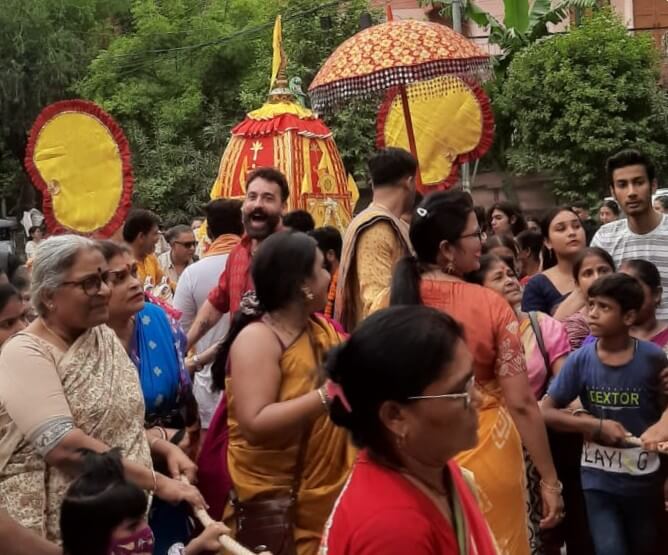
For millions of Hindus on the subcontinent and across the globe, Deepavali or Diwali is the festival of lights. Though the festival’s antecedents may be traced back to the triumphant return of the mythical/legendary Lord Rama to his kingdom after vanquishing evil, yet in major parts of the country, siblings Lakshmi Devi and Ganesha/Ganapati are ritually worshipped on the occasion. However, in several other states and communities (Bengalis, prominent among them) Goddess Kali is venerated on this day.
Maa Kali, the name itself is awe inspiring. The dark sinister fiery-eyed deity with unbridled raven tresses, scantily clad in a skirt comprising severed demon heads, arms and fingers, tongue lolling out, her clenched fists fitted with lethal weaponry, evokes fear, coupled with a sense of grotesque beauty. Her very name Kali symbolises darkness or utter blackness. Another connotation of the word is Mahakaal orendless time — engulfing, devastating life, creation, beauty, human existence — in fact everything. She may be considered the epitome of negativity, depression, sorrow, suffering and death.
The Element of Darkness
Not surprising, therefore, that Kali puja always coincides with amavasya (new moon) nights; the rituals begin in the dead of the night, lasting nearly till dawn. It is palpable how the element of darkness pervades all. Interestingly, Goddess Kali is depicted as residing permanently in major cremation grounds of cities, towns, and villages, where people may often behold her static images. It is common practice among Shakta (devotees of Shakti) house elders, not forgetting Tantriks/Kapaliks pay obeisance to Maa Kali at the cremation grounds on the night of Deepavali. The latter reportedly indulge in bizarre rituals like consuming raw meat, karan bari (liquor) and such like. The objective is transcending the mundane and discovering the Truth, no matter how gruesome or ghastly it might be.
Shamsans (burning ghats) are characterised by gloom, pestilence, decay, and death. The dark deity transmits a harsh but timeless message…
Shamsans (burning ghats) are characterised by gloom, pestilence, decay, and death. The dark deity transmits a harsh but timeless message — all worldly things except Death are transient, ephemeral. To proceed from life via death to eternal life, mortals must overcome the three negative elements of their psyche, viz lajja (shame) ghrina (repulsion/disgust), and bhaya (fear).
Just as a black object absorbs all seven colours of the visible spectrum of natural light, reflecting none to the human eye, likewise the dark deity symbolically purges our minds, hearts, and bodies of all the dross, ushering in purity, beauty, and joy. After all, doesn’t the old adage say black is beautiful?
Benign Mother
Yet, despite her formidable, ferocious aspects, marked by blood and gore, Kali is the lovely benign mother exuding love and kindness for all. For instance, out of her four hands (sometimes ten) right hands are poised in abhaya mudra (dispels fear) and varada mudra (benediction). Interestingly, we get to see her Bhavatarini (She who liberates Her devotees from the ocean of existence) avatar at the iconic Dakshineshwar shrine on the outskirts of Kolkata. The serenity, grace, and beauty of the idol is soul stirring.
According to Hindu mythology, Kali is the primordial mass from which life sprang.
According to Hindu mythology, Kali is the primordial mass from which life sprang. She is the mother of the universe, the fountainhead of compassion. She reminds us that good can emerge out of evil. Where there is fear, she instils courage. For the downcast, hopeless, and distraught she ushers in joy and hope.
Visuals by Different Truths

Ruchira Adhikari Ghosh brings a liberal, wide-ranging outlook shaped by extensive travel across India and abroad. Educated at Holy Child School, New Delhi, Sacred Heart Convent, Ludhiana, and Panjab University, Chandigarh, she holds a Master’s in English Literature and a postgraduate diploma in Journalism and Mass Communication. With three decades in media, she writes on travel, books, music, performing arts, women’s issues, and especially food, drawing inspiration from rich life experiences. She is our Features Editor.


 By
By
 By
By
 By
By